
1173 lines
341 KiB
Markdown
1173 lines
341 KiB
Markdown
# What is Socialism
|
||
|
||
## Political philosophy emphasising social ownership of production
|
||
|
||
**Socialism** is an [economic](https://en.wikipedia.org/wiki/Economic_ideology "Economic ideology") and [political philosophy](https://en.wikipedia.org/wiki/Political_philosophy "Political philosophy") encompassing diverse [economic](https://en.wikipedia.org/wiki/Economic_system "Economic system") and [social systems](https://en.wikipedia.org/wiki/Social_system "Social system")[^1] characterised by [social ownership](https://en.wikipedia.org/wiki/Social_ownership "Social ownership") of the [means of production](https://en.wikipedia.org/wiki/Means_of_production "Means of production"),[^2] as opposed to [private ownership](https://en.wikipedia.org/wiki/Private_ownership "Private ownership").[^footnotehorvat20001515%e2%80%931516-3][^footnotearnold19947%e2%80%938-4][^oxfordcomp-5] It describes the [economic](https://en.wikipedia.org/wiki/Economic_ideology "Economic ideology"), [political](https://en.wikipedia.org/wiki/Political_philosophy "Political philosophy"), and [social](https://en.wikipedia.org/wiki/Social_theory "Social theory") theories and [movements](https://en.wikipedia.org/wiki/Political_movement "Political movement") associated with the implementation of such systems. Social ownership can take various forms, including [public](https://en.wikipedia.org/wiki/State_ownership "State ownership"), [community](https://en.wikipedia.org/wiki/Community_ownership "Community ownership"), [collective](https://en.wikipedia.org/wiki/Collective_ownership "Collective ownership"), [cooperative](https://en.wikipedia.org/wiki/Cooperative "Cooperative"),[^7][^8][^9] or [employee](https://en.wikipedia.org/wiki/Employee_stock_ownership "Employee stock ownership").[^horvat_2000-10][^11] As one of the main ideologies on the [political spectrum](https://en.wikipedia.org/wiki/Political_spectrum "Political spectrum"), socialism is the standard [left-wing](https://en.wikipedia.org/wiki/Left-wing "Left-wing") ideology in most countries.[^12] Types of socialism vary based on the role of markets and planning in [resource allocation](https://en.wikipedia.org/wiki/Resource_allocation "Resource allocation"), and the structure of management in organizations.[^nove-13][^14]
|
||
|
||
Socialist systems divide into [non-market](https://en.wikipedia.org/wiki/Economic_planning "Economic planning") and [market](https://en.wikipedia.org/wiki/Market_\(economics\) "Market (economics)") forms.[^kolb-15][^16] A non-market socialist system seeks to eliminate the perceived [inefficiencies, irrationalities, unpredictability](https://en.wikipedia.org/wiki/Criticism_of_capitalism#Inefficiency,_irrationality,_and_unpredictability "Criticism of capitalism"), and [crises](https://en.wikipedia.org/wiki/Financial_crisis "Financial crisis") that socialists traditionally associate with [capital accumulation](https://en.wikipedia.org/wiki/Capital_accumulation "Capital accumulation") and the [profit](https://en.wikipedia.org/wiki/Profit_\(economics\) "Profit (economics)") system.[^17] [Market socialism](https://en.wikipedia.org/wiki/Market_socialism "Market socialism") retains the use of monetary prices, factor markets and sometimes the [profit motive](https://en.wikipedia.org/wiki/Profit_motive "Profit motive").[^19][^20] As a political force, [socialist parties](https://en.wikipedia.org/wiki/Socialist_parties "Socialist parties") and ideas exercise varying degrees of power and influence, heading national governments in several countries. Socialist politics have been [internationalist](https://en.wikipedia.org/wiki/Proletarian_internationalism "Proletarian internationalism") and [nationalist](https://en.wikipedia.org/wiki/Socialist_nationalism "Socialist nationalism"); organised through political parties and opposed to party politics; at times overlapping with [trade unions](https://en.wikipedia.org/wiki/Trade_union "Trade union") and other times independent and critical of them, and present in industrialised and developing nations.[^21] [Social democracy](https://en.wikipedia.org/wiki/Social_democracy "Social democracy") originated within the socialist movement,[^22] supporting [economic](https://en.wikipedia.org/wiki/Economic_interventionism "Economic interventionism") and [social interventions](https://en.wikipedia.org/wiki/Social_interventionism "Social interventionism") to promote [social justice](https://en.wikipedia.org/wiki/Social_justice "Social justice").[^23][^24] While retaining socialism as a long-term goal,[^25] in the post-war period social democracy embraced a [mixed economy](https://en.wikipedia.org/wiki/Mixed_economy "Mixed economy") based on [Keynesianism](https://en.wikipedia.org/wiki/Keynesianism "Keynesianism") within a predominantly developed capitalist [market economy](https://en.wikipedia.org/wiki/Market_economy "Market economy") and [liberal democratic](https://en.wikipedia.org/wiki/Liberal_democratic "Liberal democratic") polity that expands state intervention to include [income redistribution](https://en.wikipedia.org/wiki/Income_redistribution "Income redistribution"), [regulation](https://en.wikipedia.org/wiki/Regulatory_economics "Regulatory economics"), and a [welfare state](https://en.wikipedia.org/wiki/Welfare_state "Welfare state").[^26][^27]
|
||
|
||
The socialist [political movement](https://en.wikipedia.org/wiki/Political_movement "Political movement") includes political philosophies that originated in the revolutionary movements of the mid-to-late 18th century and out of concern for the [social problems](https://en.wikipedia.org/wiki/Social_problems "Social problems") that socialists associated with capitalism.[^footnotelambdocherty20061-28] By the late 19th century, after the work of [Karl Marx](https://en.wikipedia.org/wiki/Karl_Marx "Karl Marx") and his collaborator [Friedrich Engels](https://en.wikipedia.org/wiki/Friedrich_Engels "Friedrich Engels"), socialism had come to signify [anti-capitalism](https://en.wikipedia.org/wiki/Anti-capitalism "Anti-capitalism") and advocacy for a [post-capitalist](https://en.wikipedia.org/wiki/Post-capitalist "Post-capitalist") system based on some form of social ownership of the means of production.[^29][^anthony_giddens_1994,_p._71-30] By the early 1920s, [communism](https://en.wikipedia.org/wiki/Communism "Communism") and social democracy had become the two dominant political tendencies within the international socialist movement,[^31] with socialism itself becoming the most influential secular movement of the 20th century.[^32] Many socialists also adopted the causes of other social movements, such as [feminism](https://en.wikipedia.org/wiki/Socialist_feminism "Socialist feminism"), [environmentalism](https://en.wikipedia.org/wiki/Eco-socialism "Eco-socialism"), and [progressivism](https://en.wikipedia.org/wiki/Progressivism "Progressivism").[^33]
|
||
|
||
Although the emergence of the [Soviet Union](https://en.wikipedia.org/wiki/Soviet_Union "Soviet Union") as the world's first nominally [socialist state](https://en.wikipedia.org/wiki/Socialist_state "Socialist state") led to widespread association of socialism with the [Soviet economic model](https://en.wikipedia.org/wiki/Soviet_economic_model "Soviet economic model"), it has since shifted in favour of [democratic socialism](https://en.wikipedia.org/wiki/Democratic_socialism "Democratic socialism"). Academics recognised the [mixed economies](https://en.wikipedia.org/wiki/Mixed_economies "Mixed economies") of several Western European and Nordic countries as "democratic socialist".[^34][^35] Following the [revolutions of 1989](https://en.wikipedia.org/wiki/Revolutions_of_1989 "Revolutions of 1989"), many of these countries moved away from socialism as a [neoliberal](https://en.wikipedia.org/wiki/Neoliberal "Neoliberal") consensus replaced the social democratic consensus in the advanced capitalist world.[^36] In parallel, many former socialist politicians and political parties embraced "[Third Way](https://en.wikipedia.org/wiki/Third_Way "Third Way")" politics, remaining committed to equality and welfare while abandoning public ownership and class-based politics.[^:1-37] Socialism experienced a resurgence in popularity in the 2010s.[^:3-38][^39]
|
||
|
||
## Etymology
|
||
|
||
According to Andrew Vincent, "\[t\]he word 'socialism' finds its root in the Latin *sociare*, which means to combine or to share. The related, more technical term in Roman and then medieval law was *societas*. This latter word could mean companionship and fellowship as well as the more legalistic idea of a consensual contract between freemen".[^40]
|
||
|
||

|
||
|
||
19th century [utopian socialist](https://en.wikipedia.org/wiki/Utopian_socialist "Utopian socialist") pamphlet by [Rudolf Sutermeister](https://en.wikipedia.org/wiki/Rudolf_Sutermeister "Rudolf Sutermeister")
|
||
|
||
Initial use of *socialism* was claimed by [Pierre Leroux](https://en.wikipedia.org/wiki/Pierre_Leroux "Pierre Leroux"), who alleged he first used the term in the Parisian journal *[Le Globe](https://en.wikipedia.org/wiki/Le_Globe "Le Globe")* in 1832.[^41][^ko%c5%82akowski2005-42] Leroux was a follower of [Henri de Saint-Simon](https://en.wikipedia.org/wiki/Henri_de_Saint-Simon "Henri de Saint-Simon"), one of the founders of what would later be labelled [utopian socialism](https://en.wikipedia.org/wiki/Utopian_socialism "Utopian socialism"). Socialism contrasted with the liberal doctrine of [individualism](https://en.wikipedia.org/wiki/Liberal_individualism "Liberal individualism") that emphasized the moral worth of the individual while stressing that people act or should act as if they are in isolation from one another. The original utopian socialists condemned this doctrine of individualism for failing to address social concerns during the [Industrial Revolution](https://en.wikipedia.org/wiki/Industrial_Revolution "Industrial Revolution"), including poverty, oppression, and vast [wealth inequality](https://en.wikipedia.org/wiki/Wealth_inequality "Wealth inequality"). They viewed their society as harming community life by basing society on competition. They presented socialism as an alternative to liberal individualism based on the shared ownership of resources.[^marvin_perry_1600,_p._540-43] Saint-Simon proposed [economic planning](https://en.wikipedia.org/wiki/Economic_planning "Economic planning"), scientific administration and the application of scientific understanding to the organisation of society. By contrast, [Robert Owen](https://en.wikipedia.org/wiki/Robert_Owen "Robert Owen") proposed to organise production and ownership via [cooperatives](https://en.wikipedia.org/wiki/Cooperative "Cooperative").[^marvin_perry_1600,_p._540-43][^44] *Socialism* is also attributed in France to [Marie Roch Louis Reybaud](https://en.wikipedia.org/wiki/Marie_Roch_Louis_Reybaud "Marie Roch Louis Reybaud") while in Britain it is attributed to Owen, who became one of the fathers of the [cooperative movement](https://en.wikipedia.org/wiki/Cooperative_movement "Cooperative movement").[^45][^46]
|
||
|
||
The definition and usage of *socialism* settled by the 1860s, with the term *socialist* replacing *[associationist](https://en.wikipedia.org/wiki/Associationist "Associationist")*, *[co-operative](https://en.wikipedia.org/wiki/Co-operative "Co-operative")*, *[mutualist](https://en.wikipedia.org/wiki/Mutualism_\(economic_theory\) "Mutualism (economic theory)")* and *[collectivist](https://en.wikipedia.org/wiki/Collectivist "Collectivist")*, which had been used as synonyms, while the term *communism* fell out of use during this period.[^williams_1983_288-47] An early distinction between *[communism](https://en.wikipedia.org/wiki/Communism "Communism")* and *socialism* was that the latter aimed to only socialise production while the former aimed to socialise both [production](https://en.wikipedia.org/wiki/Production_\(economics\) "Production (economics)") and [consumption](https://en.wikipedia.org/wiki/Consumption_\(economics\) "Consumption (economics)") (in the form of free access to final goods).[^steele_1992_43-48] By 1888, [Marxists](https://en.wikipedia.org/wiki/Marxists "Marxists") employed *socialism* in place of *communism* as the latter had come to be considered an old-fashioned synonym for *socialism*. It was not until after the [Bolshevik Revolution](https://en.wikipedia.org/wiki/Bolshevik_Revolution "Bolshevik Revolution") that *socialism* was appropriated by [Vladimir Lenin](https://en.wikipedia.org/wiki/Vladimir_Lenin "Vladimir Lenin") to mean a stage between [capitalism](https://en.wikipedia.org/wiki/Capitalism "Capitalism") and communism. He used it to defend the Bolshevik program from Marxist criticism that Russia's [productive forces](https://en.wikipedia.org/wiki/Productive_forces "Productive forces") were not sufficiently developed for communism.[^steele_1992_44-45-49] The distinction between *communism* and *socialism* became salient in 1918 after the [Russian Social Democratic Labour Party](https://en.wikipedia.org/wiki/Russian_Social_Democratic_Labour_Party "Russian Social Democratic Labour Party") renamed itself to the [All-Russian Communist Party](https://en.wikipedia.org/wiki/All-Russian_Communist_Party "All-Russian Communist Party"), interpreting *communism* specifically to mean socialists who supported the politics and theories of [Bolshevism](https://en.wikipedia.org/wiki/Bolshevism "Bolshevism"), [Leninism](https://en.wikipedia.org/wiki/Leninism "Leninism") and later that of [Marxism–Leninism](https://en.wikipedia.org/wiki/Marxism%E2%80%93Leninism "Marxism–Leninism"),[^50] although [communist parties](https://en.wikipedia.org/wiki/Communist_parties "Communist parties") continued to describe themselves as socialists dedicated to socialism.[^51] According to *The Oxford Handbook of Karl Marx*, "Marx used many terms to refer to a [post-capitalist society](https://en.wikipedia.org/wiki/Post-capitalist_society "Post-capitalist society")—positive [humanism](https://en.wikipedia.org/wiki/Humanism "Humanism"), socialism, communism, realm of free individuality, [free association of producers](https://en.wikipedia.org/wiki/Free_association_of_producers "Free association of producers"), etc. He used these terms completely interchangeably. The notion that 'socialism' and 'communism' are distinct historical stages is alien to his work and only entered the lexicon of Marxism after his death".[^hudis-52]
|
||
|
||
In [Christian Europe](https://en.wikipedia.org/wiki/Christian_Europe "Christian Europe"), communists were believed to have adopted [atheism](https://en.wikipedia.org/wiki/Atheism "Atheism"). In Protestant England, *communism* was too close to the [Roman Catholic](https://en.wikipedia.org/wiki/Roman_Catholic "Roman Catholic") [communion rite](https://en.wikipedia.org/wiki/Communion_rite "Communion rite"), hence *socialist* was the preferred term.[^53] Engels wrote that in 1848, when *[The Communist Manifesto](https://en.wikipedia.org/wiki/The_Communist_Manifesto "The Communist Manifesto")* was published, socialism was respectable in Europe while communism was not. The [Owenites](https://en.wikipedia.org/wiki/Owenites "Owenites") in England and the [Fourierists](https://en.wikipedia.org/wiki/Fourierists "Fourierists") in France were considered respectable socialists while working-class movements that "proclaimed the necessity of total social change" denoted themselves *communists*.[^54] This branch of socialism produced the communist work of [Étienne Cabet](https://en.wikipedia.org/wiki/%C3%89tienne_Cabet "Étienne Cabet") in France and [Wilhelm Weitling](https://en.wikipedia.org/wiki/Wilhelm_Weitling "Wilhelm Weitling") in Germany.[^55] British moral philosopher [John Stuart Mill](https://en.wikipedia.org/wiki/John_Stuart_Mill "John Stuart Mill") discussed a form of economic socialism within free market. In later editions of his *[Principles of Political Economy](https://en.wikipedia.org/wiki/Principles_of_Political_Economy "Principles of Political Economy")* (1848), Mill posited that "as far as economic theory was concerned, there is nothing in principle in economic theory that precludes an economic order based on socialist policies"[^56][^57] and promoted substituting capitalist businesses with [worker cooperatives](https://en.wikipedia.org/wiki/Worker_cooperative "Worker cooperative").[^58] While democrats looked to the [Revolutions of 1848](https://en.wikipedia.org/wiki/Revolutions_of_1848 "Revolutions of 1848") as a [democratic revolution](https://en.wikipedia.org/wiki/Democratic_revolution "Democratic revolution") which in the long run ensured [liberty, equality, and fraternity](https://en.wikipedia.org/wiki/Liberty,_equality,_and_fraternity "Liberty, equality, and fraternity"), Marxists denounced it as a betrayal of working-class ideals by a [bourgeoisie](https://en.wikipedia.org/wiki/Bourgeoisie "Bourgeoisie") indifferent to the [proletariat](https://en.wikipedia.org/wiki/Proletariat "Proletariat").[^59]
|
||
|
||
## History
|
||
|
||
The history of socialism has its origins in the [Age of Enlightenment](https://en.wikipedia.org/wiki/Age_of_Enlightenment "Age of Enlightenment") and the 1789 [French Revolution](https://en.wikipedia.org/wiki/French_Revolution "French Revolution"), along with the changes that brought, although it has precedents in earlier movements and ideas. *[The Communist Manifesto](https://en.wikipedia.org/wiki/The_Communist_Manifesto "The Communist Manifesto")* was written by [Karl Marx](https://en.wikipedia.org/wiki/Karl_Marx "Karl Marx") and [Friedrich Engels](https://en.wikipedia.org/wiki/Friedrich_Engels "Friedrich Engels") in 1847-48 just before the [Revolutions of 1848](https://en.wikipedia.org/wiki/Revolutions_of_1848 "Revolutions of 1848") swept Europe, expressing what they termed [scientific socialism](https://en.wikipedia.org/wiki/Scientific_socialism "Scientific socialism"). In the last third of the 19th century parties dedicated to [Democratic socialism](https://en.wikipedia.org/wiki/Democratic_socialism "Democratic socialism") arose in Europe, drawing mainly from [Marxism](https://en.wikipedia.org/wiki/Marxism "Marxism"). For a duration of one week in December 1899, the [Australian Labor Party](https://en.wikipedia.org/wiki/Australian_Labor_Party "Australian Labor Party") formed the first ever socialist government in the world when it was elected into power in the [Colony of Queensland](https://en.wikipedia.org/wiki/Colony_of_Queensland "Colony of Queensland") with Premier [Anderson Dawson](https://en.wikipedia.org/wiki/Anderson_Dawson "Anderson Dawson") as its leader.[^60]
|
||
|
||

|
||
|
||
New Harmony, a utopian attempt as proposed by [Robert Owen](https://en.wikipedia.org/wiki/Robert_Owen "Robert Owen")
|
||
|
||
In the first half of the 20th century, the [Soviet Union](https://en.wikipedia.org/wiki/Soviet_Union "Soviet Union") and the [communist parties](https://en.wikipedia.org/wiki/Communist_party "Communist party") of the [Third International](https://en.wikipedia.org/wiki/Third_International "Third International") around the world, came to represent socialism in terms of the [Soviet model of economic development](https://en.wikipedia.org/wiki/Economy_of_the_Soviet_Union "Economy of the Soviet Union") and the creation of [centrally planned economies](https://en.wikipedia.org/wiki/Planned_economy "Planned economy") directed by a state that owns all the [means of production](https://en.wikipedia.org/wiki/Means_of_production "Means of production"), although other trends condemned what they saw as the lack of democracy. The establishment of the [People's Republic of China](https://en.wikipedia.org/wiki/People%27s_Republic_of_China "People's Republic of China") in 1949, saw socialism introduced. China experienced land redistribution and the [Anti-Rightist Movement](https://en.wikipedia.org/wiki/Anti-Rightist_Movement "Anti-Rightist Movement"), followed by the disastrous [Great Leap Forward](https://en.wikipedia.org/wiki/Great_Leap_Forward "Great Leap Forward"). In the UK, [Herbert Morrison](https://en.wikipedia.org/wiki/Herbert_Morrison "Herbert Morrison") said that "socialism is what the [Labour](https://en.wikipedia.org/wiki/Labour_Party_\(UK\) "Labour Party (UK)") government does" whereas [Aneurin Bevan](https://en.wikipedia.org/wiki/Aneurin_Bevan "Aneurin Bevan") argued socialism requires that the "main streams of economic activity are brought under public direction", with an economic plan and workers' democracy.[^61] Some argued that capitalism had been abolished.[^62] Socialist governments established the [mixed economy](https://en.wikipedia.org/wiki/Mixed_economy "Mixed economy") with partial [nationalisations](https://en.wikipedia.org/wiki/Nationalisation "Nationalisation") and social welfare.
|
||
|
||
By 1968, the prolonged [Vietnam War](https://en.wikipedia.org/wiki/Vietnam_War "Vietnam War") gave rise to the [New Left](https://en.wikipedia.org/wiki/New_Left "New Left"), socialists who tended to be critical of the Soviet Union and [social democracy](https://en.wikipedia.org/wiki/Social_democracy "Social democracy"). [Anarcho-syndicalists](https://en.wikipedia.org/wiki/Anarcho-syndicalists "Anarcho-syndicalists") and some elements of the New Left and others favoured [decentralised](https://en.wikipedia.org/wiki/Decentralized_planning "Decentralized planning") [collective ownership](https://en.wikipedia.org/wiki/Collective_ownership "Collective ownership") in the form of [cooperatives](https://en.wikipedia.org/wiki/Cooperatives "Cooperatives") or [workers' councils](https://en.wikipedia.org/wiki/Workers%27_councils "Workers' councils"). In 1989, the Soviet Union saw the end of [communism](https://en.wikipedia.org/wiki/Communism "Communism"), marked by the [Revolutions of 1989](https://en.wikipedia.org/wiki/Revolutions_of_1989 "Revolutions of 1989") across [Eastern Europe](https://en.wikipedia.org/wiki/Eastern_Europe "Eastern Europe"), culminating in the dissolution of the Soviet Union in 1991. Socialists have adopted the causes of other social movements such as [environmentalism](https://en.wikipedia.org/wiki/Eco-socialism "Eco-socialism"), [feminism](https://en.wikipedia.org/wiki/Socialist_feminism "Socialist feminism") and [progressivism](https://en.wikipedia.org/wiki/Progressivism "Progressivism").[^63]
|
||
|
||
### Early 21st century
|
||
|
||
In 1990, the [São Paulo Forum](https://en.wikipedia.org/wiki/S%C3%A3o_Paulo_Forum "São Paulo Forum") was launched by the [Workers' Party (Brazil)](https://en.wikipedia.org/wiki/Workers%27_Party_\(Brazil\) "Workers' Party (Brazil)"), linking left-wing socialist parties in Latin America. Its members were associated with the [Pink tide](https://en.wikipedia.org/wiki/Pink_tide "Pink tide") of left-wing governments on the continent in the early 21st century. Member parties ruling countries included the [Front for Victory](https://en.wikipedia.org/wiki/Front_for_Victory "Front for Victory") in Argentina, the [PAIS Alliance](https://en.wikipedia.org/wiki/PAIS_Alliance "PAIS Alliance") in Ecuador, [Farabundo Martí National Liberation Front](https://en.wikipedia.org/wiki/Farabundo_Mart%C3%AD_National_Liberation_Front "Farabundo Martí National Liberation Front") in El Salvador, [Peru Wins](https://en.wikipedia.org/wiki/Peru_Wins "Peru Wins") in Peru, and the [United Socialist Party of Venezuela](https://en.wikipedia.org/wiki/United_Socialist_Party_of_Venezuela "United Socialist Party of Venezuela"), whose leader [Hugo Chávez](https://en.wikipedia.org/wiki/Hugo_Ch%C3%A1vez "Hugo Chávez") initiated what he called "[Socialism of the 21st century](https://en.wikipedia.org/wiki/Socialism_of_the_21st_century "Socialism of the 21st century")".
|
||
|
||
Many mainstream democratic socialist and social democratic parties continued to drift right-wards. On the right of the socialist movement, the [Progressive Alliance](https://en.wikipedia.org/wiki/Progressive_Alliance "Progressive Alliance") was founded in 2013 by current or former members of the [Socialist International](https://en.wikipedia.org/wiki/Socialist_International "Socialist International"). The organisation states the aim of becoming the global network of "the [progressive](https://en.wikipedia.org/wiki/Progressivism "Progressivism"), [democratic](https://en.wikipedia.org/wiki/Democratic_socialism "Democratic socialism"), [social-democratic](https://en.wikipedia.org/wiki/Social-democratic "Social-democratic"), socialist and [labour movement](https://en.wikipedia.org/wiki/Labour_movement "Labour movement")".[^64][^65] Mainstream social democratic and socialist parties are also networked in Europe in the [Party of European Socialists](https://en.wikipedia.org/wiki/Party_of_European_Socialists "Party of European Socialists") formed in 1992. Many of these parties lost large parts of their electoral base in the early 21st century. This phenomenon is known as [Pasokification](https://en.wikipedia.org/wiki/Pasokification "Pasokification")[^66][^67] from the Greek party [PASOK](https://en.wikipedia.org/wiki/PASOK "PASOK"), which saw a declining share of the vote in national elections—from 43.9% in 2009 to 13.2% in May 2012, to 12.3% in June 2012 and 4.7% in 2015—due to its poor handling of the [Greek government-debt crisis](https://en.wikipedia.org/wiki/Greek_government-debt_crisis "Greek government-debt crisis") and implementation of harsh [austerity](https://en.wikipedia.org/wiki/Austerity "Austerity") measures.[^68][^69]
|
||
|
||
In Europe, the share of votes for such socialist parties was at its 70-year lowest in 2015. For example, the [Socialist Party](https://en.wikipedia.org/wiki/Socialist_Party_\(France\) "Socialist Party (France)"), after winning the [2012 French presidential election](https://en.wikipedia.org/wiki/2012_French_presidential_election "2012 French presidential election"), rapidly lost its vote share, the [Social Democratic Party of Germany](https://en.wikipedia.org/wiki/Social_Democratic_Party_of_Germany "Social Democratic Party of Germany")'s fortunes declined rapidly from 2005 to 2019, and outside Europe the [Israeli Labor Party](https://en.wikipedia.org/wiki/Israeli_Labor_Party "Israeli Labor Party") fell from being the dominant force in Israeli politics to 4.43% of the vote in the [April 2019 Israeli legislative election](https://en.wikipedia.org/wiki/April_2019_Israeli_legislative_election "April 2019 Israeli legislative election"), and the [Peruvian Aprista Party](https://en.wikipedia.org/wiki/Peruvian_Aprista_Party "Peruvian Aprista Party") went from ruling party in 2011 to a minor party. The decline of these mainstream parties opened space for more radical and populist left parties in some countries, such as Spain's [Podemos](https://en.wikipedia.org/wiki/Podemos_\(Spanish_political_party\) "Podemos (Spanish political party)"), Greece's [Syriza](https://en.wikipedia.org/wiki/Syriza "Syriza") (in government, 2015–19), Germany's [Die Linke](https://en.wikipedia.org/wiki/Die_Linke "Die Linke"), and France's [La France Insoumise](https://en.wikipedia.org/wiki/La_France_Insoumise "La France Insoumise"). In other countries, left-wing revivals have taken place within mainstream democratic socialist and centrist parties, as with [Jeremy Corbyn](https://en.wikipedia.org/wiki/Jeremy_Corbyn "Jeremy Corbyn") in the United Kingdom and [Bernie Sanders](https://en.wikipedia.org/wiki/Bernie_Sanders "Bernie Sanders") in the United States.[^:3-38] Few of these radical left parties have won national government in Europe, while some more mainstream socialist parties have managed to, such as Portugal's [Socialist Party](https://en.wikipedia.org/wiki/Socialist_Party_\(Portugal\) "Socialist Party (Portugal)").[^70]
|
||
|
||
[Bhaskar Sunkara](https://en.wikipedia.org/wiki/Bhaskar_Sunkara "Bhaskar Sunkara"), the founding editor of the American socialist magazine [*Jacobin*](https://en.wikipedia.org/wiki/Jacobin_\(magazine\) "Jacobin (magazine)"), argued that the appeal of socialism persists due to the inequality and "tremendous suffering" under current global capitalism, the use of wage labor "which rests on the exploitation and domination of humans by other humans," and ecological crises, such as [climate change](https://en.wikipedia.org/wiki/Climate_change "Climate change").[^:2-71] In contrast, [Mark J. Perry](https://en.wikipedia.org/wiki/Mark_J._Perry "Mark J. Perry") of the conservative [American Enterprise Institute](https://en.wikipedia.org/wiki/American_Enterprise_Institute "American Enterprise Institute") (AEI) argued that despite socialism's resurgence, it is still "a flawed system based on completely faulty principles that aren't consistent with human behavior and can't nurture the human spirit.", adding that "While it promised prosperity, equality, and security, it delivered poverty, misery, and tyranny."[^72] Some in the scientific community have suggested that a contemporary radical response to social and ecological problems could be seen in the emergence of movements associated with [degrowth](https://en.wikipedia.org/wiki/Degrowth "Degrowth"), [eco-socialism](https://en.wikipedia.org/wiki/Eco-socialism "Eco-socialism") and [eco-anarchism](https://en.wikipedia.org/wiki/Eco-anarchism "Eco-anarchism").[^73][^74]
|
||
|
||
## Social and political theory
|
||
|
||
Early socialist thought took influences from a diverse range of philosophies such as civic [republicanism](https://en.wikipedia.org/wiki/Republicanism "Republicanism"), [Enlightenment](https://en.wikipedia.org/wiki/Age_of_Enlightenment "Age of Enlightenment") [rationalism](https://en.wikipedia.org/wiki/Rationalism "Rationalism"), [romanticism](https://en.wikipedia.org/wiki/Romanticism "Romanticism"), forms of [materialism](https://en.wikipedia.org/wiki/Materialism "Materialism"), Christianity (both Catholic and Protestant), [natural law](https://en.wikipedia.org/wiki/Natural_law "Natural law") and [natural rights theory](https://en.wikipedia.org/wiki/Natural_rights_theory "Natural rights theory"), [utilitarianism](https://en.wikipedia.org/wiki/Utilitarianism "Utilitarianism") and liberal political economy.[^75] Another philosophical basis for a great deal of early socialism was the emergence of [positivism](https://en.wikipedia.org/wiki/Positivism "Positivism") during the [European Enlightenment](https://en.wikipedia.org/wiki/European_Enlightenment "European Enlightenment"). Positivism held that both the natural and social worlds could be understood through scientific knowledge and be analysed using scientific methods.
|
||
|
||

|
||
|
||
[Claude Henri de Rouvroy, comte de Saint-Simon](https://en.wikipedia.org/wiki/Henri_de_Saint-Simon "Henri de Saint-Simon"), early French socialist
|
||
|
||
The fundamental objective of socialism is to attain an advanced level of material production and therefore greater productivity, efficiency and rationality as compared to capitalism and all previous systems, under the view that an expansion of human productive capability is the basis for the extension of freedom and equality in society.[^76] Many forms of socialist theory hold that human behaviour is largely shaped by the social environment. In particular, socialism holds that social [mores](https://en.wikipedia.org/wiki/Mores "Mores"), values, cultural traits and economic practices are social creations and not the result of an immutable natural law.[^77][^78] The object of their critique is thus not human avarice or human consciousness, but the material conditions and man-made social systems (i.e. the economic structure of society) which give rise to observed social problems and inefficiencies. [Bertrand Russell](https://en.wikipedia.org/wiki/Bertrand_Russell "Bertrand Russell"), often considered to be the father of analytic philosophy, identified as a socialist. Russell opposed the class struggle aspects of Marxism, viewing socialism solely as an adjustment of economic relations to accommodate modern machine production to benefit all of humanity through the progressive reduction of necessary work time.[^79]
|
||
|
||
Socialists view creativity as an essential aspect of human nature and define freedom as a state of being where individuals are able to express their creativity unhindered by constraints of both material scarcity and coercive social institutions.[^80] The socialist concept of individuality is intertwined with the concept of individual creative expression. Karl Marx believed that expansion of the productive forces and technology was the basis for the expansion of human freedom and that socialism, being a system that is consistent with modern developments in technology, would enable the flourishing of "free individualities" through the progressive reduction of necessary labour time. The reduction of necessary labour time to a minimum would grant individuals the opportunity to pursue the development of their true individuality and creativity.[^81]
|
||
|
||
### Criticism of capitalism
|
||
|
||
Socialists argue that the accumulation of capital generates waste through [externalities](https://en.wikipedia.org/wiki/Externality "Externality") that require costly corrective regulatory measures. They also point out that this process generates wasteful industries and practices that exist only to generate sufficient demand for products such as high-pressure advertisement to be sold at a profit, thereby creating rather than satisfying economic demand.[^use_not_profit-82][^83] Socialists argue that capitalism consists of irrational activity, such as the purchasing of commodities only to sell at a later time when their price appreciates, rather than for consumption, even if the commodity cannot be sold at a profit to individuals in need and therefore a crucial criticism often made by socialists is that "making money", or accumulation of capital, does not correspond to the satisfaction of demand (the production of [use-values](https://en.wikipedia.org/wiki/Use-value "Use-value")).[^use_not_profit-82] The fundamental criterion for economic activity in capitalism is the accumulation of capital for reinvestment in production, but this spurs the development of new, non-productive industries that do not produce use-value and only exist to keep the accumulation process afloat (otherwise the system goes into crisis), such as the spread of the [financial industry](https://en.wikipedia.org/wiki/Financialization "Financialization"), contributing to the formation of economic bubbles.[^84] Such accumulation and reinvestment, when it demands a constant rate of profit, causes problems if the earnings in the rest of society do not increase in proportion.[^85]
|
||
|
||
Socialists view [private property](https://en.wikipedia.org/wiki/Private_property "Private property") relations as limiting the potential of [productive forces](https://en.wikipedia.org/wiki/Productive_forces "Productive forces") in the economy. According to socialists, private property becomes obsolete when it concentrates into centralised, socialised institutions based on private appropriation of revenue*—*but based on cooperative work and internal planning in allocation of inputs—until the role of the capitalist becomes redundant.[^86] With no need for [capital accumulation](https://en.wikipedia.org/wiki/Capital_accumulation "Capital accumulation") and a class of owners, private property in the means of production is perceived as being an outdated form of economic organisation that should be replaced by a [free association](https://en.wikipedia.org/wiki/Free_association_\(communism_and_anarchism\) "Free association (communism and anarchism)") of individuals based on public or [common ownership](https://en.wikipedia.org/wiki/Common_ownership "Common ownership") of these socialised assets.[^footnotehorvat198215%e2%80%93201:_capitalism,_the_general_pattern_of_capitalist_development-87][^engels_selected_works_1968,_p._40-88] Private ownership imposes constraints on planning, leading to uncoordinated economic decisions that result in business fluctuations, unemployment and a tremendous waste of material resources during crisis of [overproduction](https://en.wikipedia.org/wiki/Overproduction "Overproduction").[^footnotehorvat1982197-89]
|
||
|
||
Excessive disparities in income distribution lead to social instability and require costly corrective measures in the form of redistributive taxation, which incurs heavy administrative costs while weakening the incentive to work, inviting dishonesty and increasing the likelihood of tax evasion while (the corrective measures) reduce the overall efficiency of the market economy.[^footnotehorvat1982197%e2%80%93198-90] These corrective policies limit the incentive system of the market by providing things such as [minimum wages](https://en.wikipedia.org/wiki/Minimum_wage "Minimum wage"), [unemployment insurance](https://en.wikipedia.org/wiki/Unemployment_insurance "Unemployment insurance"), taxing profits and reducing the [reserve army of labour](https://en.wikipedia.org/wiki/Reserve_army_of_labour "Reserve army of labour"), resulting in reduced incentives for capitalists to invest in more production. In essence, social welfare policies cripple capitalism and its incentive system and are thus unsustainable in the long run.[^footnoteschweickartlawlerticktinollman199860%e2%80%9361-91] Marxists argue that the establishment of a [socialist mode of production](https://en.wikipedia.org/wiki/Socialist_mode_of_production "Socialist mode of production") is the only way to overcome these deficiencies. Socialists and specifically Marxian socialists argue that the inherent conflict of interests between the working class and capital prevent optimal use of available human resources and leads to contradictory interest groups (labour and business) striving to influence the state to intervene in the economy in their favour at the expense of overall economic efficiency. Early socialists ([utopian socialists](https://en.wikipedia.org/wiki/Utopian_socialists "Utopian socialists") and [Ricardian socialists](https://en.wikipedia.org/wiki/Ricardian_socialists "Ricardian socialists")) criticised capitalism for concentrating [power](https://en.wikipedia.org/wiki/Power_\(philosophy\) "Power (philosophy)") and wealth within a small segment of society.[^92] In addition, they complained that capitalism does not use available technology and resources to their maximum potential in the interests of the public.[^engels_selected_works_1968,_p._40-88]
|
||
|
||
### Marxism
|
||
|
||
> At a certain stage of development, the material productive forces of society come into conflict with the existing relations of production or—this merely expresses the same thing in legal terms—with the property relations within the framework of which they have operated hitherto. Then begins an era of social revolution. The changes in the economic foundation lead sooner or later to the transformation of the whole immense superstructure.[^referencea-93]
|
||
|
||
[Karl Marx](https://en.wikipedia.org/wiki/Karl_Marx "Karl Marx") and [Friedrich Engels](https://en.wikipedia.org/wiki/Friedrich_Engels "Friedrich Engels") argued that socialism would emerge from historical necessity as capitalism rendered itself obsolete and unsustainable from increasing internal contradictions emerging from the development of the [productive forces](https://en.wikipedia.org/wiki/Productive_forces "Productive forces") and technology. It was these advances in the productive forces combined with the old [social relations of production](https://en.wikipedia.org/wiki/Social_relations_of_production "Social relations of production") of capitalism that would generate contradictions, leading to working-class consciousness.[^comparingeconomic-94]
|
||
|
||

|
||
|
||
The writings of [Karl Marx](https://en.wikipedia.org/wiki/Karl_Marx "Karl Marx") provided the basis for the development of [Marxist](https://en.wikipedia.org/wiki/Marxist "Marxist") political theory and [Marxian economics](https://en.wikipedia.org/wiki/Marxian_economics "Marxian economics").
|
||
|
||
Marx and Engels held the view that the consciousness of those who earn a wage or salary (the working class in the broadest Marxist sense) would be moulded by their conditions of [wage slavery](https://en.wikipedia.org/wiki/Wage_slavery "Wage slavery"), leading to a tendency to seek their freedom or [emancipation](https://en.wikipedia.org/wiki/Emancipation_of_labour "Emancipation of labour") by overthrowing ownership of the means of production by capitalists and consequently, overthrowing the state that upheld this economic order. For Marx and Engels, conditions determine consciousness and ending the role of the capitalist class leads eventually to a [classless society](https://en.wikipedia.org/wiki/Classless_society "Classless society") in which the [state would wither away](https://en.wikipedia.org/wiki/Withering_away_of_the_state "Withering away of the state").
|
||
|
||
Marx and Engels used the terms socialism and [communism](https://en.wikipedia.org/wiki/Communism "Communism") interchangeably, but many later Marxists defined socialism as a specific historical phase that would displace capitalism and precede communism.[^steele_1992_44-45-49][^hudis-52]
|
||
|
||
The major characteristics of socialism (particularly as conceived by Marx and Engels after the [Paris Commune](https://en.wikipedia.org/wiki/Paris_Commune "Paris Commune") of 1871) are that the [proletariat](https://en.wikipedia.org/wiki/Proletariat "Proletariat") would control the means of production through a [workers' state](https://en.wikipedia.org/wiki/Workers%27_state "Workers' state") erected by the workers in their interests.
|
||
|
||
For [orthodox Marxists](https://en.wikipedia.org/wiki/Orthodox_Marxists "Orthodox Marxists"), socialism is the lower stage of communism based on the principle of "from each according to his ability, [to each according to his contribution](https://en.wikipedia.org/wiki/To_each_according_to_his_contribution "To each according to his contribution")", while upper stage communism is based on the principle of "[from each according to his ability, to each according to his need](https://en.wikipedia.org/wiki/From_each_according_to_his_ability,_to_each_according_to_his_need "From each according to his ability, to each according to his need")", the upper stage becoming possible only after the socialist stage further develops economic efficiency and the automation of production has led to a superabundance of goods and services.[^ks-95][^wa-96] Marx argued that the material productive forces (in industry and commerce) brought into existence by capitalism predicated a cooperative society since production had become a mass social, collective activity of the working class to create commodities but with private ownership (the relations of production or property relations). This conflict between collective effort in large factories and private ownership would bring about a conscious desire in the working class to establish collective ownership commensurate with the collective efforts their daily experience.[^referencea-93]
|
||
|
||
### Role of the state
|
||
|
||
Socialists have taken different perspectives on the [state](https://en.wikipedia.org/wiki/State_\(polity\) "State (polity)") and the role it should play in revolutionary struggles, in constructing socialism and within an established socialist economy.
|
||
|
||
In the 19th century, the philosophy of state socialism was first explicitly expounded by the German political philosopher [Ferdinand Lassalle](https://en.wikipedia.org/wiki/Ferdinand_Lassalle "Ferdinand Lassalle"). In contrast to Karl Marx's perspective of the state, Lassalle rejected the concept of the state as a class-based power structure whose main function was to preserve existing class structures. Lassalle also rejected the Marxist view that the state was destined to "wither away". Lassalle considered the state to be an entity independent of class allegiances and an instrument of justice that would therefore be essential for achieving socialism.[^footnoteberlau194921-97]
|
||
|
||
Preceding the Bolshevik-led revolution in Russia, many socialists including [reformists](https://en.wikipedia.org/wiki/Reformists "Reformists"), [orthodox Marxist](https://en.wikipedia.org/wiki/Orthodox_Marxist "Orthodox Marxist") currents such as [council communism](https://en.wikipedia.org/wiki/Council_communism "Council communism"), anarchists and [libertarian socialists](https://en.wikipedia.org/wiki/Libertarian_socialists "Libertarian socialists") criticised the idea of using the state to conduct central planning and own the means of production as a way to establish socialism. Following the victory of Leninism in Russia, the idea of "state socialism" spread rapidly throughout the socialist movement and eventually state socialism came to be identified with the [Soviet economic model](https://en.wikipedia.org/wiki/Soviet_economic_model "Soviet economic model").[^98]
|
||
|
||
[Joseph Schumpeter](https://en.wikipedia.org/wiki/Joseph_Schumpeter "Joseph Schumpeter") rejected the association of socialism and social ownership with state ownership over the means of production because the state as it exists in its current form is a product of capitalist society and cannot be transplanted to a different institutional framework. Schumpeter argued that there would be different institutions within socialism than those that exist within modern capitalism, just as [feudalism](https://en.wikipedia.org/wiki/Feudalism "Feudalism") had its own distinct and unique institutional forms. The state, along with concepts like [property](https://en.wikipedia.org/wiki/Private_property "Private property") and taxation, were concepts exclusive to commercial society (capitalism) and attempting to place them within the context of a future socialist society would amount to a distortion of these concepts by using them out of context.[^99]
|
||
|
||
### Utopian versus scientific
|
||
|
||
Utopian socialism is a term used to define the first currents of modern socialist thought as exemplified by the work of [Henri de Saint-Simon](https://en.wikipedia.org/wiki/Henri_de_Saint-Simon "Henri de Saint-Simon"), [Charles Fourier](https://en.wikipedia.org/wiki/Charles_Fourier "Charles Fourier") and [Robert Owen](https://en.wikipedia.org/wiki/Robert_Owen "Robert Owen") which inspired [Karl Marx](https://en.wikipedia.org/wiki/Karl_Marx "Karl Marx") and other early socialists.[^100] Visions of imaginary ideal societies, which competed with revolutionary social democratic movements, were viewed as not being grounded in the material conditions of society and as reactionary.[^draper-101] Although it is technically possible for any set of ideas or any person living at any time in history to be a utopian socialist, the term is most often applied to those socialists who lived in the first quarter of the 19th century who were ascribed the label "utopian" by later socialists as a negative term to imply naivete and dismiss their ideas as fanciful or unrealistic.[^footnotenewman2005-102]
|
||
|
||
Religious sects whose members live communally such as the [Hutterites](https://en.wikipedia.org/wiki/Hutterites "Hutterites") are not usually called "utopian socialists", although their way of living is a prime example. They have been categorised as [religious socialists](https://en.wikipedia.org/wiki/Religious_socialists "Religious socialists") by some. Similarly, modern [intentional communities](https://en.wikipedia.org/wiki/Intentional_communities "Intentional communities") based on socialist ideas could also be categorised as "utopian socialist". For Marxists, the development of capitalism in Western Europe provided a material basis for the possibility of bringing about socialism because according to *[The Communist Manifesto](https://en.wikipedia.org/wiki/The_Communist_Manifesto "The Communist Manifesto")* "\[w\]hat the bourgeoisie produces above all is its own grave diggers",[^103] namely the working class, which must become conscious of the historical objectives set it by society.
|
||
|
||
### Reform versus revolution
|
||
|
||
Revolutionary socialists believe that a social revolution is necessary to effect structural changes to the socioeconomic structure of society. Among revolutionary socialists there are differences in strategy, theory and the definition of *revolution*. Orthodox Marxists and left communists take an [impossibilist](https://en.wikipedia.org/wiki/Impossibilist "Impossibilist") stance, believing that revolution should be spontaneous as a result of contradictions in society due to technological changes in the productive forces. Lenin theorised that under capitalism the workers cannot achieve class consciousness beyond organising into trade unions and making demands of the capitalists. Therefore, [Leninists](https://en.wikipedia.org/wiki/Leninists "Leninists") argue that it is historically necessary for a [vanguard](https://en.wikipedia.org/wiki/Vanguardism "Vanguardism") of class conscious revolutionaries to take a central role in coordinating the social revolution to overthrow the capitalist state and eventually the institution of the state altogether.[^104] *Revolution* is not necessarily defined by revolutionary socialists as violent insurrection,[^105] but as a complete dismantling and rapid transformation of all areas of class society led by the majority of the masses: the working class.
|
||
|
||
Reformism is generally associated with [social democracy](https://en.wikipedia.org/wiki/Social_democracy "Social democracy") and [gradualist](https://en.wikipedia.org/wiki/Gradualist "Gradualist") [democratic socialism](https://en.wikipedia.org/wiki/Democratic_socialism "Democratic socialism"). Reformism is the belief that socialists should stand in parliamentary elections within capitalist society and if elected use the [machinery of government](https://en.wikipedia.org/wiki/Machinery_of_government "Machinery of government") to pass political and social reforms for the purposes of ameliorating the instabilities and inequities of capitalism. Within socialism, *reformism* is used in two different ways. One has no intention of bringing about socialism or fundamental economic change to society and is used to oppose such structural changes. The other is based on the assumption that while reforms are not socialist in themselves, they can help rally supporters to the cause of revolution by popularizing the cause of socialism to the working class.[^parker-106]
|
||
|
||
The debate on the ability for social democratic reformism to lead to a socialist transformation of society is over a century old. Reformism is criticized for being paradoxical as it seeks to overcome the existing economic system of capitalism while trying to improve the conditions of capitalism, thereby making it appear more tolerable to society. According to [Rosa Luxemburg](https://en.wikipedia.org/wiki/Rosa_Luxemburg "Rosa Luxemburg"), capitalism is not overthrown, "but is on the contrary strengthened by the development of social reforms".[^107] In a similar vein, Stan Parker of the [Socialist Party of Great Britain](https://en.wikipedia.org/wiki/Socialist_Party_of_Great_Britain "Socialist Party of Great Britain") argues that reforms are a diversion of energy for socialists and are limited because they must adhere to the logic of capitalism.[^parker-106] French social theorist [André Gorz](https://en.wikipedia.org/wiki/Andr%C3%A9_Gorz "André Gorz") criticized reformism by advocating a third alternative to reformism and social revolution that he called "[non-reformist reforms](https://en.wikipedia.org/wiki/Non-reformist_reforms "Non-reformist reforms")", specifically focused on structural changes to capitalism as opposed to reforms to improve living conditions within capitalism or to prop it up through economic interventions.[^108]
|
||
|
||
## Culture
|
||
|
||
> Under Socialism, solidarity will be the basis of society. Literature and art will be tuned to a different key.
|
||
|
||
—Trotsky, *Literature and Revolution*, 1924[^109][^110]
|
||
|
||
In the Leninist conception, the role of the vanguard party was to politically educate the workers and peasants to dispel the societal [false consciousness](https://en.wikipedia.org/wiki/False_consciousness "False consciousness") of institutional religion and nationalism that constitute the [cultural *status quo*](https://en.wikipedia.org/wiki/Cultural_hegemony "Cultural hegemony") taught by the [bourgeoisie](https://en.wikipedia.org/wiki/Bourgeoisie "Bourgeoisie") to the proletariat to facilitate their economic [exploitation](https://en.wikipedia.org/wiki/Exploitation_of_labour "Exploitation of labour") of peasants and workers. Influenced by Lenin, the [Central Committee of the Bolshevik Party](https://en.wikipedia.org/wiki/Central_Committee_of_the_Communist_Party_of_the_Soviet_Union "Central Committee of the Communist Party of the Soviet Union") stated that the development of the socialist workers' culture should not be "hamstrung from above" and opposed the *[Proletkult](https://en.wikipedia.org/wiki/Proletkult "Proletkult")* (1917–1925) organisational control of the national culture.[^111] Similarly, Trotsky viewed the party as transmitters of culture to the masses for raising the standards of [education](https://en.wikipedia.org/wiki/Education "Education"), as well as entry into the cultural sphere, but that the process of artistic creation in terms of language and presentation should be the domain of the practitioner. According to political scientist Baruch Knei-Paz in his book *[The Social and Political Thought of Leon Trotsky](https://en.wikipedia.org/wiki/The_Social_and_Political_Thought_of_Leon_Trotsky "The Social and Political Thought of Leon Trotsky")*, this represented one of several distinctions between Trotsky's approach on cultural matters and [Stalin's policy in the 1930s](https://en.wikipedia.org/wiki/Socialist_realism#Stalin_era "Socialist realism").[^oxford_eng._:_clarendon_press-112]
|
||
|
||
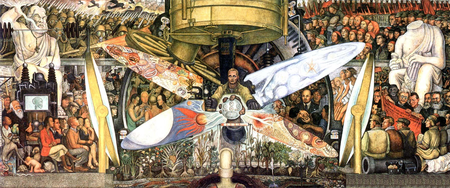
|
||
|
||
[Man, Controller of the Universe](https://en.wikipedia.org/wiki/Man_at_the_Crossroads "Man at the Crossroads") produced by Mexican artist [Diego Rivera](https://en.wikipedia.org/wiki/Diego_Rivera "Diego Rivera")
|
||
|
||
In *[Literature and Revolution](https://en.wikipedia.org/wiki/Literature_and_Revolution "Literature and Revolution")*, Trotsky examined aesthetic issues in relation to class and the Russian revolution. Soviet scholar Robert Bird considered his work as the "first systematic treatment of art by a Communist leader" and a catalyst for later, Marxist cultural and critical theories.[^113] He would later co-author the 1938 *[Manifesto for an Independent Revolutionary Art](https://en.wikipedia.org/wiki/Manifesto_for_an_Independent_Revolutionary_Art "Manifesto for an Independent Revolutionary Art")* with the endorsement of prominent artists [Andre Breton](https://en.wikipedia.org/wiki/Andre_Breton "Andre Breton") and [Diego Rivera](https://en.wikipedia.org/wiki/Diego_Rivera "Diego Rivera").[^114] Trotsky's writings on literature such as his 1923 survey which advocated tolerance, limited censorship and respect for literary tradition had strong appeal to the [New York Intellectuals](https://en.wikipedia.org/wiki/New_York_Intellectuals "New York Intellectuals").[^115]
|
||
|
||
Prior to Stalin's rule, [literary, religious and national representatives](https://en.wikipedia.org/wiki/Russian_literature#Early_post-Revolutionary_era "Russian literature") had some level of autonomy in [Soviet Russia](https://en.wikipedia.org/wiki/Soviet_Russia "Soviet Russia") throughout the 1920s but these groups were later rigorously repressed during the [Stalinist era](https://en.wikipedia.org/wiki/Stalinism "Stalinism"). [Socialist realism](https://en.wikipedia.org/wiki/Socialist_realism "Socialist realism") was imposed under Stalin in artistic production and other creative industries such as [music](https://en.wikipedia.org/wiki/Music "Music"), [film](https://en.wikipedia.org/wiki/Film "Film") along with [sports](https://en.wikipedia.org/wiki/Sports "Sports") were subject to extreme levels of political control.[^116]
|
||
|
||
The [counter-cultural](https://en.wikipedia.org/wiki/Counter-cultural "Counter-cultural") phenomenon which emerged in the 1960s shaped the [intellectual](https://en.wikipedia.org/wiki/Intellectual "Intellectual") and radical outlook of the [New Left](https://en.wikipedia.org/wiki/New_Left "New Left"); this movement placed a heavy emphasis on [anti-racism](https://en.wikipedia.org/wiki/Anti-racism#Anti-racism_and_socialism "Anti-racism"), [anti-imperialism](https://en.wikipedia.org/wiki/Anti-imperialism "Anti-imperialism") and [direct democracy](https://en.wikipedia.org/wiki/Direct_democracy "Direct democracy") in opposition to the [dominant culture](https://en.wikipedia.org/wiki/Culture_of_capitalism "Culture of capitalism") of advanced [industrial capitalism](https://en.wikipedia.org/wiki/Industrial_capitalism "Industrial capitalism").[^117] Socialist groups have also been closely involved with a number of counter-cultural movements such as [Vietnam Solidarity Campaign](https://en.wikipedia.org/wiki/Vietnam_Solidarity_Campaign "Vietnam Solidarity Campaign"), [Stop the War Coalition](https://en.wikipedia.org/wiki/Stop_the_War_Coalition "Stop the War Coalition"), [Love Music Hate Racism](https://en.wikipedia.org/wiki/Love_Music_Hate_Racism "Love Music Hate Racism"), [Anti-Nazi League](https://en.wikipedia.org/wiki/Anti-Nazi_League "Anti-Nazi League")[^118] and [Unite Against Fascism](https://en.wikipedia.org/wiki/Unite_Against_Fascism "Unite Against Fascism").[^119]
|
||
|
||
## Economics
|
||
|
||
> The economic anarchy of capitalist society as it exists today is, in my opinion, the real source of the evil. ... I am convinced there is only one way to eliminate these grave evils, namely through the establishment of a socialist economy, accompanied by an educational system which would be oriented toward social goals. In such an economy, the means of production are owned by society itself and are utilised in a planned fashion. A planned economy, which adjusts production to the needs of the community, would distribute the work to be done among all those able to work and would guarantee a livelihood to every man, woman, and child. The education of the individual, in addition to promoting his own innate abilities, would attempt to develop in him a sense of responsibility for his fellow men in place of the glorification of power and success in our present society.[^120]
|
||
|
||

|
||
|
||
Albert Einstein advocated for a socialist [planned economy](https://en.wikipedia.org/wiki/Planned_economy "Planned economy") with his 1949 article "[Why Socialism?](https://en.wikipedia.org/wiki/Why_Socialism%3F "Why Socialism?")"
|
||
|
||
Socialist economics starts from the premise that "individuals do not live or work in isolation but live in cooperation with one another. Furthermore, everything that people produce is in some sense a social product, and everyone who contributes to the production of a good is entitled to a share in it. Society as whole, therefore, should own or at least control property for the benefit of all its members".[^referenceb-121]
|
||
|
||
The original conception of socialism was an economic system whereby production was organised in a way to directly produce goods and services for their utility (or use-value in [classical](https://en.wikipedia.org/wiki/Classical_economics "Classical economics") and [Marxian economics](https://en.wikipedia.org/wiki/Marxian_economics "Marxian economics")), with the direct allocation of resources in terms of physical units as opposed to financial calculation and the economic laws of capitalism (see [law of value](https://en.wikipedia.org/wiki/Law_of_value "Law of value")), often entailing the end of capitalistic economic categories such as [rent](https://en.wikipedia.org/wiki/Renting "Renting"), interest, [profit](https://en.wikipedia.org/wiki/Profit_\(economics\) "Profit (economics)") and money.[^122] In a fully developed socialist economy, production and balancing factor inputs with outputs becomes a technical process to be undertaken by engineers.[^123]
|
||
|
||
[Market socialism](https://en.wikipedia.org/wiki/Market_socialism "Market socialism") refers to an array of different economic theories and systems that use the market mechanism to organise production and to allocate factor inputs among socially owned enterprises, with the economic surplus (profits) accruing to society in a [social dividend](https://en.wikipedia.org/wiki/Social_dividend "Social dividend") as opposed to private capital owners.[^124] Variations of market socialism include [libertarian](https://en.wikipedia.org/wiki/Libertarian "Libertarian") proposals such as [mutualism](https://en.wikipedia.org/wiki/Mutualism_\(economic_theory\) "Mutualism (economic theory)"), based on classical economics, and [neoclassical](https://en.wikipedia.org/wiki/Neoclassical_economics "Neoclassical economics") economic models such as the [Lange model](https://en.wikipedia.org/wiki/Lange_model "Lange model"). Some economists, such as [Joseph Stiglitz](https://en.wikipedia.org/wiki/Joseph_Stiglitz "Joseph Stiglitz"), [Mancur Olson](https://en.wikipedia.org/wiki/Mancur_Olson "Mancur Olson"), and others not specifically advancing anti-socialists positions have shown that prevailing economic models upon which such democratic or market socialism models might be based have logical flaws or unworkable presuppositions.[^125][^126] These criticisms have been incorporated into the models of market socialism developed by [John Roemer](https://en.wikipedia.org/wiki/John_Roemer "John Roemer") and [Nicholas Vrousalis](https://en.wikipedia.org/w/index.php?title=Nicholas_Vrousalis&action=edit&redlink=1 "Nicholas Vrousalis (page does not exist)").[^127][^128]<sup class="noprint Inline-Template">[<i><a href="https://en.wikipedia.org/wiki/Wikipedia:Manual_of_Style/Dates_and_numbers#Chronological_items" title="Wikipedia:Manual of Style/Dates and numbers"><span title="The time period mentioned near this tag is ambiguous. (June 2023)">when?</span></a></i>]</sup>
|
||
|
||
The ownership of the [means of production](https://en.wikipedia.org/wiki/Means_of_production "Means of production") can be based on direct ownership by the users of the productive property through [worker cooperative](https://en.wikipedia.org/wiki/Worker_cooperative "Worker cooperative"); or [commonly owned](https://en.wikipedia.org/wiki/Commonly_owned "Commonly owned") by all of society with management and control delegated to those who operate/use the means of production; or [public ownership](https://en.wikipedia.org/wiki/Public_ownership "Public ownership") by a state apparatus. Public ownership may refer to the creation of [state-owned enterprises](https://en.wikipedia.org/wiki/State-owned_enterprises "State-owned enterprises"), [nationalisation](https://en.wikipedia.org/wiki/Nationalisation "Nationalisation"), [municipalisation](https://en.wikipedia.org/wiki/Municipalisation "Municipalisation") or autonomous collective institutions. Some socialists feel that in a socialist economy, at least the "[commanding heights](https://en.wikipedia.org/wiki/Commanding_Heights:_The_Battle_for_the_World_Economy "Commanding Heights: The Battle for the World Economy")" of the economy must be publicly owned.[^129] [Economic liberals](https://en.wikipedia.org/wiki/Economic_liberals "Economic liberals") and [right libertarians](https://en.wikipedia.org/wiki/Right_libertarians "Right libertarians") view private ownership of the [means of production](https://en.wikipedia.org/wiki/Means_of_production "Means of production") and the market exchange as natural entities or moral rights which are central to their conceptions of freedom and liberty and view the economic dynamics of capitalism as immutable and absolute, therefore they perceive public ownership of the means of production, [cooperatives](https://en.wikipedia.org/wiki/Cooperatives "Cooperatives") and [economic planning](https://en.wikipedia.org/wiki/Economic_planning "Economic planning") as infringements upon liberty.[^milton-130][^131]
|
||
|
||
Management and control over the activities of enterprises are based on self-management and self-governance, with equal power-relations in the workplace to maximise occupational autonomy. A socialist form of organisation would eliminate controlling hierarchies so that only a hierarchy based on technical knowledge in the workplace remains. Every member would have decision-making power in the firm and would be able to participate in establishing its overall policy objectives. The policies/goals would be carried out by the technical specialists that form the coordinating hierarchy of the firm, who would establish plans or directives for the work community to accomplish these goals.[^133]
|
||
|
||
The role and use of money in a hypothetical socialist economy is a contested issue. Nineteenth century socialists including [Karl Marx](https://en.wikipedia.org/wiki/Karl_Marx "Karl Marx"), [Robert Owen](https://en.wikipedia.org/wiki/Robert_Owen "Robert Owen"), [Pierre-Joseph Proudhon](https://en.wikipedia.org/wiki/Pierre-Joseph_Proudhon "Pierre-Joseph Proudhon") and [John Stuart Mill](https://en.wikipedia.org/wiki/John_Stuart_Mill "John Stuart Mill") advocated various forms of [labour vouchers](https://en.wikipedia.org/wiki/Labour_voucher "Labour voucher") or labour credits, which like money would be used to acquire articles of consumption, but unlike money they are unable to become [capital](https://en.wikipedia.org/wiki/Financial_capital "Financial capital") and would not be used to allocate resources within the production process. Bolshevik revolutionary [Leon Trotsky](https://en.wikipedia.org/wiki/Leon_Trotsky "Leon Trotsky") argued that money could not be arbitrarily abolished following a socialist revolution. Money had to exhaust its "historic mission", meaning it would have to be used until its function became redundant, eventually being transformed into bookkeeping receipts for statisticians and only in the more distant future would money not be required for even that role.[^134]
|
||
|
||
### Planned economy
|
||
|
||
A planned economy is a type of economy consisting of a mixture of public ownership of the means of production and the coordination of production and distribution through [economic planning](https://en.wikipedia.org/wiki/Economic_planning "Economic planning"). A planned economy can be either decentralised or centralised. [Enrico Barone](https://en.wikipedia.org/wiki/Enrico_Barone "Enrico Barone") provided a comprehensive theoretical framework for a planned socialist economy. In his model, assuming perfect computation techniques, simultaneous equations relating inputs and outputs to ratios of equivalence would provide appropriate valuations to balance supply and demand.[^135]
|
||
|
||
The most prominent example of a planned economy was the [economic system of the Soviet Union](https://en.wikipedia.org/wiki/Economy_of_the_Soviet_Union "Economy of the Soviet Union") and as such the centralised-planned economic model is usually associated with the [communist states](https://en.wikipedia.org/wiki/Communist_state "Communist state") of the 20th century, where it was combined with a single-party political system. In a centrally planned economy, decisions regarding the quantity of goods and services to be produced are planned in advance by a planning agency (see also the [analysis of Soviet-type economic planning](https://en.wikipedia.org/wiki/Analysis_of_Soviet-type_economic_planning "Analysis of Soviet-type economic planning")). The economic systems of the Soviet Union and the [Eastern Bloc](https://en.wikipedia.org/wiki/Eastern_Bloc "Eastern Bloc") are further classified as "command economies", which are defined as systems where economic coordination is undertaken by commands, directives and production targets.[^136] Studies by economists of various political persuasions on the actual functioning of the Soviet economy indicate that it was not actually a planned economy. Instead of conscious planning, the Soviet economy was based on a process whereby the plan was modified by localised agents and the original plans went largely unfulfilled. Planning agencies, ministries and enterprises all adapted and bargained with each other during the formulation of the plan as opposed to following a plan passed down from a higher authority, leading some economists to suggest that planning did not actually take place within the Soviet economy and that a better description would be an "administered" or "managed" economy.[^137]
|
||
|
||
Although central planning was largely supported by [Marxist–Leninists](https://en.wikipedia.org/wiki/Marxist%E2%80%93Leninists "Marxist–Leninists"), some factions within the Soviet Union before the rise of [Stalinism](https://en.wikipedia.org/wiki/Stalinism "Stalinism") held positions contrary to central planning. Leon Trotsky rejected central planning in favour of decentralised planning. He argued that central planners, regardless of their intellectual capacity, would be unable to coordinate effectively all economic activity within an economy because they operated without the input and tacit knowledge embodied by the participation of the millions of people in the economy. As a result, central planners would be unable to respond to local economic conditions.[^138] [State socialism](https://en.wikipedia.org/wiki/State_socialism "State socialism") is unfeasible in this view because information cannot be aggregated by a central body and effectively used to formulate a plan for an entire economy, because doing so would result in [distorted or absent price signals](https://en.wikipedia.org/wiki/Economic_calculation_problem "Economic calculation problem").[^hayek-139]
|
||
|
||
### Self-managed economy
|
||
|
||
> Socialism, you see, is a bird with two wings. The definition is 'social ownership and democratic control of the instruments and means of production.'[^footnotesinclair1918-140]
|
||
|
||

|
||
|
||
The [Soviet of Workers' Deputies of St. Petersburg](https://en.wikipedia.org/wiki/Saint_Petersburg_Soviet "Saint Petersburg Soviet") in 1905, Trotsky in the center. The [soviets](https://en.wikipedia.org/wiki/Soviet_\(council\) "Soviet (council)") were an early example of a [workers council](https://en.wikipedia.org/wiki/Workers_council "Workers council").
|
||
|
||
A self-managed, decentralised economy is based on autonomous self-regulating economic units and a decentralised mechanism of resource allocation and decision-making. This model has found support in notable classical and neoclassical economists including [Alfred Marshall](https://en.wikipedia.org/wiki/Alfred_Marshall "Alfred Marshall"), [John Stuart Mill](https://en.wikipedia.org/wiki/John_Stuart_Mill "John Stuart Mill") and [Jaroslav Vanek](https://en.wikipedia.org/wiki/Jaroslav_Vanek "Jaroslav Vanek"). There are numerous variations of self-management, including labour-managed firms and worker-managed firms. The goals of self-management are to eliminate exploitation and reduce [alienation](https://en.wikipedia.org/wiki/Social_alienation "Social alienation").[^141] [Guild socialism](https://en.wikipedia.org/wiki/Guild_socialism "Guild socialism") is a political movement advocating [workers' control](https://en.wikipedia.org/wiki/Workers%27_control "Workers' control") of industry through the medium of trade-related [guilds](https://en.wikipedia.org/wiki/Guild "Guild") "in an implied contractual relationship with the public".[^britannica.com-142] It originated in the United Kingdom and was at its most influential in the first quarter of the 20th century.[^britannica.com-142] It was strongly associated with [G. D. H. Cole](https://en.wikipedia.org/wiki/G._D._H._Cole "G. D. H. Cole") and influenced by the ideas of [William Morris](https://en.wikipedia.org/wiki/William_Morris "William Morris").
|
||
|
||

|
||
|
||
[Project Cybersyn](https://en.wikipedia.org/wiki/Project_Cybersyn "Project Cybersyn") was an early form of computational [economic planning](https://en.wikipedia.org/wiki/Economic_planning "Economic planning")
|
||
|
||
One such system is the cooperative economy, a largely free [market economy](https://en.wikipedia.org/wiki/Market_economy "Market economy") in which workers manage the firms and democratically determine remuneration levels and labour divisions. Productive resources would be legally owned by the [cooperative](https://en.wikipedia.org/wiki/Cooperative "Cooperative") and rented to the workers, who would enjoy [usufruct](https://en.wikipedia.org/wiki/Usufruct "Usufruct") rights.[^143] Another form of decentralised planning is the use of [cybernetics](https://en.wikipedia.org/wiki/Cybernetics "Cybernetics"), or the use of computers to manage the allocation of economic inputs. The socialist-run government of [Salvador Allende](https://en.wikipedia.org/wiki/Salvador_Allende "Salvador Allende") in Chile experimented with [Project Cybersyn](https://en.wikipedia.org/wiki/Project_Cybersyn "Project Cybersyn"), a real-time information bridge between the government, state enterprises and consumers.[^144] This had been preceded by similar efforts to introduce a form of cybernetic economic planning as seen with the proposed [OGAS](https://en.wikipedia.org/wiki/OGAS "OGAS") system in the Soviet Union. The OGAS project was conceived to oversee a nationwide [information network](https://en.wikipedia.org/wiki/Information_network "Information network") but was never implemented due to conflicting, [bureaucratic interests](https://en.wikipedia.org/wiki/Nomenklatura "Nomenklatura").[^145] Another, more recent variant is [participatory economics](https://en.wikipedia.org/wiki/Participatory_economics "Participatory economics"), wherein the economy is planned by decentralised councils of workers and consumers. Workers would be remunerated solely according to effort and sacrifice, so that those engaged in dangerous, uncomfortable and strenuous work would receive the highest incomes and could thereby work less.[^146] A contemporary model for a self-managed, non-market socialism is [Pat Devine](https://en.wikipedia.org/wiki/Pat_Devine "Pat Devine")'s model of negotiated coordination. Negotiated coordination is based upon social ownership by those affected by the use of the assets involved, with decisions made by those at the most localised level of production.[^147]
|
||
|
||
[Michel Bauwens](https://en.wikipedia.org/wiki/Michel_Bauwens "Michel Bauwens") identifies the emergence of the open software movement and [peer-to-peer production](https://en.wikipedia.org/wiki/Social_peer-to-peer_processes "Social peer-to-peer processes") as a new alternative [mode of production](https://en.wikipedia.org/wiki/Mode_of_production "Mode of production") to the capitalist economy and centrally planned economy that is based on collaborative self-management, common ownership of resources and the production of use-values through the free cooperation of producers who have access to distributed capital.[^ctheory-148]
|
||
|
||
[Anarcho-communism](https://en.wikipedia.org/wiki/Anarcho-communism "Anarcho-communism") is a theory of [anarchism](https://en.wikipedia.org/wiki/Anarchism "Anarchism") which advocates the abolition of the [state](https://en.wikipedia.org/wiki/State_\(polity\) "State (polity)"), [private property](https://en.wikipedia.org/wiki/Private_property "Private property") and capitalism in favour of [common ownership](https://en.wikipedia.org/wiki/Common_ownership "Common ownership") of the [means of production](https://en.wikipedia.org/wiki/Means_of_production "Means of production").[^mayne-149][^150] [Anarcho-syndicalism](https://en.wikipedia.org/wiki/Anarcho-syndicalism "Anarcho-syndicalism") was practised in [Catalonia](https://en.wikipedia.org/wiki/Catalonia "Catalonia") and other places in the [Spanish Revolution](https://en.wikipedia.org/wiki/Spanish_Revolution_of_1936 "Spanish Revolution of 1936") during the Spanish Civil War. [Sam Dolgoff](https://en.wikipedia.org/wiki/Sam_Dolgoff "Sam Dolgoff") estimated that about eight million people participated directly or at least indirectly in the Spanish Revolution.[^dolgoff1974-151]
|
||
|
||
The economy of the former [Socialist Federal Republic of Yugoslavia](https://en.wikipedia.org/wiki/Socialist_Federal_Republic_of_Yugoslavia "Socialist Federal Republic of Yugoslavia") established a [system](https://en.wikipedia.org/wiki/Socialist_self-management "Socialist self-management") based on market-based allocation, social ownership of the means of production and self-management within firms. This system substituted Yugoslavia's Soviet-type central planning with a decentralised, self-managed system after reforms in 1953.[^152]
|
||
|
||
The [Marxian economist](https://en.wikipedia.org/wiki/Marxian_economist "Marxian economist") [Richard D. Wolff](https://en.wikipedia.org/wiki/Richard_D._Wolff "Richard D. Wolff") argues that "re-organising production so that workers become collectively self-directed at their work-sites" not only moves society beyond both capitalism and [state socialism](https://en.wikipedia.org/wiki/State_socialism "State socialism") of the last century, but would also mark another milestone in human history, similar to earlier transitions out of slavery and feudalism.[^153] As an example, Wolff claims that [Mondragon](https://en.wikipedia.org/wiki/Mondragon_Corporation "Mondragon Corporation") is "a stunningly successful alternative to the capitalist organisation of production".[^154]
|
||
|
||
### State-directed economy
|
||
|
||
State socialism can be used to classify any variety of socialist philosophies that advocates the ownership of the [means of production](https://en.wikipedia.org/wiki/Means_of_production "Means of production") by the [state apparatus](https://en.wikipedia.org/wiki/State_apparatus "State apparatus"), either as a transitional stage between capitalism and socialism, or as an end-goal in itself. Typically, it refers to a form of technocratic management, whereby technical specialists administer or manage economic enterprises on behalf of society and the public interest instead of workers' councils or workplace democracy.
|
||
|
||
A state-directed economy may refer to a type of mixed economy consisting of public ownership over large industries, as promoted by various Social democratic political parties during the 20th century. This ideology influenced the policies of the British Labour Party during Clement Attlee's administration. In the biography of the 1945 United Kingdom Labour Party Prime Minister [Clement Attlee](https://en.wikipedia.org/wiki/Clement_Attlee "Clement Attlee"), [Francis Beckett](https://en.wikipedia.org/wiki/Francis_Beckett "Francis Beckett") states: "\[T\]he government ... wanted what would become known as a mixed economy."[^footnotebeckett2007-155]
|
||
|
||
Nationalisation in the United Kingdom was achieved through compulsory purchase of the industry (i.e. with compensation). [British Aerospace](https://en.wikipedia.org/wiki/British_Aerospace "British Aerospace") was a combination of major aircraft companies [British Aircraft Corporation](https://en.wikipedia.org/wiki/British_Aircraft_Corporation "British Aircraft Corporation"), [Hawker Siddeley](https://en.wikipedia.org/wiki/Hawker_Siddeley "Hawker Siddeley") and others. [British Shipbuilders](https://en.wikipedia.org/wiki/British_Shipbuilders "British Shipbuilders") was a combination of the major shipbuilding companies including [Cammell Laird](https://en.wikipedia.org/wiki/Cammell_Laird "Cammell Laird"), [Govan Shipbuilders](https://en.wikipedia.org/wiki/Govan_Shipbuilders "Govan Shipbuilders"), [Swan Hunter](https://en.wikipedia.org/wiki/Swan_Hunter "Swan Hunter") and [Yarrow Shipbuilders](https://en.wikipedia.org/wiki/Yarrow_Shipbuilders "Yarrow Shipbuilders"), whereas the nationalisation of the coal mines in 1947 created a coal board charged with running the coal industry commercially so as to be able to meet the interest payable on the bonds which the former mine owners' shares had been converted into.[^156][^157]
|
||
|
||
Market socialism consists of publicly owned or cooperatively owned enterprises operating in a [market economy](https://en.wikipedia.org/wiki/Market_economy "Market economy"). It is a system that uses the market and [monetary prices](https://en.wikipedia.org/wiki/Price_system "Price system") for the allocation and accounting of the [means of production](https://en.wikipedia.org/wiki/Means_of_production "Means of production"), thereby retaining the process of [capital accumulation](https://en.wikipedia.org/wiki/Capital_accumulation "Capital accumulation"). The profit generated would be used to directly remunerate employees, collectively sustain the enterprise or finance public institutions.[^158] In state-oriented forms of market socialism, in which state enterprises attempt to maximise profit, the profits can be used to fund government programs and services through a [social dividend](https://en.wikipedia.org/wiki/Social_dividend "Social dividend"), eliminating or greatly diminishing the need for various forms of taxation that exist in capitalist systems. [Neoclassical economist](https://en.wikipedia.org/wiki/Neoclassical_economist "Neoclassical economist") [Léon Walras](https://en.wikipedia.org/wiki/L%C3%A9on_Walras "Léon Walras") believed that a socialist economy based on state ownership of land and natural resources would provide a means of public finance to make income taxes unnecessary.[^159] [Yugoslavia](https://en.wikipedia.org/wiki/Yugoslavia "Yugoslavia") implemented a market socialist economy based on cooperatives and worker self-management.[^160] Some of the economic reforms introduced during the [Prague Spring](https://en.wikipedia.org/wiki/Prague_Spring "Prague Spring") by [Alexander Dubček](https://en.wikipedia.org/wiki/Alexander_Dub%C4%8Dek "Alexander Dubček"), the [leader](https://en.wikipedia.org/wiki/Communist_Party_of_Czechoslovakia#Leaders "Communist Party of Czechoslovakia") of [Czechoslovakia](https://en.wikipedia.org/wiki/Czechoslovakia "Czechoslovakia"), included elements of market socialism.[^161]
|
||
|
||

|
||
|
||
[Pierre-Joseph Proudhon](https://en.wikipedia.org/wiki/Pierre-Joseph_Proudhon "Pierre-Joseph Proudhon"), main theorist of [mutualism](https://en.wikipedia.org/wiki/Mutualism_\(economic_theory\) "Mutualism (economic theory)") and influential French socialist thinker
|
||
|
||
[Mutualism](https://en.wikipedia.org/wiki/Mutualism_\(economy\) "Mutualism (economy)") is an [economic theory](https://en.wikipedia.org/wiki/Economics "Economics") and [anarchist school of thought](https://en.wikipedia.org/wiki/Anarchist_school_of_thought "Anarchist school of thought") that advocates a society where each person might possess a [means of production](https://en.wikipedia.org/wiki/Means_of_production "Means of production"), either individually or collectively, with trade representing equivalent amounts of labour in the [free market](https://en.wikipedia.org/wiki/Free_market "Free market").[^162] Integral to the scheme was the establishment of a mutual-credit bank that would lend to producers at a minimal interest rate, just high enough to cover administration.[^163] Mutualism is based on a [labour theory of value](https://en.wikipedia.org/wiki/Labour_theory_of_value "Labour theory of value") that holds that when labour or its product is sold, in exchange it ought to receive goods or services embodying "the amount of labour necessary to produce an article of exactly similar and equal utility".[^164]
|
||
|
||
The current economic system in China is formally referred to as a [socialist market economy with Chinese characteristics](https://en.wikipedia.org/wiki/Socialist_market_economy_with_Chinese_characteristics "Socialist market economy with Chinese characteristics"). It combines a large state sector that comprises the commanding heights of the economy, which are guaranteed their public ownership status by law,[^165] with a [private sector](https://en.wikipedia.org/wiki/Private_sector "Private sector") mainly engaged in commodity production and light industry responsible from anywhere between 33%[^166] to over 70% of GDP generated in 2005.[^167] Although there has been a rapid expansion of private-sector activity since the 1980s, privatisation of state assets was virtually halted and were partially reversed in 2005.[^168] The current Chinese economy consists of 150 [corporatised](https://en.wikipedia.org/wiki/Corporatised "Corporatised") state-owned enterprises that report directly to China's central government.[^169] By 2008, these state-owned corporations had become increasingly dynamic and generated large increases in revenue for the state,[^170][^171] resulting in a state-sector led recovery during the 2009 financial crises while accounting for most of China's economic growth.[^172] The Chinese economic model is widely cited as a contemporary form of state capitalism, the major difference between Western capitalism and the Chinese model being the degree of state-ownership of shares in publicly listed corporations. The Socialist Republic of Vietnam has adopted a similar model after the [Doi Moi](https://en.wikipedia.org/wiki/Doi_Moi "Doi Moi") economic renovation but slightly differs from the Chinese model in that the Vietnamese government retains firm control over the state sector and strategic industries, but allows for private-sector activity in commodity production.[^173]
|
||
|
||
## Politics
|
||
|
||

|
||
|
||
Socialists in [Union Square](https://en.wikipedia.org/wiki/Union_Square,_Manhattan "Union Square, Manhattan"), New York City on [May Day](https://en.wikipedia.org/wiki/International_Workers%27_Day "International Workers' Day") 1912
|
||
|
||
While major socialist political movements include anarchism, communism, the labour movement, Marxism, social democracy, and syndicalism, independent socialist theorists, [utopian socialist](https://en.wikipedia.org/wiki/Utopian_socialist "Utopian socialist") authors, and academic supporters of socialism may not be represented in these movements. Some political groups have called themselves *socialist* while holding views that some consider antithetical to socialism. *Socialist* has been used by members of the [political right](https://en.wikipedia.org/wiki/Political_right "Political right") as an epithet, including against individuals who do not consider themselves to be socialists and against policies that are not considered socialist by their proponents. While there are many variations of socialism, and there is no single definition encapsulating all of socialism, there have been common elements identified by scholars.[^footnotelambdocherty20061%e2%80%933-174]
|
||
|
||
In his *Dictionary of Socialism* (1924), Angelo S. Rappoport analysed forty definitions of socialism to conclude that common elements of socialism include general criticism of the social effects of [private ownership](https://en.wikipedia.org/wiki/Private_ownership "Private ownership") and control of capital—as being the cause of poverty, low wages, unemployment, economic and social inequality and a lack of economic security; a general view that the solution to these problems is a form of collective control over the [means of production](https://en.wikipedia.org/wiki/Means_of_production "Means of production"), [distribution](https://en.wikipedia.org/wiki/Distribution_\(economics\) "Distribution (economics)") and [exchange](https://en.wikipedia.org/wiki/Means_of_exchange "Means of exchange") (the degree and means of control vary among socialist movements); an agreement that the outcome of this collective control should be a society based upon [social justice](https://en.wikipedia.org/wiki/Social_justice "Social justice"), including social equality, economic protection of people and should provide a more satisfying life for most people.[^footnotelambdocherty20061%e2%80%932-175]
|
||
|
||
In *The Concepts of Socialism* (1975), [Bhikhu Parekh](https://en.wikipedia.org/wiki/Bhikhu_Parekh "Bhikhu Parekh") identifies four core principles of socialism and particularly socialist society, namely sociality, social responsibility, cooperation and planning.[^footnotelambdocherty20062-176] In his study *Ideologies and Political Theory* (1996), [Michael Freeden](https://en.wikipedia.org/wiki/Michael_Freeden "Michael Freeden") states that all socialists share five themes: the first is that socialism posits that society is more than a mere collection of individuals; second, that it considers human welfare a desirable objective; third, that it considers humans by nature to be active and productive; fourth, it holds the belief of human equality; and fifth, that history is progressive and will create positive change on the condition that humans work to achieve such change.[^footnotelambdocherty20062-176]
|
||
|
||
### Anarchism
|
||
|
||
Anarchism advocates [stateless societies](https://en.wikipedia.org/wiki/Stateless_societies "Stateless societies") often defined as [self-governed](https://en.wikipedia.org/wiki/Self-governed "Self-governed") voluntary institutions,[^177][^178][^179][^180] but that several authors have defined as more specific institutions based on non-[hierarchical](https://en.wikipedia.org/wiki/Hierarchical "Hierarchical") [free associations](https://en.wikipedia.org/wiki/Free_association_\(communism_and_anarchism\) "Free association (communism and anarchism)").[^iaf-ifa.org-181][^182][^183][^184] While anarchism holds the [state](https://en.wikipedia.org/wiki/State_\(polity\) "State (polity)") to be undesirable, unnecessary or harmful,[^definition-185][^slevin-186] it is not the central aspect.[^footnotemclaughlin200728-187] Anarchism entails opposing [authority](https://en.wikipedia.org/wiki/Authority "Authority") or [hierarchical organisation](https://en.wikipedia.org/wiki/Hierarchical_organisation "Hierarchical organisation") in the conduct of human relations, including the state system.[^iaf-ifa.org-181][^brown_2002_106-188][^footnotemclaughlin20071-189][^190][^191] [Mutualists](https://en.wikipedia.org/wiki/Mutualism_\(economic_theory\) "Mutualism (economic theory)") support market socialism, [collectivist anarchists](https://en.wikipedia.org/wiki/Collectivist_anarchist "Collectivist anarchist") favour [workers cooperatives](https://en.wikipedia.org/wiki/Workers_cooperative "Workers cooperative") and salaries based on the amount of time contributed to production, [anarcho-communists](https://en.wikipedia.org/wiki/Anarcho-communists "Anarcho-communists") advocate a direct transition from capitalism to [libertarian communism](https://en.wikipedia.org/wiki/Libertarian_communism "Libertarian communism") and a [gift economy](https://en.wikipedia.org/wiki/Gift_economy "Gift economy") and [anarcho-syndicalists](https://en.wikipedia.org/wiki/Anarcho-syndicalist "Anarcho-syndicalist") prefer workers' [direct action](https://en.wikipedia.org/wiki/Direct_action "Direct action") and the [general strike](https://en.wikipedia.org/wiki/General_strike "General strike").[^mckay_2008-192]
|
||
|
||
The authoritarian–[libertarian](https://en.wikipedia.org/wiki/Libertarian "Libertarian") struggles and disputes within the socialist movement go back to the First International and the expulsion in 1872 of the anarchists, who went on to lead the [Anti-authoritarian International](https://en.wikipedia.org/wiki/Anti-authoritarian_International "Anti-authoritarian International") and then founded their own libertarian international, the [Anarchist St. Imier International](https://en.wikipedia.org/wiki/Anarchist_St._Imier_International "Anarchist St. Imier International").[^193] In 1888, the [individualist anarchist](https://en.wikipedia.org/wiki/Individualist_anarchist "Individualist anarchist") [Benjamin Tucker](https://en.wikipedia.org/wiki/Benjamin_Tucker "Benjamin Tucker"), who proclaimed himself to be an anarchistic socialist and [libertarian socialist](https://en.wikipedia.org/wiki/Libertarian_socialist "Libertarian socialist") in opposition to the authoritarian [state socialism](https://en.wikipedia.org/wiki/State_socialism "State socialism") and the compulsory communism, included the full text of a "Socialistic Letter" by [Ernest Lesigne](https://en.wikipedia.org/wiki/Ernest_Lesigne "Ernest Lesigne")[^194] in his essay on "State Socialism and Anarchism". According to Lesigne, there are two types of socialism: "One is dictatorial, the other libertarian".[^195] Tucker's two socialisms were the authoritarian state socialism which he associated to the Marxist school and the libertarian anarchist socialism, or simply anarchism, that he advocated. Tucker noted that the fact that the authoritarian "State Socialism has overshadowed other forms of Socialism gives it no right to a monopoly of the Socialistic idea".[^196] According to Tucker, what those two schools of socialism had in common was the [labor theory of value](https://en.wikipedia.org/wiki/Labor_theory_of_value "Labor theory of value") and the ends, by which anarchism pursued different means.[^197]
|
||
|
||
According to anarchists such as the authors of *An Anarchist FAQ*, anarchism is one of the many traditions of socialism. For anarchists and other anti-authoritarian socialists, socialism "can only mean a classless and anti-authoritarian (i.e. libertarian) society in which people manage their own affairs, either as individuals or as part of a group (depending on the situation). In other words, it implies self-management in all aspects of life", including at the workplace.[^mckay_2008-192] Michael Newman includes anarchism as one of many socialist traditions.[^footnotenewman2005-102] [Peter Marshall](https://en.wikipedia.org/wiki/Peter_Marshall_\(author,_born_1946\) "Peter Marshall (author, born 1946)") argues that "\[i\]n general anarchism is closer to socialism than liberalism. ... Anarchism finds itself largely in the socialist camp, but it also has outriders in liberalism. It cannot be reduced to socialism, and is best seen as a separate and distinctive doctrine."[^198]
|
||
|
||
### Democratic socialism and social democracy
|
||
|
||
> You can't talk about ending the slums without first saying profit must be taken out of slums. You're really tampering and getting on dangerous ground because you are messing with folk then. You are messing with captains of industry. Now this means that we are treading in difficult water, because it really means that we are saying that something is wrong with capitalism. There must be a better distribution of wealth, and maybe America must move toward a democratic socialism.[^199][^200]
|
||
|
||
Democratic socialism represents any socialist movement that seeks to establish an economy based on [economic democracy](https://en.wikipedia.org/wiki/Economic_democracy "Economic democracy") by and for the working class. Democratic socialism is difficult to define and groups of scholars have radically different definitions for the term. Some definitions simply refer to all forms of socialism that follow an electoral, reformist or evolutionary path to socialism rather than a revolutionary one.[^201] According to Christopher Pierson, "\[i\]f the contrast which 1989 highlights is not that between socialism in the East and liberal democracy in the West, the latter must be recognised to have been shaped, reformed and compromised by a century of social democratic pressure". Pierson further claims that "social democratic and socialist parties within the constitutional arena in the West have almost always been involved in a politics of compromise with existing capitalist institutions (to whatever far distant prize its eyes might from time to time have been lifted)". For Pierson, "if advocates of the death of socialism accept that social democrats belong within the socialist camp, as I think they must, then the contrast between socialism (in all its variants) and liberal democracy must collapse. For *actually existing* liberal democracy is, in substantial part, a product of socialist (social democratic) forces".[^202]
|
||
|
||
Social democracy is a socialist tradition of political thought.[^203][^footnotenewman20055-204] Many social democrats refer to themselves as socialists or democratic socialists and some such as [Tony Blair](https://en.wikipedia.org/wiki/Tony_Blair "Tony Blair") employ these terms interchangeably.[^205][^206][^207] Others found "clear differences" between the three terms and prefer to describe their own political beliefs by using the term *social democracy*.[^footnotebrandalbratbergthorsen20137-208] The two main directions were to establish democratic socialism or to build first a welfare state within the capitalist system. The first variant advances democratic socialism through [reformist](https://en.wikipedia.org/wiki/Reformist "Reformist") and [gradualist](https://en.wikipedia.org/wiki/Gradualist "Gradualist") methods.[^footnotebusky20008-209] In the second variant, social democracy is a policy regime involving a welfare state, [collective bargaining](https://en.wikipedia.org/wiki/Collective_bargaining "Collective bargaining") schemes, support for publicly financed public services and a mixed economy. It is often used in this manner to refer to Western and Northern Europe during the later half of the 20th century.[^210] It was described by [Jerry Mander](https://en.wikipedia.org/wiki/Jerry_Mander "Jerry Mander") as "hybrid economics", an active collaboration of capitalist and socialist visions.[^212] Some studies and surveys indicate that people tend to live happier and healthier lives in social democratic societies rather than [neoliberal](https://en.wikipedia.org/wiki/Neoliberal "Neoliberal") ones.[^213][^214][^215][^216]
|
||
|
||
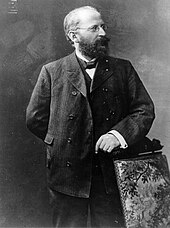
|
||
|
||
[Eduard Bernstein](https://en.wikipedia.org/wiki/Eduard_Bernstein "Eduard Bernstein")
|
||
|
||
Social democrats advocate a peaceful, evolutionary transition of the economy to socialism through [progressive](https://en.wikipedia.org/wiki/Progressivism "Progressivism") social reform.[^eb-217][^footnotenewman2005[httpsbooksgooglecombooksidkn8lluabgh8cpgpa74_74]-218] It asserts that the only acceptable constitutional form of government is [representative democracy](https://en.wikipedia.org/wiki/Representative_democracy "Representative democracy") under the rule of law.[^footnotemeyer201391-219] It promotes extending democratic decision-making beyond political democracy to include [economic democracy](https://en.wikipedia.org/wiki/Economic_democracy "Economic democracy") to guarantee employees and other economic stakeholders sufficient rights of [co-determination](https://en.wikipedia.org/wiki/Co-determination "Co-determination").[^footnotemeyer201391-219] It supports a [mixed economy](https://en.wikipedia.org/wiki/Mixed_economy "Mixed economy") that opposes inequality, poverty and oppression while rejecting both a totally unregulated [market economy](https://en.wikipedia.org/wiki/Market_economy "Market economy") or a fully [planned economy](https://en.wikipedia.org/wiki/Planned_economy "Planned economy").[^220] Common social democratic policies include universal social rights and universally accessible public services such as education, health care, workers' compensation and other services, including child care and elder care.[^footnotemeyer2013137-221] Socialist child care and elderly care systems allow citizens to take a more active role in building a socialist society, especially women.[^222] Social democracy supports the trade union labour movement and supports collective bargaining rights for workers.[^223] Most social democratic parties are affiliated with the [Socialist International](https://en.wikipedia.org/wiki/Socialist_International "Socialist International").[^footnotebusky20008-209]
|
||
|
||
Modern democratic socialism is a broad political movement that seeks to promote the ideals of socialism within the context of a democratic system. Some democratic socialists support social democracy as a temporary measure to reform the current system while others reject reformism in favour of more revolutionary methods. Modern social democracy emphasises a program of gradual legislative modification of capitalism to make it more equitable and humane while the theoretical end goal of building a socialist society is relegated to the indefinite future. According to [Sheri Berman](https://en.wikipedia.org/wiki/Sheri_Berman "Sheri Berman"), Marxism is loosely held to be valuable for its emphasis on changing the world for a more just, better future.[^224]
|
||
|
||
The two movements are widely similar both in terminology and in ideology, although there are a few key differences. The major difference between social democracy and democratic socialism is the object of their politics in that contemporary social democrats support a welfare state and unemployment insurance as well as other practical, progressive reforms of capitalism and are more concerned to administrate and humanise it. On the other hand, democratic socialists seek to replace capitalism with a socialist economic system, arguing that any attempt to humanise capitalism through regulations and welfare policies would distort the market and create economic contradictions.[^225]
|
||
|
||
### Ethical and liberal socialism
|
||
|
||
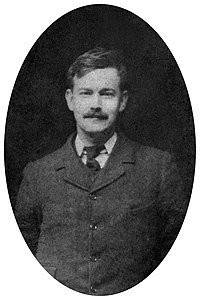
|
||
|
||
[R. H. Tawney](https://en.wikipedia.org/wiki/R._H._Tawney "R. H. Tawney"), founder of ethical socialism
|
||
|
||
Ethical socialism appeals to socialism on ethical and moral grounds as opposed to economic, egoistic, and consumeristic grounds. It emphasizes the need for a morally conscious economy based upon the principles of altruism, cooperation, and social justice while opposing possessive individualism.[^footnotethompson200652,_58%e2%80%9359-226] Ethical socialism has been the official philosophy of mainstream socialist parties.[^footnoteorlow2000190tanseyjackson200897-227]
|
||
|
||
Liberal socialism incorporates liberal principles to socialism.[^footnotegauskukathas2004420-228] It has been compared to [post-war social democracy](https://en.wikipedia.org/wiki/Social_democratic_mixed_economy "Social democratic mixed economy")[^adams1998-229] for its support of a [mixed economy](https://en.wikipedia.org/wiki/Mixed_economy "Mixed economy") that includes both public and private capital goods.[^230][^231] While [democratic socialism](https://en.wikipedia.org/wiki/Democratic_socialism "Democratic socialism") and [social democracy](https://en.wikipedia.org/wiki/Social_democracy "Social democracy") are [anti-capitalist](https://en.wikipedia.org/wiki/Anti-capitalist "Anti-capitalist") positions insofar as [criticism of capitalism](https://en.wikipedia.org/wiki/Criticism_of_capitalism "Criticism of capitalism") is linked to the [private ownership](https://en.wikipedia.org/wiki/Private_ownership "Private ownership") of the [means of production](https://en.wikipedia.org/wiki/Means_of_production "Means of production"),[^footnotelambdocherty20061%e2%80%932-175] liberal socialism identifies artificial and legalistic monopolies to be the fault of [capitalism](https://en.wikipedia.org/wiki/Capitalism "Capitalism")[^232] and opposes an entirely unregulated [market economy](https://en.wikipedia.org/wiki/Market_economy "Market economy").[^ref72-233] It considers both [liberty](https://en.wikipedia.org/wiki/Liberty "Liberty") and [social equality](https://en.wikipedia.org/wiki/Social_equality "Social equality") to be compatible and mutually dependent.[^footnotegauskukathas2004420-228]
|
||
|
||
Principles that can be described as ethical or liberal socialist have been based upon or developed by philosophers such as [John Stuart Mill](https://en.wikipedia.org/wiki/John_Stuart_Mill "John Stuart Mill"), [Eduard Bernstein](https://en.wikipedia.org/wiki/Eduard_Bernstein "Eduard Bernstein"), [John Dewey](https://en.wikipedia.org/wiki/John_Dewey "John Dewey"), [Carlo Rosselli](https://en.wikipedia.org/wiki/Carlo_Rosselli "Carlo Rosselli"), [Norberto Bobbio](https://en.wikipedia.org/wiki/Norberto_Bobbio "Norberto Bobbio"), and [Chantal Mouffe](https://en.wikipedia.org/wiki/Chantal_Mouffe "Chantal Mouffe").[^234] Other important liberal socialist figures include Guido Calogero, [Piero Gobetti](https://en.wikipedia.org/wiki/Piero_Gobetti "Piero Gobetti"), [Leonard Trelawny Hobhouse](https://en.wikipedia.org/wiki/Leonard_Trelawny_Hobhouse "Leonard Trelawny Hobhouse"), [John Maynard Keynes](https://en.wikipedia.org/wiki/John_Maynard_Keynes "John Maynard Keynes") and [R. H. Tawney](https://en.wikipedia.org/wiki/R._H._Tawney "R. H. Tawney").[^ref72-233] Liberal socialism has been particularly prominent in British and Italian politics.[^ref72-233]
|
||
|
||
### Leninism and precedents
|
||
|
||

|
||
|
||
Russian revolutionary, politician, and political theorist [Vladimir Lenin](https://en.wikipedia.org/wiki/Vladimir_Lenin "Vladimir Lenin") in 1920
|
||
|
||
Blanquism is a conception of revolution named for [Louis Auguste Blanqui](https://en.wikipedia.org/wiki/Louis_Auguste_Blanqui "Louis Auguste Blanqui"). It holds that socialist revolution should be carried out by a relatively small group of highly organised and secretive conspirators. Upon seizing power, the revolutionaries introduce socialism.<sup class="noprint Inline-Template Template-Fact">[<i><a href="https://en.wikipedia.org/wiki/Wikipedia:Citation_needed" title="Wikipedia:Citation needed"><span title="This claim needs references to reliable sources. (February 2025)">citation needed</span></a></i>]</sup> [Rosa Luxemburg](https://en.wikipedia.org/wiki/Rosa_Luxemburg "Rosa Luxemburg") and [Eduard Bernstein](https://en.wikipedia.org/wiki/Eduard_Bernstein "Eduard Bernstein")[^bern-235] criticised Lenin, stating that his conception of revolution was elitist and Blanquist.[^236] Marxism–Leninism combines Marx's [scientific socialist](https://en.wikipedia.org/wiki/Scientific_socialist "Scientific socialist") concepts and Lenin's [anti-imperialism](https://en.wikipedia.org/wiki/Anti-imperialism "Anti-imperialism"), [democratic centralism](https://en.wikipedia.org/wiki/Democratic_centralism "Democratic centralism"), [vanguardism](https://en.wikipedia.org/wiki/Vanguardism "Vanguardism")[^237] and the principle of "[He who does not work, neither shall he eat](https://en.wikipedia.org/wiki/He_who_does_not_work,_neither_shall_he_eat "He who does not work, neither shall he eat")".[^238]
|
||
|
||
[Hal Draper](https://en.wikipedia.org/wiki/Hal_Draper "Hal Draper") defined [socialism from above](https://en.wikipedia.org/wiki/Socialism_from_above "Socialism from above") as the philosophy which employs an elite [administration](https://en.wikipedia.org/wiki/Administration_\(government\) "Administration (government)") to run the [socialist state](https://en.wikipedia.org/wiki/Socialist_state "Socialist state"). The other side of socialism is a more democratic [socialism from below](https://en.wikipedia.org/wiki/Socialism_from_below "Socialism from below").[^two_souls-239] The idea of socialism from above is much more frequently discussed in elite circles than socialism from below—even if that is the Marxist ideal—because it is more practical.[^240] Draper viewed socialism from below as being the purer, more [Marxist](https://en.wikipedia.org/wiki/Marxist "Marxist") version of socialism.[^241] According to Draper, [Karl Marx](https://en.wikipedia.org/wiki/Karl_Marx "Karl Marx") and [Friedrich Engels](https://en.wikipedia.org/wiki/Friedrich_Engels "Friedrich Engels") were devoutly opposed to any socialist institution that was "conducive to superstitious authoritarianism". Draper makes the argument that this division echoes the division between "reformist or revolutionary, peaceful or violent, democratic or authoritarian, etc." and further identifies six major varieties of socialism from above, among them "Philanthropism", "Elitism", "Pannism", "Communism", "Permeationism" and "Socialism-from-Outside".[^242] According to Arthur Lipow, Marx and Engels were "the founders of modern revolutionary democratic socialism", described as a form of "socialism from below" that is "based on a mass working-class movement, fighting from below for the extension of democracy and human freedom". This [type of socialism](https://en.wikipedia.org/wiki/Type_of_socialism "Type of socialism") is contrasted to that of the "authoritarian, anti-democratic creed" and "the various totalitarian collectivist ideologies which claim the title of socialism" as well as "the many varieties of 'socialism from above' which have led in the twentieth century to movements and state forms in which a despotic '[new class](https://en.wikipedia.org/wiki/New_class "New class")' rules over a stratified economy in the name of socialism", a division that "runs through the history of the socialist movement". Lipow identifies [Bellamyism](https://en.wikipedia.org/wiki/Bellamyism "Bellamyism") and [Stalinism](https://en.wikipedia.org/wiki/Stalinism "Stalinism") as two prominent authoritarian socialist currents within the history of the socialist movement.[^243]
|
||
|
||
Trotsky viewed himself to be an adherent of Leninism but opposed the [bureaucratic](https://en.wikipedia.org/wiki/Bureaucratic "Bureaucratic") and authoritarian methods of Stalin.[^244] A number of scholars and Western socialists have regarded Leon Trotsky as a [democratic](https://en.wikipedia.org/wiki/Democracy "Democracy") [alternative](https://en.wikipedia.org/wiki/Anti-Stalinist_Left "Anti-Stalinist Left") rather than a forerunner to Stalin with particular emphasis drawn to his activities in the [pre-Civil War period](https://en.wikipedia.org/wiki/Saint_Petersburg_Soviet "Saint Petersburg Soviet") and as leader of the [Left Opposition](https://en.wikipedia.org/wiki/Left_Opposition "Left Opposition").[^245][^246][^247][^248] More specifically, Trotsky advocated for a [decentralised](https://en.wikipedia.org/wiki/Decentralised "Decentralised") form of economic planning,[^249] mass [soviet](https://en.wikipedia.org/wiki/Soviet_\(council\) "Soviet (council)") [democratization](https://en.wikipedia.org/wiki/Democratization "Democratization"),[^250][^251][^252][worker's control of production](https://en.wikipedia.org/wiki/Worker%27s_control "Worker's control"),[^253] elected representation of Soviet [socialist parties](https://en.wikipedia.org/wiki/List_of_political_parties_in_the_Soviet_Union "List of political parties in the Soviet Union"),[^254][^255] the tactic of a [united front](https://en.wikipedia.org/wiki/United_front "United front") against far-right parties,[^256] [cultural](https://en.wikipedia.org/wiki/Cultural "Cultural") autonomy for artistic movements,[^257] voluntary [collectivisation](https://en.wikipedia.org/wiki/Collectivisation "Collectivisation"),[^258][^259] a [transitional program](https://en.wikipedia.org/wiki/The_Death_Agony_of_Capitalism_and_the_Tasks_of_the_Fourth_International "The Death Agony of Capitalism and the Tasks of the Fourth International"),[^260] and socialist [internationalism](https://en.wikipedia.org/wiki/Proletarian_internationalism "Proletarian internationalism").[^261]
|
||
|
||
Several scholars state that in practice, the Soviet model functioned as a form of [state capitalism](https://en.wikipedia.org/wiki/State_capitalism "State capitalism").[^chomsky_1986-262][^state_capitalism_in_the_soviet_union,_2001-263][^fitzgibbons_2002-264]
|
||
|
||
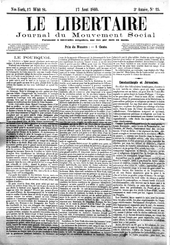
|
||
|
||
The first anarchist journal to use the term *[libertarian](https://en.wikipedia.org/wiki/Libertarian "Libertarian")* was *[Le Libertaire](https://en.wikipedia.org/wiki/Le_Libertaire "Le Libertaire"), Journal du Mouvement Social*, published in New York City between 1858 and 1861 by French [libertarian communist](https://en.wikipedia.org/wiki/Libertarian_communist "Libertarian communist") [Joseph Déjacque](https://en.wikipedia.org/wiki/Joseph_D%C3%A9jacque "Joseph Déjacque"),[^theanarchistlibrary-265] the first recorded person to describe himself as *libertarian.*[^dejacque-266]
|
||
|
||
Libertarian socialism, sometimes called [left-libertarianism](https://en.wikipedia.org/wiki/Left-libertarianism "Left-libertarianism"),[^267][^268] [social anarchism](https://en.wikipedia.org/wiki/Social_anarchism "Social anarchism")[^ostergaard_1991._p._21-269][^noam_chomsky_2004,_p._739-270] and [socialist libertarianism](https://en.wikipedia.org/wiki/Socialist_libertarianism "Socialist libertarianism"),[^271] is an [anti-authoritarian](https://en.wikipedia.org/wiki/Anti-authoritarian "Anti-authoritarian"), [anti-statist](https://en.wikipedia.org/wiki/Anti-statist "Anti-statist") and [libertarian](https://en.wikipedia.org/wiki/Libertarian "Libertarian")[^272] tradition within socialism that rejects centralised state ownership and control[^273] including criticism of [wage labour](https://en.wikipedia.org/wiki/Wage_labour "Wage labour") relationships ([wage slavery](https://en.wikipedia.org/wiki/Wage_slavery "Wage slavery"))[^274] as well as the state itself.[^:0-275] It emphasises [workers' self-management](https://en.wikipedia.org/wiki/Workers%27_self-management "Workers' self-management") and [decentralised](https://en.wikipedia.org/wiki/Libertarian_socialist_decentralization "Libertarian socialist decentralization") structures of political organisation.[^:0-275][^276] Libertarian socialism asserts that a society based on freedom and equality can be achieved through abolishing authoritarian institutions that control production.[^277] Libertarian socialists generally prefer [direct democracy](https://en.wikipedia.org/wiki/Direct_democracy "Direct democracy") and [federal](https://en.wikipedia.org/wiki/Federalism#Federalism_as_the_anarchist_and_libertarian_socialist_mode_of_political_organization "Federalism") or [confederal](https://en.wikipedia.org/wiki/Confederal "Confederal") associations such as [libertarian municipalism](https://en.wikipedia.org/wiki/Libertarian_municipalism "Libertarian municipalism"), [citizens' assemblies](https://en.wikipedia.org/wiki/Citizens%27_assemblies "Citizens' assemblies"), trade unions and [workers' councils](https://en.wikipedia.org/wiki/Workers%27_council "Workers' council").[^278][^279]
|
||
|
||
Anarcho-syndicalist [Gaston Leval](https://en.wikipedia.org/wiki/Gaston_Leval "Gaston Leval") explained:
|
||
|
||
> We therefore foresee a Society in which all activities will be coordinated, a structure that has, at the same time, sufficient flexibility to permit the greatest possible autonomy for social life, or for the life of each enterprise, and enough cohesiveness to prevent all disorder. ... In a well-organised society, all of these things must be systematically accomplished by means of parallel federations, vertically united at the highest levels, constituting one vast organism in which all economic functions will be performed in solidarity with all others and that will permanently preserve the necessary cohesion".[^280]
|
||
|
||
All of this is typically done within a general call for [libertarian](https://en.wikipedia.org/wiki/Liberty "Liberty")[^281] and [voluntary](https://en.wikipedia.org/wiki/Voluntaryism "Voluntaryism") [free associations](https://en.wikipedia.org/wiki/Free_association_\(communism_and_anarchism\) "Free association (communism and anarchism)")[^282] through the identification, criticism and practical dismantling of illegitimate authority in all aspects of human life.[^auto-283][^284][^footnotemclaughlin20071-189]
|
||
|
||
As part of the larger socialist movement, it seeks to distinguish itself from Bolshevism, Leninism and Marxism–Leninism as well as social democracy.[^285] Past and present political philosophies and movements commonly described as libertarian socialist include [anarchism](https://en.wikipedia.org/wiki/Anarchism "Anarchism") ([anarcho-communism](https://en.wikipedia.org/wiki/Anarcho-communism "Anarcho-communism"), [anarcho-syndicalism](https://en.wikipedia.org/wiki/Anarcho-syndicalism "Anarcho-syndicalism"),[^286] [collectivist anarchism](https://en.wikipedia.org/wiki/Collectivist_anarchism "Collectivist anarchism"), [individualist anarchism](https://en.wikipedia.org/wiki/Individualist_anarchism "Individualist anarchism")[^287][^288][^289] and [mutualism](https://en.wikipedia.org/wiki/Mutualism_\(economic_theory\) "Mutualism (economic theory)")),[^290] [autonomism](https://en.wikipedia.org/wiki/Autonomism "Autonomism"), [Communalism](https://en.wikipedia.org/wiki/Communalism_\(Bookchin\) "Communalism (Bookchin)"), participism, [libertarian Marxism](https://en.wikipedia.org/wiki/Libertarian_Marxism "Libertarian Marxism") ([council communism](https://en.wikipedia.org/wiki/Council_communism "Council communism") and [Luxemburgism](https://en.wikipedia.org/wiki/Luxemburgism "Luxemburgism")),[^291][^graham-2005-292] [revolutionary syndicalism](https://en.wikipedia.org/wiki/Revolutionary_syndicalism "Revolutionary syndicalism") and [utopian socialism](https://en.wikipedia.org/wiki/Utopian_socialism "Utopian socialism") ([Fourierism](https://en.wikipedia.org/wiki/Fourierism "Fourierism")).[^293]
|
||
|
||
[Christian socialism](https://en.wikipedia.org/wiki/Christian_socialism "Christian socialism") is a broad concept involving an intertwining of Christian religion with socialism.[^294]
|
||
|
||

|
||
|
||
Arabic letters "Lam" and "Alif" reading "Lā" (Arabic for "No!") are a symbol of Islamic Socialism in [Turkey](https://en.wikipedia.org/wiki/Turkey "Turkey").
|
||
|
||
[Islamic socialism](https://en.wikipedia.org/wiki/Islamic_socialism "Islamic socialism") is a more [spiritual](https://en.wikipedia.org/wiki/Spirituality "Spirituality") form of socialism. Muslim socialists believe that the teachings of the [Quran](https://en.wikipedia.org/wiki/Quran "Quran") and [Muhammad](https://en.wikipedia.org/wiki/Muhammad "Muhammad") are not only compatible with, but actively promoting the principles of [equality](https://en.wikipedia.org/wiki/Social_equality "Social equality") and [public ownership](https://en.wikipedia.org/wiki/Public_ownership "Public ownership"), drawing inspiration from the early [Medina welfare state](https://en.wikipedia.org/wiki/Muhammad_in_Medina "Muhammad in Medina") he established. Muslim socialists are more conservative than their Western contemporaries and find their roots in [anti-imperialism](https://en.wikipedia.org/wiki/Anti-imperialism "Anti-imperialism"), [anti-colonialism](https://en.wikipedia.org/wiki/Anti-colonialism "Anti-colonialism")[^reid_1974-295][^paracha-296] and sometimes, if in an Arab speaking country, [Arab nationalism](https://en.wikipedia.org/wiki/Arab_nationalism "Arab nationalism"). Islamic socialists believe in deriving legitimacy from political [mandate](https://en.wikipedia.org/wiki/Mandate_\(politics\) "Mandate (politics)") as opposed to religious texts.
|
||
|
||
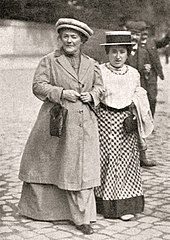
|
||
|
||
Socialist feminist [Clara Zetkin](https://en.wikipedia.org/wiki/Clara_Zetkin "Clara Zetkin") and Rosa Luxemburg in 1910
|
||
|
||
Socialist feminism is a branch of [feminism](https://en.wikipedia.org/wiki/Feminism "Feminism") that argues that [liberation](https://en.wikipedia.org/wiki/Women%27s_liberation "Women's liberation") can only be achieved by working to end both economic and [cultural](https://en.wikipedia.org/wiki/Cultural "Cultural") sources of women's [oppression](https://en.wikipedia.org/wiki/Oppression "Oppression").[^297] [Marxist feminism](https://en.wikipedia.org/wiki/Marxist_feminism "Marxist feminism")'s foundation was laid by Engels in *[The Origin of the Family, Private Property, and the State](https://en.wikipedia.org/wiki/The_Origin_of_the_Family,_Private_Property,_and_the_State "The Origin of the Family, Private Property, and the State")* (1884). [August Bebel](https://en.wikipedia.org/wiki/August_Bebel "August Bebel")'s *Woman under Socialism* (1879), is the "single work dealing with sexuality most widely read by rank-and-file members of the [Social Democratic Party of Germany](https://en.wikipedia.org/wiki/Social_Democratic_Party_of_Germany "Social Democratic Party of Germany") (SPD)".[^298] In the late 19th and early 20th centuries, both [Clara Zetkin](https://en.wikipedia.org/wiki/Clara_Zetkin "Clara Zetkin") and [Eleanor Marx](https://en.wikipedia.org/wiki/Eleanor_Marx "Eleanor Marx") were against the [demonisation](https://en.wikipedia.org/wiki/Demonisation "Demonisation") of men and supported a [proletariat](https://en.wikipedia.org/wiki/Proletariat "Proletariat") revolution that would overcome as many male-female inequalities as possible.[^stokes-299] As their movement already had the most radical demands in women's equality, most Marxist leaders, including Clara Zetkin[^300][^301] and [Alexandra Kollontai](https://en.wikipedia.org/wiki/Alexandra_Kollontai "Alexandra Kollontai"),[^302][^303] counterposed Marxism against [liberal feminism](https://en.wikipedia.org/wiki/Liberal_feminism "Liberal feminism") rather than trying to combine them. Anarcha-feminism began with late 19th- and early 20th-century authors and theorists such as anarchist feminists Goldman and [Voltairine de Cleyre](https://en.wikipedia.org/wiki/Voltairine_de_Cleyre "Voltairine de Cleyre").[^304] In the [Spanish Civil War](https://en.wikipedia.org/wiki/Spanish_Civil_War "Spanish Civil War"), an anarcha-feminist group, *[Mujeres Libres](https://en.wikipedia.org/wiki/Mujeres_Libres "Mujeres Libres")* ("Free Women") linked to the *[Federación Anarquista Ibérica](https://en.wikipedia.org/wiki/Federaci%C3%B3n_Anarquista_Ib%C3%A9rica "Federación Anarquista Ibérica")*, organised to defend both anarchist and feminist ideas.[^305] In 1972, the [Chicago Women's Liberation Union](https://en.wikipedia.org/wiki/Chicago_Women%27s_Liberation_Union "Chicago Women's Liberation Union") published "Socialist Feminism: A Strategy for the Women's Movement", which is believed to be the first published use of the term "socialist feminism".[^cwluover-306]
|
||
|
||

|
||
|
||
[Edward Carpenter](https://en.wikipedia.org/wiki/Edward_Carpenter "Edward Carpenter"), philosopher and activist who was instrumental in the foundation of the [Fabian Society](https://en.wikipedia.org/wiki/Fabian_Society "Fabian Society") and the [Labour Party](https://en.wikipedia.org/wiki/Labour_Party_\(UK\) "Labour Party (UK)") as well as in the early [LGBTI](https://en.wikipedia.org/wiki/LGBTI "LGBTI") western movements
|
||
|
||
Many socialists were early advocates of [LGBT rights](https://en.wikipedia.org/wiki/LGBT_rights "LGBT rights"). For early socialist [Charles Fourier](https://en.wikipedia.org/wiki/Charles_Fourier "Charles Fourier"), true freedom could only occur without suppressing passions, as the suppression of passions is not only destructive to the individual, but to society as a whole. Writing before the advent of the term "homosexuality", Fourier recognised that both men and women have a wide range of sexual needs and preferences which may change throughout their lives, including same-sex sexuality and *androgénité*. He argued that all sexual expressions should be enjoyed as long as people are not abused and that "affirming one's difference" can actually enhance social integration.[^307][^308] In [Oscar Wilde](https://en.wikipedia.org/wiki/Oscar_Wilde "Oscar Wilde")'s *[The Soul of Man Under Socialism](https://en.wikipedia.org/wiki/The_Soul_of_Man_Under_Socialism "The Soul of Man Under Socialism")*, he advocates an [egalitarian](https://en.wikipedia.org/wiki/Egalitarian "Egalitarian") society where wealth is shared by all, while warning of the dangers of social systems that crush individuality.[^309] [Edward Carpenter](https://en.wikipedia.org/wiki/Edward_Carpenter "Edward Carpenter") actively campaigned for homosexual rights. His work *[The Intermediate Sex](https://en.wikipedia.org/wiki/The_Intermediate_Sex "The Intermediate Sex"): A Study of Some Transitional Types of Men and Women* was a 1908 book arguing for [gay liberation](https://en.wikipedia.org/wiki/Gay_liberation "Gay liberation").[^310] who was an influential personality in the foundation of the [Fabian Society](https://en.wikipedia.org/wiki/Fabian_Society "Fabian Society") and the [Labour Party](https://en.wikipedia.org/wiki/Labour_Party_\(UK\) "Labour Party (UK)"). After the [Russian Revolution](https://en.wikipedia.org/wiki/Russian_Revolution "Russian Revolution") under the leadership of Lenin and Trotsky, the Soviet Union abolished previous laws against homosexuality.[^311] [Harry Hay](https://en.wikipedia.org/wiki/Harry_Hay "Harry Hay") was an early leader in the American LGBT rights movement as well as a member of the [Communist Party USA](https://en.wikipedia.org/wiki/Communist_Party_USA "Communist Party USA"). He is known for his involvement in the founding of gay organisations, including the [Mattachine Society](https://en.wikipedia.org/wiki/Mattachine_Society "Mattachine Society"), the first sustained gay rights group in the United States which in its early days reflected a strong Marxist influence. The *Encyclopedia of Homosexuality* reports that "\[a\]s Marxists the founders of the group believed that the injustice and oppression which they suffered stemmed from relationships deeply embedded in the structure of American society".[^312] Emerging from events such as the May 1968 insurrection in France, the [anti-Vietnam war movement](https://en.wikipedia.org/wiki/Opposition_to_the_Vietnam_War "Opposition to the Vietnam War") in the US and the [Stonewall riots](https://en.wikipedia.org/wiki/Stonewall_riots "Stonewall riots") of 1969, militant gay liberation organisations began to spring up around the world. Many sprang from left radicalism more than established homophile groups,[^313] although the [Gay Liberation Front](https://en.wikipedia.org/wiki/Gay_Liberation_Front "Gay Liberation Front") took an [anti-capitalist](https://en.wikipedia.org/wiki/Anti-capitalist "Anti-capitalist") stance and attacked the [nuclear family](https://en.wikipedia.org/wiki/Nuclear_family "Nuclear family") and traditional [gender roles](https://en.wikipedia.org/wiki/Gender_role "Gender role").[^314]
|
||
|
||
Eco-socialism is a political strain merging aspects of socialism, Marxism or libertarian socialism with green politics, ecology and [alter-globalisation](https://en.wikipedia.org/wiki/Alter-globalisation "Alter-globalisation"). Eco-socialists generally claim that the expansion of the capitalist system is the cause of social exclusion, poverty, war and environmental degradation through [globalisation](https://en.wikipedia.org/wiki/Globalisation "Globalisation") and [imperialism](https://en.wikipedia.org/wiki/Imperialism "Imperialism") under the supervision of repressive [states](https://en.wikipedia.org/wiki/State_\(polity\) "State (polity)") and transnational structures.[^manifesto-315] Contrary to the depiction of [Karl Marx](https://en.wikipedia.org/wiki/Karl_Marx "Karl Marx") by some environmentalists,[^eckersley-316] [social ecologists](https://en.wikipedia.org/wiki/Social_ecology_\(theory\) "Social ecology (theory)")[^317] and fellow socialists[^benton-318] as a [productivist](https://en.wikipedia.org/wiki/Productivism "Productivism") who favoured the domination of nature, eco-socialists revisited Marx's writings and believe that he "was a main originator of the ecological world-view".[^kovel-319] Marx discussed a "metabolic rift" between man and nature, stating that "private ownership of the globe by single individuals will appear quite absurd as private ownership of one man by another" and his observation that a society must "hand it \[the planet\] down to succeeding generations in an improved condition".[^capital3-320] English socialist [William Morris](https://en.wikipedia.org/wiki/William_Morris "William Morris") is credited with developing principles of what was later called eco-socialism.[^babylon-321] During the 1880s and 1890s, Morris promoted his ideas within the [Social Democratic Federation](https://en.wikipedia.org/wiki/Social_Democratic_Federation "Social Democratic Federation") and [Socialist League](https://en.wikipedia.org/wiki/Socialist_League_\(UK,_1885\) "Socialist League (UK, 1885)").[^glsite-322] Green anarchism blends anarchism with [environmental issues](https://en.wikipedia.org/wiki/Environmental_issues "Environmental issues"). An important early influence was [Henry David Thoreau](https://en.wikipedia.org/wiki/Henry_David_Thoreau "Henry David Thoreau") and his book *[Walden](https://en.wikipedia.org/wiki/Walden "Walden")*[^323] as well as [Élisée Reclus](https://en.wikipedia.org/wiki/%C3%89lis%C3%A9e_Reclus "Élisée Reclus").[^reclus1-324][^325]
|
||
|
||
In the late 19th century, anarcho-naturism fused anarchism and [naturist](https://en.wikipedia.org/wiki/Naturist "Naturist") philosophies within [individualist anarchist](https://en.wikipedia.org/wiki/Individualist_anarchist "Individualist anarchist") circles in France, Spain, Cuba[^raforum.info-326] and Portugal.[^spanishind-327] [Murray Bookchin](https://en.wikipedia.org/wiki/Murray_Bookchin "Murray Bookchin")'s first book *[Our Synthetic Environment](https://en.wikipedia.org/wiki/Our_Synthetic_Environment "Our Synthetic Environment")*[^328] was followed by his essay "Ecology and Revolutionary Thought" which introduced ecology as a concept in radical politics.[^329] In the 1970s, [Barry Commoner](https://en.wikipedia.org/wiki/Barry_Commoner "Barry Commoner"), claimed that capitalist technologies were chiefly responsible for [environmental degradation](https://en.wikipedia.org/wiki/Environmental_degradation "Environmental degradation") as opposed to [population pressures](https://en.wikipedia.org/wiki/Human_overpopulation "Human overpopulation").[^commoner-330] In the 1990s socialist/feminists Mary Mellor[^mellor-331] and [Ariel Salleh](https://en.wikipedia.org/wiki/Ariel_Salleh "Ariel Salleh")[^salleh-332] adopt an eco-socialist paradigm. An "environmentalism of the poor" combining ecological awareness and [social justice](https://en.wikipedia.org/wiki/Social_justice "Social justice") has also become prominent.[^guha-333] Pepper critiqued the current approach of many within [green politics](https://en.wikipedia.org/wiki/Green_politics "Green politics"), particularly [deep ecologists](https://en.wikipedia.org/wiki/Deep_ecologists "Deep ecologists").[^334]
|
||
|
||
### Syndicalism
|
||
|
||
Syndicalism operates through industrial trade unions. It rejects [state socialism](https://en.wikipedia.org/wiki/State_socialism "State socialism") and the use of establishment politics. Syndicalists reject state power in favour of strategies such as the [general strike](https://en.wikipedia.org/wiki/General_strike "General strike"). Syndicalists advocate a socialist economy based on federated unions or syndicates of workers who own and manage the means of production. Some Marxist currents advocate syndicalism, such as [De Leonism](https://en.wikipedia.org/wiki/De_Leonism "De Leonism"). Anarcho-syndicalism views syndicalism as a method for workers in [capitalist society](https://en.wikipedia.org/wiki/Capitalist_society "Capitalist society") to gain control of an economy. The [Spanish Revolution](https://en.wikipedia.org/wiki/Spanish_Revolution_of_1936 "Spanish Revolution of 1936") was largely orchestrated by the anarcho-syndicalist trade union [CNT](https://en.wikipedia.org/wiki/Confederaci%C3%B3n_Nacional_del_Trabajo "Confederación Nacional del Trabajo").[^335] The [International Workers' Association](https://en.wikipedia.org/wiki/International_Workers%27_Association_%E2%80%93_Asociaci%C3%B3n_Internacional_de_los_Trabajadores "International Workers' Association – Asociación Internacional de los Trabajadores") is an international federation of anarcho-syndicalist labour unions and initiatives.[^336]
|
||
|
||
## Public views
|
||
|
||
A multitude of polls have found significant levels of support for socialism among modern populations.[^337][^338]
|
||
|
||
A 2018 [IPSOS](https://en.wikipedia.org/wiki/Ipsos "Ipsos") poll found that 50% of the respondents globally strongly or somewhat agreed that present socialist values were of great value for societal progress. In China this was 84%, India 72%, Malaysia 62%, Turkey 62%, South Africa 57%, Brazil 57%, Russia 55%, Spain 54%, Argentina 52%, Mexico 51%, Saudi Arabia 51%, Sweden 49%, Canada 49%, Great Britain 49%, Australia 49%, Poland 48%, Chile 48%, South Korea 48%, Peru 48%, Italy 47%, Serbia 47%, Germany 45%, Belgium 44%, Romania 40%, United States 39%, France 31%, Hungary 28% and Japan 21%.[^339]
|
||
|
||
A 2021 survey conducted by the [Institute of Economic Affairs](https://en.wikipedia.org/wiki/Institute_of_Economic_Affairs "Institute of Economic Affairs") (IEA) found that 67% of young British (16–24) respondents wanted to live in a [socialist economic system](https://en.wikipedia.org/wiki/Planned_economy "Planned economy"), 72% supported the [re-nationalisation](https://en.wikipedia.org/wiki/Nationalization "Nationalization") of various industries such as [energy](https://en.wikipedia.org/wiki/Energy_industry "Energy industry"), [water](https://en.wikipedia.org/wiki/Water_industry "Water industry") along with [railways](https://en.wikipedia.org/wiki/Railways "Railways") and 75% agreed with the view that [climate change](https://en.wikipedia.org/wiki/Climate_change "Climate change") was a specifically [capitalist](https://en.wikipedia.org/wiki/Capitalist "Capitalist") problem.[^340]
|
||
|
||
A 2023 IPSOS poll found that a majority of British public favoured public ownership of [utilities](https://en.wikipedia.org/wiki/Utilities "Utilities") including water, rail and [electricity](https://en.wikipedia.org/wiki/Electricity "Electricity"). Specifically, 68% of respondents favoured the nationalisation of water services, 65% supporting the nationalisation of the railways, 63% supporting the public ownership of [power networks](https://en.wikipedia.org/wiki/Electrical_grid "Electrical grid") and 39% favouring [broadband access](https://en.wikipedia.org/wiki/Broadband_access "Broadband access") which is operated by the government. The poll also found broad levels of support among traditional Labour and Conservative voters.[^341]
|
||
|
||
The results of a 2019 [Axios](https://en.wikipedia.org/wiki/Axios_\(website\) "Axios (website)") poll found that 70% of US [millennials](https://en.wikipedia.org/wiki/Millennials "Millennials") were willing to vote for a socialist candidate and 50% of this same demographic had a somewhat or very unfavourable view of capitalism.[^342] Subsequently, another 2021 Axios poll found that 51% of 18-34 US adults had a positive view of socialism. Yet, 41% of Americans more generally had a positive view of socialism compared to 52% of those who viewing socialism more negatively.[^343]
|
||
|
||
In 2023, the [Fraser Institute](https://en.wikipedia.org/wiki/Fraser_Institute "Fraser Institute") published findings which found that 42% of Canadians viewed socialism as the ideal system compared to 43% of British respondents, 40% Australian respondents and 31% American respondents. Overall support for socialism ranged from 50% of Canadians 18-24 year olds to 28% of Canadians over 55.[^344]
|
||
|
||
## Criticism
|
||
|
||
According to [analytical Marxist](https://en.wikipedia.org/wiki/Analytical_Marxist "Analytical Marxist") sociologist [Erik Olin Wright](https://en.wikipedia.org/wiki/Erik_Olin_Wright "Erik Olin Wright"), "The Right condemned socialism as violating individual rights to private property and unleashing monstrous forms of state oppression", while "the Left saw it as opening up new vistas of social equality, genuine freedom and the development of human potentials."[^345]
|
||
|
||
Because of socialism's many varieties, most critiques have focused on a specific approach. Proponents of one approach typically criticise others. Socialism has been criticised in terms of its [models of economic organization](https://en.wikipedia.org/wiki/Socialist_economics "Socialist economics") as well as its political and social implications. Other critiques are directed at the [socialist movement](https://en.wikipedia.org/wiki/Socialist_movement "Socialist movement"), [parties](https://en.wikipedia.org/wiki/Socialist_Party "Socialist Party"), or existing [states](https://en.wikipedia.org/wiki/Socialist_state "Socialist state").
|
||
|
||
Some forms of criticism occupy theoretical grounds, such as in the [economic calculation problem](https://en.wikipedia.org/wiki/Economic_calculation_problem "Economic calculation problem") presented by proponents of the [Austrian School](https://en.wikipedia.org/wiki/Austrian_School "Austrian School") as part of the [socialist calculation debate](https://en.wikipedia.org/wiki/Socialist_calculation_debate "Socialist calculation debate"), while others support their criticism by examining historical attempts to establish socialist societies. The economic calculation problem concerns the feasibility and methods of resource allocation for a [planned socialist system](https://en.wikipedia.org/wiki/Planned_economy "Planned economy").[^346][^347][^348] Central planning is also criticized by elements of the radical left. Libertarian socialist economist [Robin Hahnel](https://en.wikipedia.org/wiki/Robin_Hahnel "Robin Hahnel") notes that even if central planning overcame its inherent inhibitions of incentives and innovation, it would nevertheless be unable to maximize economic democracy and self-management, which he believes are concepts that are more intellectually coherent, consistent and just than mainstream notions of economic freedom.[^hahnel,_robin_2002-349]
|
||
|
||
[Economic liberals](https://en.wikipedia.org/wiki/Economic_liberals "Economic liberals") and [right-libertarians](https://en.wikipedia.org/wiki/Right-libertarians "Right-libertarians") argue that [private ownership](https://en.wikipedia.org/wiki/Private_enterprise "Private enterprise") of the [means of production](https://en.wikipedia.org/wiki/Means_of_production "Means of production") and market exchange are natural entities or moral rights which are central to freedom and liberty and argue that the economic dynamics of [capitalism](https://en.wikipedia.org/wiki/Capitalism "Capitalism") are immutable and absolute. As such, they also argue that [public ownership](https://en.wikipedia.org/wiki/Public_ownership "Public ownership") of the means of production and [economic planning](https://en.wikipedia.org/wiki/Economic_planning "Economic planning") are infringements upon liberty.[^milton2-350][^bellamy,_richard_2003_60-351]
|
||
|
||
Critics of socialism have argued that in any society where everyone holds equal wealth, there can be no material incentive to work because one does not receive rewards for a work well done. They further argue that incentives increase productivity for all people and that the loss of those effects would lead to stagnation. Some critics of socialism argue that income sharing reduces individual incentives to work and therefore incomes should be individualized as much as possible.[^352]
|
||
|
||
Some philosophers have also criticized the aims of socialism, arguing that equality erodes away at individual diversities and that the establishment of an equal society would have to entail strong coercion.[^self-353]
|
||
|
||
[Milton Friedman](https://en.wikipedia.org/wiki/Milton_Friedman "Milton Friedman") argued that the absence of private economic activity would enable political leaders to grant themselves coercive powers, powers that, under a capitalist system, would instead be granted by a capitalist class, which Friedman found preferable.[^bellamy,_richard_2003_602-354]
|
||
|
||
Many commentators on the political right point to the [mass killings under communist regimes](https://en.wikipedia.org/wiki/Mass_killings_under_communist_regimes "Mass killings under communist regimes"), claiming them as an indictment of socialism.[^355][^footnoteengel-dimauro20211%e2%80%9317-356][^357] Opponents of this view, including supporters of socialism, state that these killings were aberrations caused by specific authoritarian regimes, and not caused by socialism itself, and draw comparisons to killings, famines and excess deaths under capitalism, [colonialism](https://en.wikipedia.org/wiki/Colonialism "Colonialism") and [anti-communist authoritarian governments](https://en.wikipedia.org/wiki/Anti-communist_mass_killings "Anti-communist mass killings").[^358]
|
||
|
||
## See also
|
||
|
||
- [Anarchism and socialism](https://en.wikipedia.org/wiki/Anarchism_and_socialism "Anarchism and socialism")
|
||
- [Critique of work](https://en.wikipedia.org/wiki/Critique_of_work "Critique of work")
|
||
- [List of socialist parties with national parliamentary representation](https://en.wikipedia.org/wiki/List_of_socialist_parties_with_national_parliamentary_representation "List of socialist parties with national parliamentary representation")
|
||
- [List of socialist economists](https://en.wikipedia.org/wiki/List_of_socialist_economists "List of socialist economists")
|
||
- [List of communist ideologies](https://en.wikipedia.org/wiki/List_of_communist_ideologies "List of communist ideologies")
|
||
- [List of socialist songs](https://en.wikipedia.org/wiki/List_of_socialist_songs "List of socialist songs")
|
||
- [List of socialist states](https://en.wikipedia.org/wiki/List_of_socialist_states "List of socialist states")
|
||
- [Paris Commune](https://en.wikipedia.org/wiki/Paris_Commune "Paris Commune")
|
||
- [Socialist democracy](https://en.wikipedia.org/wiki/Socialist_democracy "Socialist democracy")
|
||
- [Scientific socialism](https://en.wikipedia.org/wiki/Scientific_socialism "Scientific socialism")
|
||
- [Socialism by country](https://en.wikipedia.org/wiki/Category:Socialism_by_country "Category:Socialism by country") (category)
|
||
- [Spanish Revolution of 1936](https://en.wikipedia.org/wiki/Spanish_Revolution_of_1936 "Spanish Revolution of 1936")
|
||
- [Marxian critique of political economy](https://en.wikipedia.org/wiki/Critique_of_political_economy#Marx "Critique of political economy")
|
||
- [Types of socialism](https://en.wikipedia.org/wiki/Types_of_socialism "Types of socialism")
|
||
- [Zenitism](https://en.wikipedia.org/wiki/Zenitism "Zenitism")
|
||
|
||
## References
|
||
|
||
[^1]: [Busky (2000)](https://en.wikipedia.org/wiki/#CITEREFBusky2000), p. 2: "Socialism may be defined as movements for social ownership and control of the economy. It is this idea that is the common element found in the many forms of socialism."
|
||
|
||
[^2]: - [Busky (2000)](https://en.wikipedia.org/wiki/#CITEREFBusky2000), p. 2: "Socialism may be defined as movements for social ownership and control of the economy. It is this idea that is the common element found in the many forms of socialism."
|
||
- [Arnold (1994)](https://en.wikipedia.org/wiki/#CITEREFArnold1994), pp. [7](https://archive.org/details/philosophyeconom00arno/page/n21)–8: "What else does a socialist economic system involve? Those who favor socialism generally speak of social ownership, social control, or socialization of the means of production as the distinctive positive feature of a socialist economic system."
|
||
- [Horvat (2000)](https://en.wikipedia.org/wiki/#CITEREFHorvat2000), pp. 1515–1516: "Just as private ownership defines capitalism, social ownership defines socialism. The essential characteristic of socialism in theory is that it destroys social hierarchies, and therefore leads to a politically and economically egalitarian society. Two closely related consequences follow. First, every individual is entitled to an equal ownership share that earns an aliquot part of the total social dividend ... Second, in order to eliminate social hierarchy in the workplace, enterprises are run by those employed, and not by the representatives of private or state capital. Thus, the well-known historical tendency of the divorce between ownership and management is brought to an end. The society — i.e. every individual equally — owns capital and those who work are entitled to manage their own economic affairs."
|
||
- [Rosser & Barkley (2003)](https://en.wikipedia.org/wiki/#CITEREFRosserBarkley2003), p. 53: "Socialism is an economic system characterised by state or collective ownership of the means of production, land, and capital.";
|
||
- [Badie, Berg-Schlosser & Morlino (2011)](https://en.wikipedia.org/wiki/#CITEREFBadieBerg-SchlosserMorlino2011), p. 2456: "Socialist systems are those regimes based on the economic and political theory of socialism, which advocates public ownership and cooperative management of the means of production and allocation of resources."
|
||
- [Zimbalist, Sherman & Brown (1988)](https://en.wikipedia.org/wiki/#CITEREFZimbalistShermanBrown1988), p. 7: "Pure socialism is defined as a system wherein all of the means of production are owned and run by the government and/or cooperative, nonprofit groups."
|
||
- [Brus (2015)](https://en.wikipedia.org/wiki/#CITEREFBrus2015), p. 87: "This alteration in the relationship between economy and politics is evident in the very definition of a socialist economic system. The basic characteristic of such a system is generally reckoned to be the predominance of the social ownership of the means of production."
|
||
- Hastings, Adrian; Mason, Alistair; Pyper, Hugh (2000). [*The Oxford Companion to Christian Thought*](https://archive.org/details/oxfordcompaniont00hast/page/677). [Oxford University Press](https://en.wikipedia.org/wiki/Oxford_University_Press "Oxford University Press"). p. [677](https://archive.org/details/oxfordcompaniont00hast/page/677). [ISBN](https://en.wikipedia.org/wiki/ISBN_\(identifier\) "ISBN (identifier)") [978-0198600244](https://en.wikipedia.org/wiki/Special:BookSources/978-0198600244 "Special:BookSources/978-0198600244"). Socialists have always recognized that there are many possible forms of social ownership of which co-operative ownership is one ... Nevertheless, socialism has throughout its history been inseparable from some form of common ownership. By its very nature it involves the abolition of private ownership of capital; bringing the means of production, distribution, and exchange into public ownership and control is central to its philosophy. It is difficult to see how it can survive, in theory or practice, without this central idea.
|
||
|
||
[^footnotehorvat20001515–1516-3]: [Horvat (2000)](https://en.wikipedia.org/wiki/#CITEREFHorvat2000), pp. 1515–1516.
|
||
|
||
[^footnotearnold19947–8-4]: [Arnold (1994)](https://en.wikipedia.org/wiki/#CITEREFArnold1994), pp. 7–8.
|
||
|
||
[^oxfordcomp-5]: Hastings, Adrian; Mason, Alistair; Pyper, Hugh (2000). [*The Oxford Companion to Christian Thought*](https://archive.org/details/oxfordcompaniont00hast/page/677). [Oxford University Press](https://en.wikipedia.org/wiki/Oxford_University_Press "Oxford University Press"). p. [677](https://archive.org/details/oxfordcompaniont00hast/page/677). [ISBN](https://en.wikipedia.org/wiki/ISBN_\(identifier\) "ISBN (identifier)") [978-0198600244](https://en.wikipedia.org/wiki/Special:BookSources/978-0198600244 "Special:BookSources/978-0198600244"). Socialists have always recognized that there are many possible forms of social ownership of which co-operative ownership is one ... Nevertheless, socialism has throughout its history been inseparable from some form of common ownership. By its very nature it involves the abolition of private ownership of capital; bringing the means of production, distribution, and exchange into public ownership and control is central to its philosophy. It is difficult to see how it can survive, in theory or practice, without this central idea.
|
||
|
||
[^7]: Sherman, Howard J.; Zimbalist, Andrew (1988). [*Comparing Economic Systems: A Political-Economic Approach*](https://archive.org/details/comparingeconomi0000zimb_q8i6/page/7). Harcourt College Pub. p. [7](https://archive.org/details/comparingeconomi0000zimb_q8i6/page/7). [ISBN](https://en.wikipedia.org/wiki/ISBN_\(identifier\) "ISBN (identifier)") [978-0-15-512403-5](https://en.wikipedia.org/wiki/Special:BookSources/978-0-15-512403-5 "Special:BookSources/978-0-15-512403-5"). Pure socialism is defined as a system wherein all of the means of production are owned and run by the government and/or cooperative, nonprofit groups.
|
||
|
||
[^8]: Rosser, Mariana V.; Rosser, J. Barkley (2003). [*Comparative Economics in a Transforming World Economy*](https://archive.org/details/comparativeecono00jrjb). [MIT Press](https://en.wikipedia.org/wiki/MIT_Press "MIT Press"). p. [53](https://archive.org/details/comparativeecono00jrjb/page/n64). [ISBN](https://en.wikipedia.org/wiki/ISBN_\(identifier\) "ISBN (identifier)") [978-0-262-18234-8](https://en.wikipedia.org/wiki/Special:BookSources/978-0-262-18234-8 "Special:BookSources/978-0-262-18234-8"). Socialism is an economic system characterised by state or collective ownership of the means of production, land, and capital.
|
||
|
||
[^9]: [Badie, Berg-Schlosser & Morlino (2011)](https://en.wikipedia.org/wiki/#CITEREFBadieBerg-SchlosserMorlino2011), p. 2456: "Socialist systems are those regimes based on the economic and political theory of socialism, which advocates public ownership and cooperative management of the means of production and allocation of resources."
|
||
|
||
[^horvat_2000-10]: [Horvat (2000)](https://en.wikipedia.org/wiki/#CITEREFHorvat2000), pp. [1515–1516](https://books.google.com/books?id=ip_IAgAAQBAJ&pg=PA1516): "Just as private ownership defines capitalism, social ownership defines socialism. The essential characteristic of socialism in theory is that it destroys social hierarchies, and therefore leads to a politically and economically egalitarian society. Two closely related consequences follow. First, every individual is entitled to an equal ownership share that earns an aliquot part of the total social dividend ... Second, in order to eliminate social hierarchy in the workplace, enterprises are run by those employed, and not by the representatives of private or state capital. Thus, the well-known historical tendency of the divorce between ownership and management is brought to an end. The society — i.e. every individual equally — owns capital and those who work are entitled to manage their own economic affairs."
|
||
|
||
[^11]: O'Hara, Phillip (2003). *Encyclopedia of Political Economy*. Vol. 2. [Routledge](https://en.wikipedia.org/wiki/Routledge "Routledge"). p. 71. [ISBN](https://en.wikipedia.org/wiki/ISBN_\(identifier\) "ISBN (identifier)") [978-0415241878](https://en.wikipedia.org/wiki/Special:BookSources/978-0415241878 "Special:BookSources/978-0415241878"). In order of increasing decentralisation (at least) three forms of socialised ownership can be distinguished: state-owned firms, employee-owned (or socially) owned firms, and citizen ownership of equity.
|
||
|
||
[^12]: ["Left"](https://www.britannica.com/topic/left). *[Encyclopædia Britannica](https://en.wikipedia.org/wiki/Encyclop%C3%A6dia_Britannica "Encyclopædia Britannica")*. 15 April 2009. Retrieved 22 May 2022. Socialism is the standard leftist ideology in most countries of the world; ... .
|
||
|
||
[^nove-13]: [Nove, Alec](https://en.wikipedia.org/wiki/Alec_Nove "Alec Nove") (2008). ["Socialism"](http://www.dictionaryofeconomics.com/article?id=pde2008_S000173). *New Palgrave Dictionary of Economics* (Second ed.). [Palgrave Macmillan](https://en.wikipedia.org/wiki/Palgrave_Macmillan "Palgrave Macmillan"). A society may be defined as socialist if the major part of the means of production of goods and services is in some sense socially owned and operated, by state, socialised or cooperative enterprises. The practical issues of socialism comprise the relationships between management and workforce within the enterprise, the interrelationships between production units (plan versus markets), and, if the state owns and operates any part of the economy, who controls it and how.
|
||
|
||
[^14]: Docherty, James C.; Lamb, Peter, eds. (2006). *Historical Dictionary of Socialism*. Historical Dictionaries of Religions, Philosophies, and Movements. Vol. 73 (2nd ed.). Lanham, Maryland: [Scarecrow Press](https://en.wikipedia.org/wiki/Scarecrow_Press "Scarecrow Press"). pp. 1–3\. [ISBN](https://en.wikipedia.org/wiki/ISBN_\(identifier\) "ISBN (identifier)") [978-0810855601](https://en.wikipedia.org/wiki/Special:BookSources/978-0810855601 "Special:BookSources/978-0810855601").
|
||
|
||
[^kolb-15]: Kolb, Robert (2007). *Encyclopedia of Business Ethics and Society* (1st ed.). [Sage Publications](https://en.wikipedia.org/wiki/Sage_Publications "Sage Publications"), Inc. p. 1345. [ISBN](https://en.wikipedia.org/wiki/ISBN_\(identifier\) "ISBN (identifier)") [978-1412916523](https://en.wikipedia.org/wiki/Special:BookSources/978-1412916523 "Special:BookSources/978-1412916523"). There are many forms of socialism, all of which eliminate private ownership of capital and replace it with collective ownership. These many forms, all focused on advancing distributive justice for long-term social welfare, can be divided into two broad types of socialism: nonmarket and market.
|
||
|
||
[^16]: [Bockman (2011)](https://en.wikipedia.org/wiki/#CITEREFBockman2011), p. 20: "socialism would function without capitalist economic categories—such as money, prices, interest, profits and rent—and thus would function according to laws other than those described by current economic science. While some socialists recognised the need for money and prices at least during the transition from capitalism to socialism, socialists more commonly believed that the socialist economy would soon administratively mobilise the economy in physical units without the use of prices or money."; [Steele (1999)](https://en.wikipedia.org/wiki/#CITEREFSteele1999), pp. 175–177: "Especially before the 1930s, many socialists and anti-socialists implicitly accepted some form of the following for the incompatibility of state-owned industry and factor markets. A market transaction is an exchange of property titles between two independent transactors. Thus internal market exchanges cease when all of industry is brought into the ownership of a single entity, whether the state or some other organization, ... the discussion applies equally to any form of social or community ownership, where the owning entity is conceived as a single organization or administration."; [Arneson (1992)](https://en.wikipedia.org/wiki/#CITEREFArneson1992): "Marxian socialism is often identified with the call to organize economic activity on a nonmarket basis."; [Schweickart et al. (1998)](https://en.wikipedia.org/wiki/#CITEREFSchweickartLawlerTicktinOllman1998), pp. 61–63: "More fundamentally, a socialist society must be one in which the economy is run on the principle of the direct satisfaction of human needs. ... Exchange-value, prices and so money are goals in themselves in a capitalist society or in any market. There is no necessary connection between the accumulation of capital or sums of money and human welfare. Under conditions of backwardness, the spur of money and the accumulation of wealth has led to a massive growth in industry and technology. ... It seems an odd argument to say that a capitalist will only be efficient in producing use-value of a good quality when trying to make more money than the next capitalist. It would seem easier to rely on the planning of use-values in a rational way, which because there is no duplication, would be produced more cheaply and be of a higher quality."
|
||
|
||
[^17]: [Nove (1991)](https://en.wikipedia.org/wiki/#CITEREFNove1991), p. 13: "Under socialism, by definition, it (private property and factor markets) would be eliminated. There would then be something like 'scientific management', 'the science of socially organized production', but it would not be economics."; [Kotz (2006)](https://en.wikipedia.org/wiki/#CITEREFKotz2006): "This understanding of socialism was held not just by revolutionary Marxist socialists but also by evolutionary socialists, Christian socialists, and even anarchists. At that time, there was also wide agreement about the basic institutions of the future socialist system: public ownership instead of private ownership of the means of production, economic planning instead of market forces, production for use instead of for profit."; [Weisskopf (1992)](https://en.wikipedia.org/wiki/#CITEREFWeisskopf1992): "Socialism has historically been committed to the improvement of people's material standards of living. Indeed, in earlier days many socialists saw the promotion of improving material living standards as the primary basis for socialism's claim to superiority over capitalism, for socialism was to overcome the irrationality and inefficiency seen as endemic to a capitalist system of economic organization."; [Prychitko (2002)](https://en.wikipedia.org/wiki/#CITEREFPrychitko2002), p. 12: "Socialism is a system based upon de facto public or social ownership of the means of production, the abolition of a hierarchical division of labor in the enterprise, a consciously organized social division of labor. Under socialism, money, competitive pricing, and profit-loss accounting would be destroyed."
|
||
|
||
[^19]: O'Hara, Phillip (2000). *Encyclopedia of Political Economy*. Vol. 2. [Routledge](https://en.wikipedia.org/wiki/Routledge "Routledge"). p. 71. [ISBN](https://en.wikipedia.org/wiki/ISBN_\(identifier\) "ISBN (identifier)") [978-0415241878](https://en.wikipedia.org/wiki/Special:BookSources/978-0415241878 "Special:BookSources/978-0415241878"). Market socialism is the general designation for a number of models of economic systems. On the one hand, the market mechanism is utilized to distribute economic output, to organize production and to allocate factor inputs. On the other hand, the economic surplus accrues to society at large rather than to a class of private (capitalist) owners, through some form of collective, public or social ownership of capital.
|
||
|
||
[^20]: Pierson, Christopher (1995). *Socialism After Communism: The New Market Socialism*. [Pennsylvania State University Press](https://en.wikipedia.org/wiki/Pennsylvania_State_University_Press "Pennsylvania State University Press"). p. 96. [ISBN](https://en.wikipedia.org/wiki/ISBN_\(identifier\) "ISBN (identifier)") [978-0271-014784](https://en.wikipedia.org/wiki/Special:BookSources/978-0271-014784 "Special:BookSources/978-0271-014784"). At the heart of the market socialist model is the abolition of the large-scale private ownership of capital and its replacement by some form of 'social ownership'. Even the most conservative accounts of market socialism insist that this abolition of large-scale holdings of private capital is essential. This requirement is fully consistent with the market socialists' general claim that the vices of market capitalism lie not with the institutions of the market but with (the consequences of) the private ownership of capital ... .
|
||
|
||
[^21]: [Newman (2005)](https://en.wikipedia.org/wiki/#CITEREFNewman2005), p. 2: "In fact, socialism has been both centralist and local; organized from above and built from below; visionary and pragmatic; revolutionary and reformist; anti-state and statist; internationalist and nationalist; harnessed to political parties and shunning them; an outgrowth of trade unionism and independent of it; a feature of rich industrialized countries and poor peasant-based communities."
|
||
|
||
[^22]: [Ely, Richard T.](https://en.wikipedia.org/wiki/Richard_T._Ely "Richard T. Ely") (1883). *French and German Socialism in Modern Times*. New York: Harper and Brothers. pp. 204–205\. Social democrats forms the extreme wing of the socialists ... inclined to lay so much stress on equality of enjoyment, regardless of the value of one's labor, that they might, perhaps, more properly be called communists. ... They have two distinguishing characteristics. The vast majority of them are laborers, and, as a rule, they expect the violent overthrow of existing institutions by revolution to precede the introduction of the socialistic state. I would not, by any means, say that they are all revolutionists, but the most of them undoubtedly are. ... The most general demands of the social democrats are the following: The state should exist exclusively for the laborers; land and capital must become collective property, and production be carried on unitedly. Private competition, in the ordinary sense of the term, is to cease.
|
||
|
||
[^23]: Merkel, Wolfgang; Petring, Alexander; Henkes, Christian; Egle, Christoph (2008). *Social Democracy in Power: The Capacity to Reform*. Routledge Research in Comparative Politics. London: [Routledge](https://en.wikipedia.org/wiki/Routledge "Routledge"). [ISBN](https://en.wikipedia.org/wiki/ISBN_\(identifier\) "ISBN (identifier)") [978-0415438209](https://en.wikipedia.org/wiki/Special:BookSources/978-0415438209 "Special:BookSources/978-0415438209").
|
||
|
||
[^24]: Heywood, Andrew (2012). *Political Ideologies: An Introduction* (5th ed.). Basingstoke, England: [Palgrave Macmillan](https://en.wikipedia.org/wiki/Palgrave_Macmillan "Palgrave Macmillan"). p. 128. [ISBN](https://en.wikipedia.org/wiki/ISBN_\(identifier\) "ISBN (identifier)") [978-0230367258](https://en.wikipedia.org/wiki/Special:BookSources/978-0230367258 "Special:BookSources/978-0230367258"). Social democracy is an ideological stance that supports a broad balance between market capitalism, on the one hand, and state intervention, on the other hand. Being based on a compromise between the market and the state, social democracy lacks a systematic underlying theory and is, arguably, inherently vague. It is nevertheless associated with the following views: (1) capitalism is the only reliable means of generating wealth, but it is a morally defective means of distributing wealth because of its tendency towards poverty and inequality; (2) the defects of the capitalist system can be rectified through economic and social intervention, the state being the custodian of the public interest ... .
|
||
|
||
[^25]: [Roemer (1994)](https://en.wikipedia.org/wiki/#CITEREFRoemer1994), pp. 25–27: "The long term and the short term."; [Berman (1998)](https://en.wikipedia.org/wiki/#CITEREFBerman1998), p. 57: "Over the long term, however, democratizing Sweden's political system was seen to be important not merely as a means but also as an end in itself. Achieving democracy was crucial not only because it would increase the power of the SAP in the Swedish political system but also because it was the form socialism would take once it arrived. Political, economic, and social equality went hand in hand, according to the SAP, and were all equally important characteristics of the future socialist society."; [Busky (2000)](https://en.wikipedia.org/wiki/#CITEREFBusky2000), pp. 7–8; [Bailey (2009)](https://en.wikipedia.org/wiki/#CITEREFBailey2009), p. 77: "... Giorgio Napolitano launched a medium-term programme, 'which tended to justify the governmental deflationary policies, and asked for the understanding of the workers, since any economic recovery would be linked with the *long-term* goal of an advance towards democratic socialism'"; [Lamb (2015)](https://en.wikipedia.org/wiki/#CITEREFLamb2015), p. 415
|
||
|
||
[^26]: [Badie, Berg-Schlosser & Morlino (2011)](https://en.wikipedia.org/wiki/#CITEREFBadieBerg-SchlosserMorlino2011), p. 2423: "Social democracy refers to a political tendency resting on three fundamental features: (1) democracy (e.g., equal rights to vote and form parties), (2) an economy partly regulated by the state (e.g., through Keynesianism), and (3) a welfare state offering social support to those in need (e.g., equal rights to education, health service, employment and pensions)."
|
||
|
||
[^27]: Smith, J. W. (2005). *Economic Democracy: The Political Struggle for the 21st century*. Radford: [Institute for Economic Democracy Press](https://en.wikipedia.org/w/index.php?title=Institute_for_Economic_Democracy_Press&action=edit&redlink=1 "Institute for Economic Democracy Press (page does not exist)"). [ISBN](https://en.wikipedia.org/wiki/ISBN_\(identifier\) "ISBN (identifier)") [1933567015](https://en.wikipedia.org/wiki/Special:BookSources/1933567015 "Special:BookSources/1933567015").
|
||
|
||
[^footnotelambdocherty20061-28]: [Lamb & Docherty (2006)](https://en.wikipedia.org/wiki/#CITEREFLambDocherty2006), p. 1.
|
||
|
||
[^29]: Gasper, Phillip (2005). *The Communist Manifesto: A Road Map to History's Most Important Political Document*. [Haymarket Books](https://en.wikipedia.org/wiki/Haymarket_Books "Haymarket Books"). p. 24. [ISBN](https://en.wikipedia.org/wiki/ISBN_\(identifier\) "ISBN (identifier)") [978-1931859257](https://en.wikipedia.org/wiki/Special:BookSources/978-1931859257 "Special:BookSources/978-1931859257"). As the nineteenth century progressed, 'socialist' came to signify not only concern with the social question, but opposition to capitalism and support for some form of social ownership.
|
||
|
||
[^anthony_giddens_1994,_p._71-30]: [Giddens, Anthony](https://en.wikipedia.org/wiki/Anthony_Giddens "Anthony Giddens") (1998) \[1994\]. *Beyond Left and Right: The Future of Radical Politics* (1998 ed.). Cambridge, England, UK: [Polity Press](https://en.wikipedia.org/wiki/Polity_Press "Polity Press"). p. 71.
|
||
|
||
[^31]: [Newman (2005)](https://en.wikipedia.org/wiki/#CITEREFNewman2005), p. 5: "Chapter 1 looks at the foundations of the doctrine by examining the contribution made by various traditions of socialism in the period between the early 19th century and the aftermath of the First World War. The two forms that emerged as dominant by the early 1920s were social democracy and communism."
|
||
|
||
[^32]: Kurian, George Thomas, ed. (2011). *The Encyclopedia of Political Science*. Washington, D.C.: [CQ Press](https://en.wikipedia.org/wiki/CQ_Press "CQ Press"). p. 1554.
|
||
|
||
[^33]: Sheldon, Garrett Ward (2001). *Encyclopedia of Political Thought*. [Facts on File. Inc.](https://en.wikipedia.org/wiki/Infobase_Publishing "Infobase Publishing") p. 280.
|
||
|
||
[^34]: [Barrett (1978)](https://en.wikipedia.org/wiki/#CITEREFBarrett1978): "If we were to extend the definition of socialism to include [Labor](https://en.wikipedia.org/wiki/Labour_Party_\(UK\) "Labour Party (UK)") Britain or socialist Sweden, there would be no difficulty in refuting the connection between capitalism and democracy."; [Heilbroner (1991)](https://en.wikipedia.org/wiki/#CITEREFHeilbroner1991), pp. 96–110; [Kendall (2011)](https://en.wikipedia.org/wiki/#CITEREFKendall2011), pp. 125–127: "Sweden, Great Britain, and France have mixed economies, sometimes referred to as democratic socialism — an economic and political system that combines private ownership of some of the means of production, governmental distribution of some essential goods and services, and free elections. For example, government ownership in Sweden is limited primarily to railroads, mineral resources, a public bank, and liquor and tobacco operations."; [Li (2015)](https://en.wikipedia.org/wiki/#CITEREFLi2015), pp. 60–69: "The scholars in camp of democratic socialism believe that China should draw on the Sweden experience, which is suitable not only for the West but also for China. In the post-Mao China, the Chinese intellectuals are confronted with a variety of models. The liberals favor the American model and share the view that the Soviet model has become archaic and should be totally abandoned. Meanwhile, democratic socialism in Sweden provided an alternative model. Its sustained economic development and extensive welfare programs fascinated many. Numerous scholars within the democratic socialist camp argue that China should model itself politically and economically on Sweden, which is viewed as more genuinely socialist than China. There is a growing consensus among them that in the Nordic countries the welfare state has been extraordinarily successful in eliminating poverty."
|
||
|
||
[^35]: [Sanandaji (2021)](https://en.wikipedia.org/wiki/#CITEREFSanandaji2021): "Nordic nations—and especially Sweden—did embrace socialism between around 1970 and 1990. During the past 30 years, however, both conservative and social democratic-led governments have moved toward the center."
|
||
|
||
[^36]: [Sanandaji (2021)](https://en.wikipedia.org/wiki/#CITEREFSanandaji2021); [Caulcutt (2022)](https://en.wikipedia.org/wiki/#CITEREFCaulcutt2022); [Krause-Jackson (2019)](https://en.wikipedia.org/wiki/#CITEREFKrause-Jackson2019); [Best et al. (2011)](https://en.wikipedia.org/wiki/#CITEREFBestKahnNocella_IIMcLaren2011), p. xviii
|
||
|
||
[^:1-37]: ["socialism"](http://www.britannica.com/EBchecked/topic/551569/socialism). *[Encyclopedia Britannica](https://en.wikipedia.org/wiki/Encyclopedia_Britannica "Encyclopedia Britannica")*. 29 May 2023.
|
||
|
||
[^:3-38]: Judis, John B. (20 November 2019). ["The Socialist Revival"](https://americanaffairsjournal.org/2019/11/the-socialist-revival/). *American Affairs Journal*. Retrieved 26 June 2023.
|
||
|
||
[^39]: Cassidy, John (18 June 2019). ["Why Socialism Is Back"](https://www.newyorker.com/news/our-columnists/why-socialism-is-back). *The New Yorker*. [ISSN](https://en.wikipedia.org/wiki/ISSN_\(identifier\) "ISSN (identifier)") [0028-792X](https://search.worldcat.org/issn/0028-792X). Retrieved 26 June 2023.
|
||
|
||
[^40]: Vincent, Andrew (2010). *Modern Political Ideologies*. [Wiley-Blackwell](https://en.wikipedia.org/wiki/Wiley-Blackwell "Wiley-Blackwell"). p. 83. [ISBN](https://en.wikipedia.org/wiki/ISBN_\(identifier\) "ISBN (identifier)") [978-1405154956](https://en.wikipedia.org/wiki/Special:BookSources/978-1405154956 "Special:BookSources/978-1405154956").
|
||
|
||
[^41]: ["socialism (n.)"](https://www.etymonline.com/word/socialism). *etymonline*. [Online Etymology Dictionary](https://en.wikipedia.org/wiki/Online_Etymology_Dictionary "Online Etymology Dictionary"). Retrieved 3 May 2021.
|
||
|
||
[^kołakowski2005-42]: [Kołakowski, Leszek](https://en.wikipedia.org/wiki/Leszek_Ko%C5%82akowski "Leszek Kołakowski") (2005). [*Main Currents of Marxism: The Founders, the Golden Age, the Breakdown*](https://books.google.com/books?id=qUCxpznbkaoC). [W.W. Norton & Company](https://en.wikipedia.org/wiki/W.W._Norton_%26_Company "W.W. Norton & Company"). p. 151. [ISBN](https://en.wikipedia.org/wiki/ISBN_\(identifier\) "ISBN (identifier)") [978-0393-060546](https://en.wikipedia.org/wiki/Special:BookSources/978-0393-060546 "Special:BookSources/978-0393-060546") – via [Google Books](https://en.wikipedia.org/wiki/Google_Books "Google Books").
|
||
|
||
[^marvin_perry_1600,_p._540-43]: Perry, Marvin; Chase, Myrna; Jacob, Margaret; Jacob, James R. (2009). *Western Civilization: Ideas, Politics, and Society – From 1600*. Vol. 2 (Ninth ed.). Boston: [Houghton Mifflin Harcourt](https://en.wikipedia.org/wiki/Houghton_Mifflin_Harcourt "Houghton Mifflin Harcourt") Publishing Company. p. 540. [ISBN](https://en.wikipedia.org/wiki/ISBN_\(identifier\) "ISBN (identifier)") [978-1305445499](https://en.wikipedia.org/wiki/Special:BookSources/978-1305445499 "Special:BookSources/978-1305445499"). [OCLC](https://en.wikipedia.org/wiki/OCLC_\(identifier\) "OCLC (identifier)") [1289795802](https://search.worldcat.org/oclc/1289795802).
|
||
|
||
[^44]: Gregory, Paul; Stuart, Robert (2013). *The Global Economy and its Economic Systems*. [South-Western College Publishing](https://en.wikipedia.org/w/index.php?title=South-Western_College_Publishing&action=edit&redlink=1 "South-Western College Publishing (page does not exist)"). p. 159. [ISBN](https://en.wikipedia.org/wiki/ISBN_\(identifier\) "ISBN (identifier)") [978-1285-05535-0](https://en.wikipedia.org/wiki/Special:BookSources/978-1285-05535-0 "Special:BookSources/978-1285-05535-0"). Socialist writers of the nineteenth century proposed socialist arrangements for sharing as a response to the inequality and poverty of the industrial revolution. English socialist Robert Owen proposed that ownership and production take place in cooperatives, where all members shared equally. French socialist Henri Saint-Simon proposed to the contrary: socialism meant solving economic problems by means of state administration and planning, and taking advantage of new advances in science.
|
||
|
||
[^45]: "Etymology of socialism". *[Oxford English Dictionary](https://en.wikipedia.org/wiki/Oxford_English_Dictionary "Oxford English Dictionary")*.
|
||
|
||
[^46]: [Russell, Bertrand](https://en.wikipedia.org/wiki/Bertrand_Russell "Bertrand Russell") (1972). *A History of Western Philosophy*. Touchstone. p. 781.
|
||
|
||
[^williams_1983_288-47]: Williams, Raymond (1983). ["Socialism"](https://archive.org/details/keywordsvocabula00willrich/page/288). *Keywords: A vocabulary of culture and society, revised edition*. [Oxford University Press](https://en.wikipedia.org/wiki/Oxford_University_Press "Oxford University Press"). p. [288](https://archive.org/details/keywordsvocabula00willrich/page/288). [ISBN](https://en.wikipedia.org/wiki/ISBN_\(identifier\) "ISBN (identifier)") [978-0195204698](https://en.wikipedia.org/wiki/Special:BookSources/978-0195204698 "Special:BookSources/978-0195204698"). Modern usage began to settle from the 1860s, and in spite of the earlier variations and distinctions it was socialist and socialism which came through as the predominant words ... Communist, in spite of the distinction that had been made in the 1840s, was very much less used, and parties in the Marxist tradition took some variant of social and socialist as titles.
|
||
|
||
[^steele_1992_43-48]: Steele, David (1992). *From Marx to Mises: Post-Capitalist Society and the Challenge of Economic Calculation*. Open Court Publishing Company. p. 43. [ISBN](https://en.wikipedia.org/wiki/ISBN_\(identifier\) "ISBN (identifier)") [978-0875484495](https://en.wikipedia.org/wiki/Special:BookSources/978-0875484495 "Special:BookSources/978-0875484495"). One widespread distinction was that socialism socialised production only while communism socialised production and consumption.
|
||
|
||
[^steele_1992_44-45-49]: Steele, David (1992). *From Marx to Mises: Post-Capitalist Society and the Challenge of Economic Calculation*. Open Court Publishing Company. pp. 44–45\. [ISBN](https://en.wikipedia.org/wiki/ISBN_\(identifier\) "ISBN (identifier)") [978-0875484495](https://en.wikipedia.org/wiki/Special:BookSources/978-0875484495 "Special:BookSources/978-0875484495"). By 1888, the term 'socialism' was in general use among Marxists, who had dropped 'communism', now considered an old fashioned term meaning the same as 'socialism'. ... At the turn of the century, Marxists called themselves socialists. ... The definition of socialism and communism as successive stages was introduced into Marxist theory by Lenin in 1917. ... the new distinction was helpful to Lenin in defending his party against the traditional Marxist criticism that Russia was too backward for a socialist revolution.
|
||
|
||
[^50]: [Busky (2000)](https://en.wikipedia.org/wiki/#CITEREFBusky2000), p. 9: "In a modern sense of the word, communism refers to the ideology of Marxism–Leninism."
|
||
|
||
[^51]: Williams, Raymond (1983). ["Socialism"](https://archive.org/details/keywordsvocabula00willrich/page/289). *Keywords: A Vocabulary of Culture and Society* (revised ed.). [Oxford University Press](https://en.wikipedia.org/wiki/Oxford_University_Press "Oxford University Press"). p. [289](https://archive.org/details/keywordsvocabula00willrich/page/289). [ISBN](https://en.wikipedia.org/wiki/ISBN_\(identifier\) "ISBN (identifier)") [978-0195204698](https://en.wikipedia.org/wiki/Special:BookSources/978-0195204698 "Special:BookSources/978-0195204698"). The decisive distinction between socialist and communist, as in one sense these terms are now ordinarily used, came with the renaming, in 1918, of the Russian Social-Democratic Labour Party (Bolsheviks) as the All-Russian Communist Party (Bolsheviks). From that time on, a distinction of socialist from communist, often with supporting definitions such as social democrat or democratic socialist, became widely current, although it is significant that all communist parties, in line with earlier usage, continued to describe themselves as socialist and dedicated to socialism.
|
||
|
||
[^hudis-52]: Hudis, Peter; Vidal, Matt; Smith, Tony; Rotta, Tomás; Prew, Paul, eds. (September 2018 – June 2019). ["Marx's Concept of Socialism"](https://www.oxfordhandbooks.com/view/10.1093/oxfordhb/9780190695545.001.0001/oxfordhb-9780190695545-e-50). [*The Oxford Handbook of Karl Marx*](https://www.oxfordhandbooks.com/view/10.1093/oxfordhb/9780190695545.001.0001/oxfordhb-9780190695545). [Oxford University Press](https://en.wikipedia.org/wiki/Oxford_University_Press "Oxford University Press"). [doi](https://en.wikipedia.org/wiki/Doi_\(identifier\) "Doi (identifier)"):[10.1093/oxfordhb/9780190695545.001.0001](https://doi.org/10.1093%2Foxfordhb%2F9780190695545.001.0001). [ISBN](https://en.wikipedia.org/wiki/ISBN_\(identifier\) "ISBN (identifier)") [978-019-0695545](https://en.wikipedia.org/wiki/Special:BookSources/978-019-0695545 "Special:BookSources/978-019-0695545").
|
||
|
||
[^53]: [Williams, Raymond](https://en.wikipedia.org/wiki/Raymond_Williams "Raymond Williams") (1976). [*Keywords: A Vocabulary of Culture and Society*](https://en.wikipedia.org/wiki/Keywords:_A_Vocabulary_of_Culture_and_Society "Keywords: A Vocabulary of Culture and Society"). [Fontana Books](https://en.wikipedia.org/wiki/Fontana_Books "Fontana Books"). [ISBN](https://en.wikipedia.org/wiki/ISBN_\(identifier\) "ISBN (identifier)") [978-0-006334798](https://en.wikipedia.org/wiki/Special:BookSources/978-0-006334798 "Special:BookSources/978-0-006334798").
|
||
|
||
[^54]: [Engels, Friedrich](https://en.wikipedia.org/wiki/Friedrich_Engels "Friedrich Engels") (2002) \[1888\]. *Preface to the 1888 English Edition of the Communist Manifesto*. [Penguin Books](https://en.wikipedia.org/wiki/Penguin_Books "Penguin Books"). p. 202.
|
||
|
||
[^55]: Todorova, Maria (2020). *The Lost World of Socialists at Europe's Margins: Imagining Utopia, 1870s–1920s* (hardcover ed.). London: [Bloomsbury Academic](https://en.wikipedia.org/wiki/Bloomsbury_Academic "Bloomsbury Academic"). [ISBN](https://en.wikipedia.org/wiki/ISBN_\(identifier\) "ISBN (identifier)") [978-1350150331](https://en.wikipedia.org/wiki/Special:BookSources/978-1350150331 "Special:BookSources/978-1350150331").
|
||
|
||
[^56]: Wilson, Fred (2007). ["John Stuart Mill"](http://plato.stanford.edu/entries/mill/). *[Stanford Encyclopedia of Philosophy](https://en.wikipedia.org/wiki/Stanford_Encyclopedia_of_Philosophy "Stanford Encyclopedia of Philosophy")*. Retrieved 2 August 2016.
|
||
|
||
[^57]: Baum, Bruce (2007). "J. S. Mill and Liberal Socialism". In Urbanati, Nadia; Zacharas, Alex (eds.). *J.S. Mill's Political Thought: A Bicentennial Reassessment*. Cambridge: [Cambridge University Press](https://en.wikipedia.org/wiki/Cambridge_University_Press "Cambridge University Press"). Mill, in contrast, advances a form of liberal democratic socialism for the enlargement of freedom as well as to realise social and distributive justice. He offers a powerful account of economic injustice and justice that is centered on his understanding of freedom and its conditions.
|
||
|
||
[^58]: *Principles of Political Economy with Some of Their Applications to Social Philosophy*, IV.7.21. *John Stuart Mill: Political Economy*, IV.7.21. "The form of association, however, which if mankind continue to improve, must be expected in the end to predominate, is not that which can exist between a capitalist as chief, and work-people without a voice in the management, but the association of the labourers themselves on terms of equality, collectively owning the capital with which they carry on their operations, and working under managers elected and removable by themselves."
|
||
|
||
[^59]: Gildea, Robert. "1848 in European Collective Memory". In Evans; Strandmann (eds.). *The Revolutions in Europe, 1848–1849*. pp. 207–235.
|
||
|
||
[^60]: [Blainey, Geoffrey](https://en.wikipedia.org/wiki/Geoffrey_Blainey "Geoffrey Blainey") (2000). [*A shorter history of Australia*](https://archive.org/details/shorterhistoryof0000blai/page/263). Milsons Point, N.S.W. P: [Vintage Books](https://en.wikipedia.org/wiki/Vintage_Books "Vintage Books"). p. [263](https://archive.org/details/shorterhistoryof0000blai/page/263). [ISBN](https://en.wikipedia.org/wiki/ISBN_\(identifier\) "ISBN (identifier)") [978-1-74051-033-2](https://en.wikipedia.org/wiki/Special:BookSources/978-1-74051-033-2 "Special:BookSources/978-1-74051-033-2").
|
||
|
||
[^61]: Bevan, Aneurin, *In Place of Fear*, p. 50, p. 126-128. MacGibbon and Kee, (1961).
|
||
|
||
[^62]: [Anthony Crosland](https://en.wikipedia.org/wiki/Anthony_Crosland "Anthony Crosland") stated: "\[T\]o the question 'Is this still capitalism?' I would answer 'No'." In *The Future of Socialism* p. 46. Constable (2006).
|
||
|
||
[^63]: Sheldon, Garrett Ward (2001). *Encyclopedia of Political Thought*. [Facts on File](https://en.wikipedia.org/wiki/Facts_on_File "Facts on File"). Inc. p. 280.
|
||
|
||
[^64]: ["Basic document | Progressive Alliance"](http://progressive-alliance.info/basic-document/). Progressive-alliance.info. Retrieved 23 May 2013.
|
||
|
||
[^65]: ["A Progressive Network for the 21st Century"](https://web.archive.org/web/20140304064047/http://www.spd.de/scalableImageBlob/84620/data/20121217_progressive_alliance_abschlussstatement-data.pdf) (PDF). Archived from [the original](http://www.spd.de/scalableImageBlob/84620/data/20121217_progressive_alliance_abschlussstatement-data.pdf) (PDF) on 4 March 2014. Retrieved 23 May 2013.
|
||
|
||
[^66]: ["Why Labour is obsessed with Greek politics"](https://web.archive.org/web/20200603102003/https://www.economist.com/britain/2018/06/30/why-labour-is-obsessed-with-greek-politics). *[The Economist](https://en.wikipedia.org/wiki/The_Economist "The Economist")*. 30 June 2018. Archived from [the original](https://www.economist.com/britain/2018/06/30/why-labour-is-obsessed-with-greek-politics) on 3 June 2020.
|
||
|
||
[^67]: Henley, Jon. ["2017 and the curious demise of Europe's centre-left"](https://web.archive.org/web/20250203162925/https://www.theguardian.com/politics/ng-interactive/2017/dec/29/2017-and-the-curious-demise-of-europes-centre-left). *[The Guardian](https://en.wikipedia.org/wiki/The_Guardian "The Guardian")*. [ISSN](https://en.wikipedia.org/wiki/ISSN_\(identifier\) "ISSN (identifier)") [0261-3077](https://search.worldcat.org/issn/0261-3077). Archived from [the original](https://www.theguardian.com/politics/ng-interactive/2017/dec/29/2017-and-the-curious-demise-of-europes-centre-left) on 3 February 2025. Retrieved 2 January 2020.
|
||
|
||
[^68]: Younge, Gary (22 May 2017). ["Jeremy Corbyn has defied his critics to become Labour's best hope of survival"](https://web.archive.org/web/20250203162925/https://www.theguardian.com/commentisfree/2017/may/22/jeremy-corbyn-labour-anti-austerity-manifesto). *[The Guardian](https://en.wikipedia.org/wiki/The_Guardian "The Guardian")*. Archived from [the original](https://www.theguardian.com/commentisfree/2017/may/22/jeremy-corbyn-labour-anti-austerity-manifesto) on 3 February 2025.
|
||
|
||
[^69]: Lowen, Mark (5 April 2013). ["How Greece's once-mighty Pasok party fell from grace"](https://web.archive.org/web/20250206180945/https://www.bbc.com/news/world-europe-22025714). *[BBC News](https://en.wikipedia.org/wiki/BBC_News "BBC News")*. Archived from [the original](https://www.bbc.com/news/world-europe-22025714) on 6 February 2025. Retrieved 20 June 2020.
|
||
|
||
[^70]: ["Rose thou art sick"](https://web.archive.org/web/20250208123544/https://www.economist.com/briefing/2016/04/02/rose-thou-art-sick). *[The Economist](https://en.wikipedia.org/wiki/The_Economist "The Economist")*. 2 April 2016. [ISSN](https://en.wikipedia.org/wiki/ISSN_\(identifier\) "ISSN (identifier)") [0013-0613](https://search.worldcat.org/issn/0013-0613). Archived from [the original](https://www.economist.com/briefing/2016/04/02/rose-thou-art-sick) on 8 February 2025. Retrieved 2 January 2020.
|
||
|
||
[^:2-71]: Sunkara, Bhaskar (1 May 2019). ["This May Day, let's hope democratic socialism makes a comeback"](https://www.theguardian.com/commentisfree/2019/may/01/this-may-day-lets-hope-democratic-socialism-makes-a-comeback). *[The Guardian](https://en.wikipedia.org/wiki/The_Guardian "The Guardian")*. [ISSN](https://en.wikipedia.org/wiki/ISSN_\(identifier\) "ISSN (identifier)") [0261-3077](https://search.worldcat.org/issn/0261-3077). Retrieved 15 June 2023.
|
||
|
||
[^72]: Perry, Mark (22 March 2016). ["Why Socialism Always Fails"](https://web.archive.org/web/20220502020234/https://www.aei.org/carpe-diem/why-socialism-always-fails/). *American Enterprise Institute – AEI*. Archived from [the original](https://www.aei.org/carpe-diem/why-socialism-always-fails/) on 2 May 2022. Retrieved 20 June 2023.
|
||
|
||
[^73]: Wiedmann, Thomas; Lenzen, Manfred; Keyßer, Lorenz T.; [Steinberger, Julia K.](https://en.wikipedia.org/wiki/Julia_Steinberger "Julia Steinberger") (2020). ["Scientists' warning on affluence"](https://www.ncbi.nlm.nih.gov/pmc/articles/PMC7305220). *[Nature Communications](https://en.wikipedia.org/wiki/Nature_Communications "Nature Communications")*. **11** (3107): 3107. [Bibcode](https://en.wikipedia.org/wiki/Bibcode_\(identifier\) "Bibcode (identifier)"):[2020NatCo..11.3107W](https://ui.adsabs.harvard.edu/abs/2020NatCo..11.3107W). [doi](https://en.wikipedia.org/wiki/Doi_\(identifier\) "Doi (identifier)"):[10.1038/s41467-020-16941-y](https://doi.org/10.1038%2Fs41467-020-16941-y). [PMC](https://en.wikipedia.org/wiki/PMC_\(identifier\) "PMC (identifier)") [7305220](https://www.ncbi.nlm.nih.gov/pmc/articles/PMC7305220). [PMID](https://en.wikipedia.org/wiki/PMID_\(identifier\) "PMID (identifier)") [32561753](https://pubmed.ncbi.nlm.nih.gov/32561753).
|
||
|
||
[^74]: [Hickel, Jason](https://en.wikipedia.org/wiki/Jason_Hickel "Jason Hickel"); [Kallis, Giorgos](https://en.wikipedia.org/wiki/Giorgos_Kallis "Giorgos Kallis"); [Jackson, Tim](https://en.wikipedia.org/wiki/Tim_Jackson_\(economist\) "Tim Jackson (economist)"); O'Neill, Daniel W.; [Schor, Juliet B.](https://en.wikipedia.org/wiki/Juliet_Schor "Juliet Schor"); et al. (12 December 2022). ["Degrowth can work — here's how science can help"](https://doi.org/10.1038%2Fd41586-022-04412-x). *[Nature](https://en.wikipedia.org/wiki/Nature_\(journal\) "Nature (journal)")*. **612** (7940): 400–403\. [Bibcode](https://en.wikipedia.org/wiki/Bibcode_\(identifier\) "Bibcode (identifier)"):[2022Natur.612..400H](https://ui.adsabs.harvard.edu/abs/2022Natur.612..400H). [doi](https://en.wikipedia.org/wiki/Doi_\(identifier\) "Doi (identifier)"):[10.1038/d41586-022-04412-x](https://doi.org/10.1038%2Fd41586-022-04412-x). [PMID](https://en.wikipedia.org/wiki/PMID_\(identifier\) "PMID (identifier)") [36510013](https://pubmed.ncbi.nlm.nih.gov/36510013). [S2CID](https://en.wikipedia.org/wiki/S2CID_\(identifier\) "S2CID (identifier)") [254614532](https://api.semanticscholar.org/CorpusID:254614532).
|
||
|
||
[^75]: Andrew Vincent. Modern political ideologies. Wiley-Blackwell publishing. 2010. pp. 87–88
|
||
|
||
[^76]: *Socialism and the Market: The Socialist Calculation Debate Revisited*. Routledge Library of 20th Century Economics. [Routledge](https://en.wikipedia.org/wiki/Routledge "Routledge"). 2000. p. 12. [ISBN](https://en.wikipedia.org/wiki/ISBN_\(identifier\) "ISBN (identifier)") [978-0415195867](https://en.wikipedia.org/wiki/Special:BookSources/978-0415195867 "Special:BookSources/978-0415195867").
|
||
|
||
[^77]: Claessens, August (2009). *The logic of socialism*. Kessinger Publishing, LLC. p. 15. [ISBN](https://en.wikipedia.org/wiki/ISBN_\(identifier\) "ISBN (identifier)") [978-1104238407](https://en.wikipedia.org/wiki/Special:BookSources/978-1104238407 "Special:BookSources/978-1104238407"). The individual is largely a product of his environment and much of his conduct and behavior is the reflex of getting a living in a particular stage of society.
|
||
|
||
[^78]: Ferri, Enrico, "Socialism and Modern Science", in *Evolution and Socialism* (1912), p. 79. "Upon what point are orthodox political economy and socialism in absolute conflict? Political economy has held and holds that the economic laws governing the production and distribution of wealth which it has established are natural laws ... not in the sense that they are laws naturally determined by the condition of the social organism (which would be correct), but that they are absolute laws, that is to say that they apply to humanity at all times and in all places, and consequently, that they are immutable in their principal points, though they may be subject to modification in details. Scientific socialism holds, the contrary, that the laws established by classical political economy, since the time of Adam Smith, are laws peculiar to the present period in the history of civilized humanity, and that they are, consequently, laws essentially relative to the period of their analysis and discovery."
|
||
|
||
[^79]: Russell, Bertrand (1932). ["In Praise of Idleness"](https://web.archive.org/web/20190822071656/http://www.zpub.com/notes/idle.html). Archived from [the original](http://www.zpub.com/notes/idle.html) on 22 August 2019. Retrieved 30 November 2013.
|
||
|
||
[^80]: Bhargava. *Political Theory: An Introduction*. Pearson Education India, 2008. p. 249.
|
||
|
||
[^81]: Marx, Karl (1857–1861). ["The Grundrisse"](https://www.marxists.org/archive/marx/works/1857/grundrisse/ch14.htm). The free development of individualities, and hence not the reduction of necessary labour time so as to posit surplus labour, but rather the general reduction of the necessary labour of society to a minimum, which then corresponds to the artistic, scientific etc. development of the individuals in the time set free, and with the means created, for all of them.
|
||
|
||
[^use_not_profit-82]: ["Let's produce for use, not profit"](https://web.archive.org/web/20100716140329/http://www.worldsocialism.org/spgb/may10/page23.html). [Socialist Party of Great Britain](https://en.wikipedia.org/wiki/Socialist_Party_of_Great_Britain "Socialist Party of Great Britain"). May 2010. Archived from [the original](http://www.worldsocialism.org/spgb/may10/page23.html) on 16 July 2010. Retrieved 18 August 2015.
|
||
|
||
[^83]: Magdoff, Fred; Yates, Michael D. (November 2009). ["What Needs To Be Done: A Socialist View"](http://www.monthlyreview.org/091109magdoff-yates.php). *Monthly Review*. Retrieved 23 February 2014.
|
||
|
||
[^84]: [Wolff, Richard D.](https://en.wikipedia.org/wiki/Richard_D._Wolff "Richard D. Wolff") (29 June 2009). ["Economic Crisis from a Socialist Perspective | Professor Richard D. Wolff"](https://web.archive.org/web/20140228090631/http://www.rdwolff.com/content/economic-crisis-socialist-perspective). Rdwolff.com. Archived from [the original](http://www.rdwolff.com/content/economic-crisis-socialist-perspective) on 28 February 2014. Retrieved 23 February 2014.
|
||
|
||
[^85]: Warren, Chris (December 2022). ["What is capitalism"](https://search.informit.org/doi/10.3316/informit.818838886883514). *Australian Socialist*. **28** (2/3). [ISSN](https://en.wikipedia.org/wiki/ISSN_\(identifier\) "ISSN (identifier)") [1327-7723](https://search.worldcat.org/issn/1327-7723).
|
||
|
||
[^86]: [Engels, Friedrich](https://en.wikipedia.org/wiki/Friedrich_Engels "Friedrich Engels"). [*Socialism: Utopian and Scientific*](https://www.marxists.org/archive/marx/works/1880/soc-utop/ch03.htm). Retrieved 30 October 2010 – via [Marxists Internet Archive](https://en.wikipedia.org/wiki/Marxists_Internet_Archive "Marxists Internet Archive"). The bourgeoisie demonstrated to be a superfluous class. All its social functions are now performed by salaried employees.
|
||
|
||
[^footnotehorvat198215–201:_capitalism,_the_general_pattern_of_capitalist_development-87]: [Horvat (1982)](https://en.wikipedia.org/wiki/#CITEREFHorvat1982), pp. 15–20, 1: Capitalism, The General Pattern of Capitalist Development.
|
||
|
||
[^engels_selected_works_1968,_p._40-88]: Wishart, Lawrence (1968). *Marx and Engels Selected Works*. p. 40. Capitalist property relations put a "fetter" on the productive forces
|
||
|
||
[^footnotehorvat1982197-89]: [Horvat (1982)](https://en.wikipedia.org/wiki/#CITEREFHorvat1982), p. 197.
|
||
|
||
[^footnotehorvat1982197–198-90]: [Horvat (1982)](https://en.wikipedia.org/wiki/#CITEREFHorvat1982), pp. 197–198.
|
||
|
||
[^footnoteschweickartlawlerticktinollman199860–61-91]: [Schweickart et al. (1998)](https://en.wikipedia.org/wiki/#CITEREFSchweickartLawlerTicktinOllman1998), pp. 60–61.
|
||
|
||
[^92]: ["Socialism"](http://www.britannica.com/EBchecked/topic/551569/socialism). *Socialism | Definition, History, Types, Examples, & Facts | Britannica*. *Britannica*. 2009. Retrieved 14 October 2009. Socialists complain that capitalism necessarily leads to unfair and exploitative concentrations of wealth and power in the hands of the relative few who emerge victorious from free-market competition—people who then use their wealth and power to reinforce their dominance in society.
|
||
|
||
[^referencea-93]: [Marx, Karl](https://en.wikipedia.org/wiki/Karl_Marx "Karl Marx") (1859). "Preface". *[A Contribution to the Critique of Political Economy](https://en.wikipedia.org/wiki/A_Contribution_to_the_Critique_of_Political_Economy "A Contribution to the Critique of Political Economy")*.
|
||
|
||
[^comparingeconomic-94]: Gregory, Paul; Stuart, Robert (2004). "Marx's Theory of Change". *Comparing Economic Systems in the Twenty-First Century*. George Hoffman. p. 62. [ISBN](https://en.wikipedia.org/wiki/ISBN_\(identifier\) "ISBN (identifier)") [0618261818](https://en.wikipedia.org/wiki/Special:BookSources/0618261818 "Special:BookSources/0618261818").
|
||
|
||
[^ks-95]: Schaff, Kory (2001). *Philosophy and the Problems of Work: A Reader*. Lanham, Md: Rowman & Littlefield. p. [224](https://books.google.com/books?id=mdLh5EMehwgC&pg=PA224). [ISBN](https://en.wikipedia.org/wiki/ISBN_\(identifier\) "ISBN (identifier)") [978-07425-07951](https://en.wikipedia.org/wiki/Special:BookSources/978-07425-07951 "Special:BookSources/978-07425-07951").
|
||
|
||
[^wa-96]: Walicki, Andrzej (1995). *Marxism and the leap to the kingdom of freedom: the rise and fall of the Communist utopia*. Stanford, Calif: Stanford University Press. p. 95. [ISBN](https://en.wikipedia.org/wiki/ISBN_\(identifier\) "ISBN (identifier)") [978-0804723848](https://en.wikipedia.org/wiki/Special:BookSources/978-0804723848 "Special:BookSources/978-0804723848").
|
||
|
||
[^footnoteberlau194921-97]: [Berlau (1949)](https://en.wikipedia.org/wiki/#CITEREFBerlau1949), p. 21.
|
||
|
||
[^98]: Screpanti, Ernesto; Zamagni, Stefano (2005). *An Outline on the History of Economic Thought* (2nd ed.). [Oxford University Press](https://en.wikipedia.org/wiki/Oxford_University_Press "Oxford University Press"). p. 295. It should not be forgotten, however, that in the period of the Second International, some of the reformist currents of Marxism, as well as some of the extreme left-wing ones, not to speak of the anarchist groups, had already criticised the view that State ownership and central planning is the best road to socialism. But with the victory of Leninism in Russia, all dissent was silenced, and socialism became identified with 'democratic centralism', 'central planning', and State ownership of the means of production.
|
||
|
||
[^99]: Schumpeter, Joseph (2008). *Capitalism, Socialism and Democracy*. Harper Perennial. p. 169. [ISBN](https://en.wikipedia.org/wiki/ISBN_\(identifier\) "ISBN (identifier)") [978-0-06156161-0](https://en.wikipedia.org/wiki/Special:BookSources/978-0-06156161-0 "Special:BookSources/978-0-06156161-0"). But there are still others (concepts and institutions) which by virtue of their nature cannot stand transplantation and always carry the flavor of a particular institutional framework. It is extremely dangerous, in fact it amounts to a distortion of historical description, to use them beyond the social world or culture whose denizens they are. Now ownership or property—also, so I believe, taxation—are such denizens of the world of commercial society, exactly as knights and fiefs are denizens of the feudal world. But so is the state (a denizen of commercial society).
|
||
|
||
[^100]: ["Heaven on Earth: The Rise and Fall of Socialism"](https://web.archive.org/web/20060104041306/http://www.pbs.org/heavenonearth/synopsis.html). [PBS](https://en.wikipedia.org/wiki/PBS "PBS"). Archived from [the original](https://www.pbs.org/heavenonearth/synopsis.html) on 4 January 2006. Retrieved 15 December 2011.
|
||
|
||
[^draper-101]: Draper, Hal (1990). *Karl Marx's Theory of Revolution, Volume IV: Critique of Other Socialisms*. New York: [Monthly Review Press](https://en.wikipedia.org/wiki/Monthly_Review_Press "Monthly Review Press"). pp. 1–21\. [ISBN](https://en.wikipedia.org/wiki/ISBN_\(identifier\) "ISBN (identifier)") [978-0853457985](https://en.wikipedia.org/wiki/Special:BookSources/978-0853457985 "Special:BookSources/978-0853457985").
|
||
|
||
[^footnotenewman2005-102]: [Newman (2005)](https://en.wikipedia.org/wiki/#CITEREFNewman2005).
|
||
|
||
[^103]: [Marx, Karl](https://en.wikipedia.org/wiki/Karl_Marx "Karl Marx"); [Engels, Friedrich](https://en.wikipedia.org/wiki/Friedrich_Engels "Friedrich Engels"). *[The Communist Manifesto](https://en.wikipedia.org/wiki/The_Communist_Manifesto "The Communist Manifesto")*.
|
||
|
||
[^104]: Workers Revolutionary Group. ["The Leninist Concept of the Revolutionary Vanguard Party"](https://www.marxists.org/history/etol/newspape/socialistvoice/partyPR46.html). Retrieved 9 December 2013 – via [Marxists Internet Archive](https://en.wikipedia.org/wiki/Marxists_Internet_Archive "Marxists Internet Archive").
|
||
|
||
[^105]: Schaff, Adam (April–June 1973). "Marxist Theory on Revolution and Violence". *[Journal of the History of Ideas](https://en.wikipedia.org/wiki/Journal_of_the_History_of_Ideas "Journal of the History of Ideas")*. **34** (2): 263–270\. [doi](https://en.wikipedia.org/wiki/Doi_\(identifier\) "Doi (identifier)"):[10.2307/2708729](https://doi.org/10.2307%2F2708729). [JSTOR](https://en.wikipedia.org/wiki/JSTOR_\(identifier\) "JSTOR (identifier)") [2708729](https://www.jstor.org/stable/2708729).
|
||
|
||
[^parker-106]: Parker, Stan (March 2002). ["Reformism – or socialism?"](http://www.worldsocialism.org/spgb/socialist-standard/2000s/2002/no-1171-march-2002/reformism-or-socialism). *Socialist Standard*. Retrieved 26 December 2019.
|
||
|
||
[^107]: Hallas, Duncan (January 1973). ["Do We Support Reformist Demands?"](https://www.marxists.org/archive/hallas/works/1973/01/reform.htm). *Controversy: Do We Support Reformist Demands?*. [International Socialism](https://en.wikipedia.org/wiki/International_Socialism "International Socialism"). Retrieved 26 December 2019 – via [Marxists Internet Archive](https://en.wikipedia.org/wiki/Marxists_Internet_Archive "Marxists Internet Archive").
|
||
|
||
[^108]: Clifton, Lois (November 2011). ["Do we need reform of revolution?"](https://web.archive.org/web/20180924191657/http://socialistreview.org.uk/363/do-we-need-reform-or-revolution). *Socialist Review*. Archived from [the original](http://socialistreview.org.uk/363/do-we-need-reform-or-revolution) on 24 September 2018. Retrieved 26 December 2019.
|
||
|
||
[^109]: Trotsky, Leon (2005). [*Literature and Revolution*](https://books.google.com/books?id=MG-981usVQEC&dq=Under+Socialism,+solidarity+will+be+the+basis+of+society.+Literature+and+art+will+be+tuned+to+a+different+key.+All+the+emotions+which+we+revolutionists,+at+the+present+time,+feel+apprehensive+of+naming+%E2%80%93+so+much+have+they+been+worn+thin+by+hypocrites+and+vulgarians+%E2%80%93+such+as+disinterested+friendship,+love+for+one%E2%80%99s+neighbor,+sympathy,+will+be+the+mighty+ringing+chords+of+Socialist+poetry+..&pg=PA188). Haymarket Books. p. 188. [ISBN](https://en.wikipedia.org/wiki/ISBN_\(identifier\) "ISBN (identifier)") [978-1-931859-16-5](https://en.wikipedia.org/wiki/Special:BookSources/978-1-931859-16-5 "Special:BookSources/978-1-931859-16-5").
|
||
|
||
[^110]: ["Trotsky on the Society of the Future (1924)"](https://www.marxists.org/history/etol/newspape/themilitant/1941/v05n34/trotsky.htm). *www.marxists.org*.
|
||
|
||
[^111]: Central Committee, "On Proletcult Organisations", *Pravda* No. 270, 1 December 1920.
|
||
|
||
[^oxford_eng._:_clarendon_press-112]: Knei-Paz, Baruch (1978). [*The Social and Political Thought of Leon Trotsky*](https://archive.org/details/socialpoliticalt0000knei/page/300/mode/2up?q=proletarian+culture). Oxford \[Eng.\]: Clarendon Press. pp. 289–301\. [ISBN](https://en.wikipedia.org/wiki/ISBN_\(identifier\) "ISBN (identifier)") [978-0-19-827233-5](https://en.wikipedia.org/wiki/Special:BookSources/978-0-19-827233-5 "Special:BookSources/978-0-19-827233-5").
|
||
|
||
[^113]: Bird, Robert (1 September 2018). ["Culture as permanent revolution: Lev Trotsky's Literature and\] Revolution"](https://link.springer.com/article/10.1007/s11212-018-9304-6). *Studies in East European Thought*. **70** (2): 181–193\. [doi](https://en.wikipedia.org/wiki/Doi_\(identifier\) "Doi (identifier)"):[10.1007/s11212-018-9304-6](https://doi.org/10.1007%2Fs11212-018-9304-6). [ISSN](https://en.wikipedia.org/wiki/ISSN_\(identifier\) "ISSN (identifier)") [1573-0948](https://search.worldcat.org/issn/1573-0948). [S2CID](https://en.wikipedia.org/wiki/S2CID_\(identifier\) "S2CID (identifier)") [207809829](https://api.semanticscholar.org/CorpusID:207809829).
|
||
|
||
[^114]: Deutscher, Isaac (6 January 2015). [*The Prophet: The Life of Leon Trotsky*](https://books.google.com/books?id=yN-QEAAAQBAJ). Verso Books. pp. 1474–1475\. [ISBN](https://en.wikipedia.org/wiki/ISBN_\(identifier\) "ISBN (identifier)") [978-1-78168-560-0](https://en.wikipedia.org/wiki/Special:BookSources/978-1-78168-560-0 "Special:BookSources/978-1-78168-560-0").
|
||
|
||
[^115]: Patenaude, Betrand (21 September 2017). *"Trotsky and Trotskyism" in The Cambridge History of Communism: Volume 1, World Revolution and Socialism in One Country 1917–1941R*. Cambridge University Press. p. 204. [ISBN](https://en.wikipedia.org/wiki/ISBN_\(identifier\) "ISBN (identifier)") [978-1-108-21041-6](https://en.wikipedia.org/wiki/Special:BookSources/978-1-108-21041-6 "Special:BookSources/978-1-108-21041-6").
|
||
|
||
[^116]: Jones, Derek (1 December 2001). [*Censorship: A World Encyclopedia*](https://books.google.com/books?id=gDqsCQAAQBAJ&q=stalin+mass+censorshipI&pg=PA2092). Routledge. p. 2083. [ISBN](https://en.wikipedia.org/wiki/ISBN_\(identifier\) "ISBN (identifier)") [978-1-136-79864-1](https://en.wikipedia.org/wiki/Special:BookSources/978-1-136-79864-1 "Special:BookSources/978-1-136-79864-1").
|
||
|
||
[^117]: Rossinow, Doug (1 January 1997). ["The New Left in the Counterculture: Hypotheses and Evidence"](https://read.dukeupress.edu/radical-history-review/article-abstract/1997/67/79/88154/The-New-Left-in-the-Counterculture-Hypotheses-and?redirectedFrom=PDF). *Radical History Review*. **1997** (67): 79–120\. [doi](https://en.wikipedia.org/wiki/Doi_\(identifier\) "Doi (identifier)"):[10.1215/01636545-1997-67-79](https://doi.org/10.1215%2F01636545-1997-67-79).
|
||
|
||
[^118]: Høgsbjerg, Christian (18 October 2018). ["Trotskyology: A review of John Kelly, Contemporary Trotskyism: Parties, Sects and Social Movements in Britain"](https://isj.org.uk/trotskyology/). *International Socialism* (160).
|
||
|
||
[^119]: Platt, Edward (20 May 2014). ["Comrades at war: the decline and fall of the Socialist Workers Party"](https://www.newstatesman.com/uncategorized/2014/05/comrades-war-decline-and-fall-socialist-workers-party). *New Statesman*.
|
||
|
||
[^120]: [Einstein, Albert](https://en.wikipedia.org/wiki/Albert_Einstein "Albert Einstein") (May 1949). ["Why Socialism?"](http://www.monthlyreview.org/598einstein.php). *[Monthly Review](https://en.wikipedia.org/wiki/Monthly_Review "Monthly Review")*.
|
||
|
||
[^referenceb-121]: ["Socialism"](http://www.britannica.com/EBchecked/topic/551569/socialism). *[Encyclopedia Britannica](https://en.wikipedia.org/wiki/Encyclopedia_Britannica "Encyclopedia Britannica")*. 29 May 2023.
|
||
|
||
[^122]: [Bockman (2011)](https://en.wikipedia.org/wiki/#CITEREFBockman2011), p. 20: "According to nineteenth-century socialist views, socialism would function without capitalist economic categories—such as money, prices, interest, profits and rent—and thus would function according to laws other than those described by current economic science. While some socialists recognised the need for money and prices at least during the transition from capitalism to socialism, socialists more commonly believed that the socialist economy would soon administratively mobilise the economy in physical units without the use of prices or money."
|
||
|
||
[^123]: Gregory, Paul; Stuart, Robert (2004). "Socialist Economy". *Comparing Economic Systems in the Twenty-First Century* (Seventh ed.). George Hoffman. p. 117. [ISBN](https://en.wikipedia.org/wiki/ISBN_\(identifier\) "ISBN (identifier)") [978-0618261819](https://en.wikipedia.org/wiki/Special:BookSources/978-0618261819 "Special:BookSources/978-0618261819"). In such a setting, information problems are not serious, and engineers rather than economists can resolve the issue of factor proportions.
|
||
|
||
[^124]: O'Hara, Phillip (2003). *Encyclopedia of Political Economy, Volume 2*. [Routledge](https://en.wikipedia.org/wiki/Routledge "Routledge"). p. 70. [ISBN](https://en.wikipedia.org/wiki/ISBN_\(identifier\) "ISBN (identifier)") [978-0415241878](https://en.wikipedia.org/wiki/Special:BookSources/978-0415241878 "Special:BookSources/978-0415241878"). Market socialism is a general designation for a number of models of economic systems. On the one hand, the market mechanism is utilised to distribute economic output, to organise production and to allocate factor inputs. On the other hand, the economic surplus accrues to society at large rather than to a class of private (capitalist) owners, through some form of collective, public or social ownership of capital.
|
||
|
||
[^125]: Stiglitz, Joseph (1996). *Whither Socialism?*. The MIT Press. [ISBN](https://en.wikipedia.org/wiki/ISBN_\(identifier\) "ISBN (identifier)") [978-0262691826](https://en.wikipedia.org/wiki/Special:BookSources/978-0262691826 "Special:BookSources/978-0262691826"). .
|
||
|
||
[^126]: Olson, Jr., Mancur (1971) \[1965\]. *The Logic of Collective Action: Public Goods and the Theory of Groups* (2nd ed.). [Harvard University Press](https://en.wikipedia.org/wiki/Harvard_University_Press "Harvard University Press"). [Description](http://www.hup.harvard.edu/catalog.php?isbn=9780674537514), [Table of Contents](http://www.hup.harvard.edu/catalog.php?recid=24500&content=toc), and [preview](https://archive.org/details/logicofcollectiv00olso_0/page/5).
|
||
|
||
[^127]: [Roemer, John E.](https://en.wikipedia.org/wiki/John_Roemer "John Roemer") (1985). "Should Marxists be Interested in Exploitation". *[Philosophy & Public Affairs](https://en.wikipedia.org/wiki/Philosophy_%26_Public_Affairs "Philosophy & Public Affairs")*. **14** (1): 30–65.
|
||
|
||
[^128]: [Vrousalis, Nicholas](https://en.wikipedia.org/w/index.php?title=Nicholas_Vrousalis&action=edit&redlink=1 "Nicholas Vrousalis (page does not exist)") (2023). [*Exploitation as Domination: What Makes Capitalism Unjust*](https://global.oup.com/academic/product/exploitation-as-domination-9780192867698?cc=us&lang=en&). Oxford: [Oxford University Press](https://en.wikipedia.org/wiki/Oxford_University_Press "Oxford University Press"). [ISBN](https://en.wikipedia.org/wiki/ISBN_\(identifier\) "ISBN (identifier)") [978-0-19286-769-8](https://en.wikipedia.org/wiki/Special:BookSources/978-0-19286-769-8 "Special:BookSources/978-0-19286-769-8"). Retrieved 9 March 2023.
|
||
|
||
[^129]: [Yergin, Daniel](https://en.wikipedia.org/wiki/Daniel_Yergin "Daniel Yergin"); Stanislaw, Joseph (2 April 2002). [*The Commanding Heights : The Battle for the World Economy*](https://www.amazon.com/dp/product-description/068483569X) (Updated ed.). [Free Press](https://en.wikipedia.org/wiki/Free_Press_\(publisher\) "Free Press (publisher)"). [ISBN](https://en.wikipedia.org/wiki/ISBN_\(identifier\) "ISBN (identifier)") [978-0-684-83569-3](https://en.wikipedia.org/wiki/Special:BookSources/978-0-684-83569-3 "Special:BookSources/978-0-684-83569-3"). Retrieved 11 February 2025. CS1 maint: date and year ([link](https://en.wikipedia.org/wiki/Category:CS1_maint:_date_and_year "Category:CS1 maint: date and year"))
|
||
|
||
[^milton-130]: ["On Milton Friedman, MGR & Annaism"](http://www.sangam.org/taraki/articles/2006/11-25_Friedman_MGR.php?uid=2075). Sangam.org. Retrieved 30 October 2011.
|
||
|
||
[^131]: Bellamy, Richard (2003). [*The Cambridge History of Twentieth-Century Political Thought*](https://archive.org/details/cambridgehistory00ball). Cambridge University Press. p. [60](https://archive.org/details/cambridgehistory00ball/page/n71). [ISBN](https://en.wikipedia.org/wiki/ISBN_\(identifier\) "ISBN (identifier)") [978-0521563543](https://en.wikipedia.org/wiki/Special:BookSources/978-0521563543 "Special:BookSources/978-0521563543").
|
||
|
||
[^133]: [Horvat (1982)](https://en.wikipedia.org/wiki/#CITEREFHorvat1982), p. 197 "The sandglass (socialist) model is based on the observation that there are two fundamentally different spheres of activity or decision making. The first is concerned with value judgments, and consequently each individual counts as one in this sphere. In the second, technical decisions are made on the basis of technical competence and expertise. The decisions of the first sphere are policy directives; those of the second, technical directives. The former are based on political authority as exercised by all members of the organisation; the latter, on professional authority specific to each member and growing out of the division of labour. Such an organisation involves a clearly defined coordinating hierarchy but eliminates a power hierarchy."
|
||
|
||
[^134]: [Trotsky, Leon](https://en.wikipedia.org/wiki/Leon_Trotsky "Leon Trotsky") (1936). ["4: The Struggle for Productivity of Labor"](https://www.marxists.org/archive/trotsky/1936/revbet/ch04.htm). *The Revolution Betrayed* – via [Marxists Internet Archive](https://en.wikipedia.org/wiki/Marxists_Internet_Archive "Marxists Internet Archive"). Having lost its ability to bring happiness or trample men in the dust, money will turn into mere bookkeeping receipts for the convenience of statisticians and for planning purposes. In the still more distant future, probably these receipts will not be needed.
|
||
|
||
[^135]: Gregory, Paul; Stuart, Robert (2004). *Comparing Economic Systems in the Twenty-First Century* (7th ed.). George Hoffman. pp. 120–121\. [ISBN](https://en.wikipedia.org/wiki/ISBN_\(identifier\) "ISBN (identifier)") [978-0618261819](https://en.wikipedia.org/wiki/Special:BookSources/978-0618261819 "Special:BookSources/978-0618261819").
|
||
|
||
[^136]: Ericson, Richard E. ["Command Economy"](https://web.archive.org/web/20111125010605/http://econ.la.psu.edu/~bickes/rickcommand.pdf) (PDF). Archived from [the original](http://econ.la.psu.edu/~bickes/rickcommand.pdf) (PDF) on 25 November 2011. Retrieved 9 March 2012.
|
||
|
||
[^137]: [Nove (1991)](https://en.wikipedia.org/wiki/#CITEREFNove1991), p. [78](https://archive.org/details/economicsoffeasi00nove/page/78) "Several authors of the most diverse political views have stated that there is in fact no planning in the Soviet Union: Eugene Zaleski, J. Wilhelm, Hillel Ticktin. They all in their very different ways note the fact that plans are often (usually) unfulfilled, that information flows are distorted, that plan-instructions are the subject of bargaining, that there are many distortions and inconsistencies, indeed that (as many sources attest) plans are frequently altered within the period to which they are supposed to apply ... ."
|
||
|
||
[^138]: [Trotsky, Leon](https://en.wikipedia.org/wiki/Leon_Trotsky "Leon Trotsky") (1972). *Writings of Leon Trotsky, 1932–33*. [Pathfinder Press](https://en.wikipedia.org/wiki/Pathfinder_Press "Pathfinder Press"). p. 96. [ISBN](https://en.wikipedia.org/wiki/ISBN_\(identifier\) "ISBN (identifier)") [978-0873482288](https://en.wikipedia.org/wiki/Special:BookSources/978-0873482288 "Special:BookSources/978-0873482288").Trotsky.
|
||
|
||
[^hayek-139]: [Hayek, F. A.](https://en.wikipedia.org/wiki/Friedrich_Hayek "Friedrich Hayek") (1935). "The Nature and History of the Problem". In [Hayek, F. A.](https://en.wikipedia.org/wiki/Friedrich_Hayek "Friedrich Hayek") (ed.). *Collectivist Economic Planning*. pp. 1–40., and [Hayek, F. A.](https://en.wikipedia.org/wiki/Friedrich_Hayek "Friedrich Hayek") (1935). "The Present State of the Debate". In [Hayek, F. A.](https://en.wikipedia.org/wiki/Friedrich_Hayek "Friedrich Hayek") (ed.). *Collectivist Economic Planning*. pp. 201–243.
|
||
|
||
[^footnotesinclair1918-140]: [Sinclair (1918)](https://en.wikipedia.org/wiki/#CITEREFSinclair1918).
|
||
|
||
[^141]: O'Hara, Phillip (2003). *Encyclopedia of Political Economy, Volume 2*. [Routledge](https://en.wikipedia.org/wiki/Routledge "Routledge"). pp. 8–9\. [ISBN](https://en.wikipedia.org/wiki/ISBN_\(identifier\) "ISBN (identifier)") [978-0415241878](https://en.wikipedia.org/wiki/Special:BookSources/978-0415241878 "Special:BookSources/978-0415241878"). One finds favorable opinions of cooperatives also among other great economists of the past, such as, for example, John Stuart Mill and Alfred Marshall...In eliminating the domination of capital over labour, firms run by workers eliminate capitalist exploitation and reduce alienation.
|
||
|
||
[^britannica.com-142]: ["Guild Socialism"](http://www.britannica.com/EBchecked/topic/248652/Guild-Socialism). *Britannica.com*. Retrieved 11 October 2013.
|
||
|
||
[^143]: Vanek, Jaroslav, *The Participatory Economy* (Ithaca, NY.: Cornell University Press, 1971).
|
||
|
||
[^144]: ["CYBERSYN/Cybernetic Synergy"](https://web.archive.org/web/20211104064421/http://www.cybersyn.cl/ingles/cybersyn/cybernet.html). Cybersyn.cl. Archived from [the original](http://www.cybersyn.cl/ingles/cybersyn/cybernet.html) on 4 November 2021.
|
||
|
||
[^145]: Gerovitch, Slava (December 2008). ["InterNyet: why the Soviet Union did not build a nationwide computer network"](https://www.tandfonline.com/doi/abs/10.1080/07341510802044736). *History and Technology*. **24** (4): 335–350\. [doi](https://en.wikipedia.org/wiki/Doi_\(identifier\) "Doi (identifier)"):[10.1080/07341510802044736](https://doi.org/10.1080%2F07341510802044736).
|
||
|
||
[^146]: [Albert, Michael](https://en.wikipedia.org/wiki/Michael_Albert "Michael Albert"); [Hahnel, Robin](https://en.wikipedia.org/wiki/Robin_Hahnel "Robin Hahnel") (1991). *The Political Economy of Participatory Economics*. Princeton, NJ.: [Princeton University Press](https://en.wikipedia.org/wiki/Princeton_University_Press "Princeton University Press").
|
||
|
||
[^147]: ["Participatory Planning Through Negotiated Coordination"](http://gesd.free.fr/devine.pdf) (PDF). Retrieved 30 October 2011.
|
||
|
||
[^ctheory-148]: ["The Political Economy of Peer Production"](https://web.archive.org/web/20190414192527/http://www.ctheory.net/articles.aspx?id=499). CTheory. 12 January 2005. Archived from [the original](http://www.ctheory.net/articles.aspx?id=499) on 14 April 2019. Retrieved 8 June 2011.
|
||
|
||
[^mayne-149]: Mayne, Alan James (1999). [*From Politics Past to Politics Future: An Integrated Analysis of Current and Emergent Paradigms*](https://books.google.com/books?id=6MkTz6Rq7wUC&pg=PA131). [Greenwood Publishing](https://en.wikipedia.org/wiki/Greenwood_Publishing "Greenwood Publishing") Group. p. 131. [ISBN](https://en.wikipedia.org/wiki/ISBN_\(identifier\) "ISBN (identifier)") [978-027596151-0](https://en.wikipedia.org/wiki/Special:BookSources/978-027596151-0 "Special:BookSources/978-027596151-0") – via [Google Books](https://en.wikipedia.org/wiki/Google_Books "Google Books").
|
||
|
||
[^150]: [*Anarchism for Know-It-Alls*](https://books.google.com/books?id=jeiudz5sBV4C&pg=PA14). Filiquarian Publishing. 2008. [ISBN](https://en.wikipedia.org/wiki/ISBN_\(identifier\) "ISBN (identifier)") [978-1599862187](https://en.wikipedia.org/wiki/Special:BookSources/978-1599862187 "Special:BookSources/978-1599862187") – via [Google Books](https://en.wikipedia.org/wiki/Google_Books "Google Books").<sup class="noprint Inline-Template"><span>[<i><a href="https://en.wikipedia.org/wiki/Wikipedia:Link_rot" title="Wikipedia:Link rot"><span title=" Dead link tagged January 2023">permanent dead link</span></a></i><span></span>]</span></sup>
|
||
|
||
[^dolgoff1974-151]: Dolgoff, S. (1974), [*The Anarchist Collectives: Workers' Self-Management in the Spanish Revolution*](https://en.wikipedia.org/wiki/The_Anarchist_Collectives "The Anarchist Collectives"), Free Life Editions, [ISBN](https://en.wikipedia.org/wiki/ISBN_\(identifier\) "ISBN (identifier)") [978-0914156-031](https://en.wikipedia.org/wiki/Special:BookSources/978-0914156-031 "Special:BookSources/978-0914156-031")
|
||
|
||
[^152]: Estrin, Saul (1991). ["Yugoslavia: The Case of Self-Managing Market Socialism"](https://doi.org/10.1257%2Fjep.5.4.187). *[Journal of Economic Perspectives](https://en.wikipedia.org/wiki/Journal_of_Economic_Perspectives "Journal of Economic Perspectives")*. **5** (4): 187–194\. [doi](https://en.wikipedia.org/wiki/Doi_\(identifier\) "Doi (identifier)"):[10.1257/jep.5.4.187](https://doi.org/10.1257%2Fjep.5.4.187).
|
||
|
||
[^153]: [Wollf, Richard](https://en.wikipedia.org/wiki/Richard_D._Wolff "Richard D. Wolff") (2012). [*Democracy at Work: A Cure for Capitalism*](http://www.democracyatwork.info/). [Haymarket Books](https://en.wikipedia.org/wiki/Haymarket_Books "Haymarket Books"). pp. [13–14](https://books.google.com/books?id=-QnzAAAAQBAJ&pg=PA13). [ISBN](https://en.wikipedia.org/wiki/ISBN_\(identifier\) "ISBN (identifier)") [978-1608462476](https://en.wikipedia.org/wiki/Special:BookSources/978-1608462476 "Special:BookSources/978-1608462476"). The disappearances of slaves and masters and lords and serfs would now be replicated by the disappearance of capitalists and workers. Such oppositional categories would no longer apply to the relationships of production, Instead, workers would become their own collective bosses. The two categories—employer and employee—would be integrated in the same individuals.
|
||
|
||
[^154]: [Wollf, Richard](https://en.wikipedia.org/wiki/Richard_D._Wolff "Richard D. Wolff") (24 June 2012). ["Yes, there is an alternative to capitalism: Mondragon shows the way"](https://www.theguardian.com/commentisfree/2012/jun/24/alternative-capitalism-mondragon). *[The Guardian](https://en.wikipedia.org/wiki/The_Guardian "The Guardian")*. Retrieved 12 August 2013.
|
||
|
||
[^footnotebeckett2007-155]: [Beckett (2007)](https://en.wikipedia.org/wiki/#CITEREFBeckett2007).
|
||
|
||
[^156]: [*The Strike Weapon: Lessons of the Miners' Strike*](https://web.archive.org/web/20070614065637/http://www.worldsocialism.org/spgb/pdf/ms.pdf) (PDF). London: Socialist Party of Great Britain. 1985. Archived from [the original](http://www.worldsocialism.org/spgb/pdf/ms.pdf) (PDF) on 14 June 2007. Retrieved 28 April 2007.
|
||
|
||
[^157]: [Hardcastle, Edgar](https://en.wikipedia.org/wiki/Edgar_Hardcastle "Edgar Hardcastle") (1947). ["The Nationalisation of the Railways"](https://www.marxists.org/archive/hardcastle/1947/02/railways.htm). *[Socialist Standard](https://en.wikipedia.org/wiki/Socialist_Standard "Socialist Standard")*. **43** (1). Retrieved 28 April 2007 – via [Marxists Internet Archive](https://en.wikipedia.org/wiki/Marxists_Internet_Archive "Marxists Internet Archive").
|
||
|
||
[^158]: Gregory, Paul; Stuart, Robert (2003). "Marx's Theory of Change". *Comparing Economic Systems in the Twenty-First Century*. George Hoffman. p. 142. [ISBN](https://en.wikipedia.org/wiki/ISBN_\(identifier\) "ISBN (identifier)") [0618261818](https://en.wikipedia.org/wiki/Special:BookSources/0618261818 "Special:BookSources/0618261818"). It is an economic system that combines social ownership of capital with market allocation of capital...The state owns the means of production, and returns accrue to society at large.
|
||
|
||
[^159]: [Bockman (2011)](https://en.wikipedia.org/wiki/#CITEREFBockman2011), p. 21 "For Walras, socialism would provide the necessary institutions for free competition and social justice. Socialism, in Walras's view, entailed state ownership of land and natural resources and the abolition of income taxes. As owner of land and natural resources, the state could then lease these resources to many individuals and groups, which would eliminate monopolies and thus enable free competition. The leasing of land and natural resources would also provide enough state revenue to make income taxes unnecessary, allowing a worker to invest his savings and become 'an owner or capitalist at the same time that he remains a worker."
|
||
|
||
[^160]: Estrin, Saul (1991). ["Yugoslavia: The Case of Self-Managing Market Socialism"](https://doi.org/10.1257%2Fjep.5.4.187). *Journal of Economic Perspectives*. **5** (4): 187–194\. [doi](https://en.wikipedia.org/wiki/Doi_\(identifier\) "Doi (identifier)"):[10.1257/jep.5.4.187](https://doi.org/10.1257%2Fjep.5.4.187).
|
||
|
||
[^161]: Golan, Galia (1971). *Reform Rule in Czechoslovakia: The Dubcek Era 1968–1969*. [Cambridge University Press](https://en.wikipedia.org/wiki/Cambridge_University_Press "Cambridge University Press"). [ISBN](https://en.wikipedia.org/wiki/ISBN_\(identifier\) "ISBN (identifier)") [978-0521085861](https://en.wikipedia.org/wiki/Special:BookSources/978-0521085861 "Special:BookSources/978-0521085861").
|
||
|
||
[^162]: ["Introduction"](https://www.mutualist.org/). Mutualist.org. Retrieved 29 April 2010.
|
||
|
||
[^163]: Miller, David (1987). "Mutualism". *The Blackwell Encyclopedia of Political Thought*. [Blackwell Publishing](https://en.wikipedia.org/wiki/Blackwell_Publishing "Blackwell Publishing"). p. 11.
|
||
|
||
[^164]: Tandy, Francis D. (1896). "6, paragraph 15". *[Voluntary Socialism](https://en.wikipedia.org/wiki/Voluntary_Socialism "Voluntary Socialism")*.
|
||
|
||
[^165]: ["China names key industries for absolute state control"](http://www.chinadaily.com.cn/china/2006-12/19/content_762056.htm). *China Daily*. 19 December 2006. Retrieved 2 June 2010.
|
||
|
||
[^166]: ["China has socialist market economy in place"](http://english.people.com.cn/200507/13/eng20050713_195876.html). [People's Daily](https://en.wikipedia.org/wiki/People%27s_Daily "People's Daily") Online. 13 July 2005. Retrieved 2 June 2010.
|
||
|
||
[^167]: ["China and the OECD"](https://web.archive.org/web/20081010154017/http://www.oecd.org/dataoecd/16/3/36174313.pdf) (PDF). May 2006. Archived from [the original](http://www.oecd.org/dataoecd/16/3/36174313.pdf) (PDF) on 10 October 2008. Retrieved 2 June 2010.
|
||
|
||
[^168]: Talent, Jim. ["10 China Myths for the New Decade | The Heritage Foundation"](https://web.archive.org/web/20100910011308/http://www.heritage.org/research/reports/2010/01/10-china-myths-for-the-new-decade#_ftn23). Heritage.org. Archived from the original on 10 September 2010. Retrieved 2 June 2010.
|
||
|
||
[^169]: ["Reassessing China's State-Owned Enterprises"](https://www.forbes.com/2008/07/08/china-enterprises-state-lead-cx_jrw_0708mckinsey.html). *Forbes*. 8 July 2008. Retrieved 2 June 2010.
|
||
|
||
[^170]: ["InfoViewer: China's champions: Why state ownership is no longer proving a dead hand"](https://web.archive.org/web/20110711045431/https://us.ft.com/ftgateway/superpage.ft?news_id=fto031620081407384075). Us.ft.com. 28 August 2003. Archived from [the original](http://us.ft.com/ftgateway/superpage.ft?news_id=fto031620081407384075) on 11 July 2011. Retrieved 2 June 2010.
|
||
|
||
[^171]: ["Today's State-Owned Enterprises of China"](https://web.archive.org/web/20110720024533/http://ufirc.ou.edu/publications/Enterprises%20of%20China.pdf) (PDF). Archived from [the original](http://ufirc.ou.edu/publications/Enterprises%20of%20China.pdf) (PDF) on 20 July 2011. Retrieved 18 November 2009.
|
||
|
||
[^172]: ["China grows faster amid worries"](http://news.bbc.co.uk/2/hi/business/8153138.stm). *[BBC News](https://en.wikipedia.org/wiki/BBC_News "BBC News")*. 16 July 2009. Retrieved 7 April 2010.
|
||
|
||
[^173]: ["VN Embassy: Socialist-oriented market economy: concept and development soluti"](https://web.archive.org/web/20110727075147/http://www.vietnamembassy-usa.org/news/story.php?d=20031117235404). *Radio Voice of Vietnam*. Embassy of the Socialist Republic of Vietnam in the United States of America. 17 November 2003. Archived from [the original](http://www.vietnamembassy-usa.org/news/story.php?d=20031117235404) on 27 July 2011. Retrieved 2 June 2010.
|
||
|
||
[^footnotelambdocherty20061–3-174]: [Lamb & Docherty (2006)](https://en.wikipedia.org/wiki/#CITEREFLambDocherty2006), pp. 1–3.
|
||
|
||
[^footnotelambdocherty20061–2-175]: [Lamb & Docherty (2006)](https://en.wikipedia.org/wiki/#CITEREFLambDocherty2006), pp. 1–2.
|
||
|
||
[^footnotelambdocherty20062-176]: [Lamb & Docherty (2006)](https://en.wikipedia.org/wiki/#CITEREFLambDocherty2006), p. 2.
|
||
|
||
[^177]: [Woodcock, George](https://en.wikipedia.org/wiki/George_Woodcock "George Woodcock"). "Anarchism". *The Encyclopedia of Philosophy*. Anarchism, a social philosophy that rejects authoritarian government and maintains that voluntary institutions are best suited to express man's natural social tendencies.
|
||
|
||
[^178]: "In a society developed on these lines, the voluntary associations which already now begin to cover all the fields of human activity would take a still greater extension so as to substitute themselves for the state in all its functions." [Peter Kropotkin. "Anarchism" from the Encyclopædia Britannica](http://dwardmac.pitzer.edu/anarchist_archives/kropotkin/britanniaanarchy.html) Peter Kropotkin. "Anarchism" from the Encyclopædia Britannica\]
|
||
|
||
[^179]: "Anarchism". *The Shorter Routledge Encyclopedia of Philosophy*. [Routledge](https://en.wikipedia.org/wiki/Routledge "Routledge"). 2005. p. 14. Anarchism is the view that a society without the state, or government, is both possible and desirable.
|
||
|
||
[^180]: Sheehan, Sean (2004). *Anarchism*. London: Reaktion Books Ltd. p. 85.
|
||
|
||
[^iaf-ifa.org-181]: ["IAF principles"](https://web.archive.org/web/20120105095946/http://www.iaf-ifa.org/principles/english.html). [International of Anarchist Federations](https://en.wikipedia.org/wiki/International_of_Anarchist_Federations "International of Anarchist Federations"). Archived from [the original](http://www.iaf-ifa.org/principles/english.html) on 5 January 2012. The IAF – IFA fights for : the abolition of all forms of authority whether economical, political, social, religious, cultural or sexual.
|
||
|
||
[^182]: Suissa, Judith (2006). *Anarchism and Education: a Philosophical Perspective*. New York: [Routledge](https://en.wikipedia.org/wiki/Routledge "Routledge"). p. 7. as many anarchists have stressed, it is not government as such that they find objectionable, but the hierarchical forms of government associated with the nation state.
|
||
|
||
[^183]: [Kropotkin, Peter](https://en.wikipedia.org/wiki/Peter_Kropotkin "Peter Kropotkin"). [*Anarchism: its philosophy and ideal*](https://web.archive.org/web/20120318013807/http://www.theanarchistlibrary.org/HTML/Petr_Kropotkin__Anarchism__its_philosophy_and_ideal.html). Archived from [the original](http://www.theanarchistlibrary.org/HTML/Petr_Kropotkin__Anarchism__its_philosophy_and_ideal.html) on 18 March 2012 – via The Anarchist Library. That is why Anarchy, when it works to destroy authority in all its aspects, when it demands the abrogation of laws and the abolition of the mechanism that serves to impose them, when it refuses all hierarchical organisation and preaches free agreement—at the same time strives to maintain and enlarge the precious kernel of social customs without which no human or animal society can exist.
|
||
|
||
[^184]: ["B.1 Why are anarchists against authority and hierarchy?"](https://web.archive.org/web/20120615071249/http://theanarchistlibrary.org/HTML/The_Anarchist_FAQ_Editorial_Collective__An_Anarchist_FAQ__03_17_.html#toc2). *An Anarchist FAQ*. Archived from [the original](http://www.theanarchistlibrary.org/HTML/The_Anarchist_FAQ_Editorial_Collective__An_Anarchist_FAQ__03_17_.html#toc2) on 15 June 2012 – via The Anarchist Library. anarchists are opposed to irrational (e.g., illegitimate) authority, in other words, hierarchy—hierarchy being the institutionalisation of authority within a society.
|
||
|
||
[^definition-185]: [Malatesta, Errico](https://en.wikipedia.org/wiki/Errico_Malatesta "Errico Malatesta"). ["Towards Anarchism"](https://www.marxists.org/archive/malatesta/1930s/xx/toanarchy.htm). *Man!*. [OCLC](https://en.wikipedia.org/wiki/OCLC_\(identifier\) "OCLC (identifier)") [3930443](https://search.worldcat.org/oclc/3930443). [Archived](https://web.archive.org/web/20121107221404/http://marxists.org/archive/malatesta/1930s/xx/toanarchy.htm) from the original on 7 November 2012. Agrell, Siri (14 May 2007). ["Working for The Man"](https://web.archive.org/web/20070516094548/http://www.theglobeandmail.com/servlet/story/RTGAM.20070514.wxlanarchist14/BNStory/lifeWork/home). *[The Globe and Mail](https://en.wikipedia.org/wiki/The_Globe_and_Mail "The Globe and Mail")*. Archived from [the original](https://www.theglobeandmail.com/servlet/story/RTGAM.20070514.wxlanarchist14/BNStory/lifeWork/home/) on 16 May 2007. Retrieved 14 April 2008. ["Anarchism"](https://web.archive.org/web/20061214085638/http://www.britannica.com/eb/article-9117285). *Encyclopædia Britannica*. Encyclopædia Britannica Premium Service. 2006. Archived from [the original](http://www.britannica.com/eb/article-9117285) on 14 December 2006. Retrieved 29 August 2006. "Anarchism". *The Shorter Routledge Encyclopedia of Philosophy*: 14. 2005. Anarchism is the view that a society without the state, or government, is both possible and desirable. The following sources cite anarchism as a political philosophy: [McLaughlin (2007)](https://en.wikipedia.org/wiki/#CITEREFMcLaughlin2007), p. 59; Johnston, R. (2000). *The Dictionary of Human Geography*. Cambridge: Blackwell Publishers. p. 24. [ISBN](https://en.wikipedia.org/wiki/ISBN_\(identifier\) "ISBN (identifier)") [978-0631205616](https://en.wikipedia.org/wiki/Special:BookSources/978-0631205616 "Special:BookSources/978-0631205616").
|
||
|
||
[^slevin-186]: Slevin, Carl (2003). "Anarchism". In McLean, Iain; McMillan, Alistair (eds.). *The Concise Oxford Dictionary of Politics*. [Oxford University Press](https://en.wikipedia.org/wiki/Oxford_University_Press "Oxford University Press").
|
||
|
||
[^footnotemclaughlin200728-187]: [McLaughlin (2007)](https://en.wikipedia.org/wiki/#CITEREFMcLaughlin2007), p. 28"Anarchists do reject the state, as we will see. But to claim that this central aspect of anarchism is definitive is to sell anarchism short."
|
||
|
||
[^brown_2002_106-188]: Brown, L. Susan (2002). "Anarchism as a Political Philosophy of Existential Individualism: Implications for Feminism". *The Politics of Individualism: Liberalism, Liberal Feminism and Anarchism*. Black Rose Books Ltd. Publishing. p. 106.
|
||
|
||
[^footnotemclaughlin20071-189]: [McLaughlin (2007)](https://en.wikipedia.org/wiki/#CITEREFMcLaughlin2007), p. 1"Authority is defined in terms of the right to exercise social control (as explored in the "sociology of power") and the correlative duty to obey (as explored in the "philosophy of practical reason"). Anarchism is distinguished, philosophically, by its scepticism towards such moral relations—by its questioning of the claims made for such normative power—and, practically, by its challenge to those "authoritative" powers which cannot justify their claims and which are therefore deemed illegitimate or without moral foundation."
|
||
|
||
[^190]: Individualist anarchist Benjamin Tucker defined anarchism as opposition to authority as follows "They found that they must turn either to the right or to the left,—follow either the path of Authority or the path of Liberty. Marx went one way; Warren and Proudhon the other. Thus were born State Socialism and Anarchism ... Authority, takes many shapes, but, broadly speaking, her enemies divide themselves into three classes: first, those who abhor her both as a means and as an end of progress, opposing her openly, avowedly, sincerely, consistently, universally; second, those who profess to believe in her as a means of progress, but who accept her only so far as they think she will subserve their own selfish interests, denying her and her blessings to the rest of the world; third, those who distrust her as a means of progress, believing in her only as an end to be obtained by first trampling upon, violating, and outraging her. These three phases of opposition to Liberty are met in almost every sphere of thought and human activity. Good representatives of the first are seen in the Catholic Church and the Russian autocracy; of the second, in the Protestant Church and the Manchester school of politics and political economy; of the third, in the atheism of Gambetta and the socialism of Karl Marx." [Benjamin Tucker](https://en.wikipedia.org/wiki/Benjamin_Tucker "Benjamin Tucker"). [*Individual Liberty.*](http://www.theanarchistlibrary.org/HTML/Benjamin_Tucker__Individual_Liberty.html)
|
||
|
||
[^191]: Anarchist historian [George Woodcock](https://en.wikipedia.org/wiki/George_Woodcock "George Woodcock") report of [Mikhail Bakunin](https://en.wikipedia.org/wiki/Mikhail_Bakunin "Mikhail Bakunin")'s anti-authoritarianism and shows opposition to both state and non-state forms of authority as follows: "All anarchists deny authority; many of them fight against it." (p. 9) ... Bakunin did not convert the League's central committee to his full program, but he did persuade them to accept a remarkably radical recommendation to the Bern Congress of September 1868, demanding economic equality and implicitly attacking authority in both Church and State."
|
||
|
||
[^mckay_2008-192]: McKay, Iain, ed. (2008). "Isn't libertarian socialism an oxymoron?". *An Anarchist FAQ*. Vol. I. Stirling: [AK Press](https://en.wikipedia.org/wiki/AK_Press "AK Press"). [ISBN](https://en.wikipedia.org/wiki/ISBN_\(identifier\) "ISBN (identifier)") [978-1902593906](https://en.wikipedia.org/wiki/Special:BookSources/978-1902593906 "Special:BookSources/978-1902593906"). [OCLC](https://en.wikipedia.org/wiki/OCLC_\(identifier\) "OCLC (identifier)") [182529204](https://search.worldcat.org/oclc/182529204).
|
||
|
||
[^193]: Hahnel, Robin (2005). *Economic Justice and Democracy*. Routledge Press. p. 138. [ISBN](https://en.wikipedia.org/wiki/ISBN_\(identifier\) "ISBN (identifier)") [0415933447](https://en.wikipedia.org/wiki/Special:BookSources/0415933447 "Special:BookSources/0415933447").
|
||
|
||
[^194]: Lesigne (1887). ["Socialistic Letters"](http://fair-use.org/liberty/1887/12/17/socialistic-letters) [Archived](https://web.archive.org/web/20200807090418/http://fair-use.org/liberty/1887/12/17/socialistic-letters) 7 August 2020 at the [Wayback Machine](https://en.wikipedia.org/wiki/Wayback_Machine "Wayback Machine"). *Le Radical*. Retrieved 20 June 2020.
|
||
|
||
[^195]: Tucker, Benjamin (1911) \[1888\]. *State Socialism and Anarchism: How Far They Agree and Wherein They Differ*. Fifield.
|
||
|
||
[^196]: Tucker, Benjamin (1893). *Instead of a Book by a Man Too Busy to Write One*. pp. 363–364.
|
||
|
||
[^197]: Brown, Susan Love (1997). "The Free Market as Salvation from Government". In Carrier, James G., ed. *Meanings of the Market: The Free Market in Western Culture*. Berg Publishers. p. 107. [ISBN](https://en.wikipedia.org/wiki/ISBN_\(identifier\) "ISBN (identifier)") [978-1859731499](https://en.wikipedia.org/wiki/Special:BookSources/978-1859731499 "Special:BookSources/978-1859731499").
|
||
|
||
[^198]: Marshall, Peter (1992). *Demanding the Impossible: A History of Anarchism*. London: HarperCollins. p. 641. [ISBN](https://en.wikipedia.org/wiki/ISBN_\(identifier\) "ISBN (identifier)") [978-0002178556](https://en.wikipedia.org/wiki/Special:BookSources/978-0002178556 "Special:BookSources/978-0002178556").
|
||
|
||
[^199]: Franklin, Robert Michael (1990). *Liberating Visions: Human Fulfillment and Social Justice in African-American Thought*. Fortress Press. p. 125. [ISBN](https://en.wikipedia.org/wiki/ISBN_\(identifier\) "ISBN (identifier)") [978-0800623920](https://en.wikipedia.org/wiki/Special:BookSources/978-0800623920 "Special:BookSources/978-0800623920").
|
||
|
||
[^200]: Osagyefo Uhuru Sekou (20 January 2014). [The radical gospel of Martin Luther King](http://america.aljazeera.com/opinions/2014/1/martin-luther-kingsocialismantiimperialism.html). *[Al Jazeera America](https://en.wikipedia.org/wiki/Al_Jazeera_America "Al Jazeera America").* Retrieved 20 January 2014.
|
||
|
||
[^201]: This definition is captured in this statement by [Anthony Crosland](https://en.wikipedia.org/wiki/Anthony_Crosland "Anthony Crosland"), who "argued that the socialisms of the pre-war world (not just that of the [Marxists](https://en.wikipedia.org/wiki/Marxist "Marxist"), but of the democratic socialists too) were now increasingly irrelevant". Pierson, Chris (June 2005). "Lost property: What the Third Way lacks". *Journal of Political Ideologies*. **10** (2): 145–63\. [doi](https://en.wikipedia.org/wiki/Doi_\(identifier\) "Doi (identifier)"):[10.1080/13569310500097265](https://doi.org/10.1080%2F13569310500097265). [S2CID](https://en.wikipedia.org/wiki/S2CID_\(identifier\) "S2CID (identifier)") [144916176](https://api.semanticscholar.org/CorpusID:144916176). Other texts which use the terms *democratic socialism* in this way include Malcolm Hamilton *Democratic Socialism in Britain and Sweden* (St Martin's Press 1989).
|
||
|
||
[^202]: Pierson, Christopher (1995). *Socialism After Communism: The New Market Socialism*. University Park, Pennsylvania: [Penn State Press](https://en.wikipedia.org/wiki/Penn_State_Press "Penn State Press"). p. 71. [ISBN](https://en.wikipedia.org/wiki/ISBN_\(identifier\) "ISBN (identifier)") [978-0271014791](https://en.wikipedia.org/wiki/Special:BookSources/978-0271014791 "Special:BookSources/978-0271014791").
|
||
|
||
[^203]: [Eatwell, Roger](https://en.wikipedia.org/wiki/Roger_Eatwell "Roger Eatwell"); Wright, Anthony (1999). *Contemporary Political Ideologies* (2nd ed.). London: Continuum. pp. 80–103\. [ISBN](https://en.wikipedia.org/wiki/ISBN_\(identifier\) "ISBN (identifier)") [978-1855676053](https://en.wikipedia.org/wiki/Special:BookSources/978-1855676053 "Special:BookSources/978-1855676053").
|
||
|
||
[^footnotenewman20055-204]: [Newman (2005)](https://en.wikipedia.org/wiki/#CITEREFNewman2005), p. 5.
|
||
|
||
[^205]: Raza, Syed Ali. [*Social Democratic System*](https://books.google.com/books?id=q07jeo_wrk4C&pg=PA86). Global Peace Trust. p. 86. [ISBN](https://en.wikipedia.org/wiki/ISBN_\(identifier\) "ISBN (identifier)") [978-9699757006](https://en.wikipedia.org/wiki/Special:BookSources/978-9699757006 "Special:BookSources/978-9699757006") – via [Google Books](https://en.wikipedia.org/wiki/Google_Books "Google Books").
|
||
|
||
[^206]: O'Reilly, David (2007). [*The New Progressive Dilemma: Australia and Tony Blair's Legacy*](https://books.google.com/books?id=Ai2BDAAAQBAJ&pg=PA91). Springer. p. 91. [ISBN](https://en.wikipedia.org/wiki/ISBN_\(identifier\) "ISBN (identifier)") [978-0230625471](https://en.wikipedia.org/wiki/Special:BookSources/978-0230625471 "Special:BookSources/978-0230625471").
|
||
|
||
[^207]: Gage, Beverly (17 July 2018). ["America Can Never Sort Out Whether 'Socialism' Is Marginal or Rising"](https://www.nytimes.com/2018/07/17/magazine/america-can-never-sort-out-whether-socialism-is-marginal-or-rising.html). *[The New York Times](https://en.wikipedia.org/wiki/The_New_York_Times "The New York Times")*. Retrieved 17 September 2018.
|
||
|
||
[^footnotebrandalbratbergthorsen20137-208]: [Brandal, Bratberg & Thorsen (2013)](https://en.wikipedia.org/wiki/#CITEREFBrandalBratbergThorsen2013), p. 7.
|
||
|
||
[^footnotebusky20008-209]: [Busky (2000)](https://en.wikipedia.org/wiki/#CITEREFBusky2000), p. 8.
|
||
|
||
[^210]: Sejersted, Francis (2011). *The age of social democracy: Norway and Sweden in the twentieth century*. [Princeton University Press](https://en.wikipedia.org/wiki/Princeton_University_Press "Princeton University Press"). [ISBN](https://en.wikipedia.org/wiki/ISBN_\(identifier\) "ISBN (identifier)") [978-0691147741](https://en.wikipedia.org/wiki/Special:BookSources/978-0691147741 "Special:BookSources/978-0691147741"). [OCLC](https://en.wikipedia.org/wiki/OCLC_\(identifier\) "OCLC (identifier)") [762965992](https://search.worldcat.org/oclc/762965992).
|
||
|
||
[^212]: [Mander, Jerry](https://en.wikipedia.org/wiki/Jerry_Mander "Jerry Mander") (2012). [*The Capitalism Papers: Fatal Flaws of an Obsolete System*](https://archive.org/details/capitalismpapers0000mand/page/213). [Counterpoint](https://en.wikipedia.org/wiki/Counterpoint_\(publisher\) "Counterpoint (publisher)"). pp. [213–217](https://archive.org/details/capitalismpapers0000mand/page/213). [ISBN](https://en.wikipedia.org/wiki/ISBN_\(identifier\) "ISBN (identifier)") [978-1582437170](https://en.wikipedia.org/wiki/Special:BookSources/978-1582437170 "Special:BookSources/978-1582437170").
|
||
|
||
[^213]: Eskow, Richard (15 October 2014). ["New Study Finds Big Government Makes People Happy, "Free Markets" Don't"](https://ourfuture.org/20141015/new-study-finds-big-government-makes-people-happy-free-markets-dont). *OurFuture.org by People's Action*. Retrieved 20 April 2020.
|
||
|
||
[^214]: [Radcliff, Benjamin](https://en.wikipedia.org/wiki/Benjamin_Radcliff "Benjamin Radcliff") (25 September 2013). ["Opinion: Social safety net makes people happier"](https://web.archive.org/web/20241208165011/https://edition.cnn.com/2013/09/25/opinion/radcliff-politics-of-happiness/index.html). *[CNN](https://en.wikipedia.org/wiki/CNN "CNN")*. Archived from [the original](https://www.cnn.com/2013/09/25/opinion/radcliff-politics-of-happiness/index.html) on 8 December 2024. Retrieved 20 April 2020.
|
||
|
||
[^215]: ["World's Happiest Countries? Social Democracies"](https://web.archive.org/web/20200807053534/https://www.commondreams.org/further/2009/05/11/worlds-happiest-countries-social-democracies). *[Common Dreams](https://en.wikipedia.org/wiki/Common_Dreams "Common Dreams")*. Archived from [the original](https://www.commondreams.org/further/2009/05/11/worlds-happiest-countries-social-democracies) on 7 August 2020. Retrieved 20 April 2020.
|
||
|
||
[^216]: Sullivan, Dylan; [Hickel, Jason](https://en.wikipedia.org/wiki/Jason_Hickel "Jason Hickel") (2023). ["Capitalism and extreme poverty: A global analysis of real wages, human height, and mortality since the long 16th century"](https://doi.org/10.1016%2Fj.worlddev.2022.106026). *[World Development](https://en.wikipedia.org/wiki/World_Development "World Development")*. **161**: 106026. [doi](https://en.wikipedia.org/wiki/Doi_\(identifier\) "Doi (identifier)"):[10.1016/j.worlddev.2022.106026](https://doi.org/10.1016%2Fj.worlddev.2022.106026). [S2CID](https://en.wikipedia.org/wiki/S2CID_\(identifier\) "S2CID (identifier)") [252315733](https://api.semanticscholar.org/CorpusID:252315733). ...amongst the developed capitalist countries, the social democracies with generous welfare states (i.e., Scandinavia) have superior health outcomes to neo-liberal states like the US. Poverty alleviation and gains in human health have historically been linked to socialist political movements and public action, not to capitalism.
|
||
|
||
[^eb-217]: ["Social democracy"](http://www.britannica.com/EBchecked/topic/551073/social-democracy). *Britannica.com*. Retrieved 12 October 2013.
|
||
|
||
[^footnotenewman2005[httpsbooksgooglecombooksidkn8lluabgh8cpgpa74_74]-218]: [Newman (2005)](https://en.wikipedia.org/wiki/#CITEREFNewman2005), p. [74](https://books.google.com/books?id=kN8llUabGh8C&pg=PA74).
|
||
|
||
[^footnotemeyer201391-219]: [Meyer (2013)](https://en.wikipedia.org/wiki/#CITEREFMeyer2013), p. 91.
|
||
|
||
[^220]: Colby, Ira Christopher (2013). Dulmus, Catherine N.; Sowers, Karen M. (eds.). *Connecting social welfare policy to fields of practice*. [John Wiley & Sons](https://en.wikipedia.org/wiki/John_Wiley_%26_Sons "John Wiley & Sons"). p. 29. [ISBN](https://en.wikipedia.org/wiki/ISBN_\(identifier\) "ISBN (identifier)") [978-1118177006](https://en.wikipedia.org/wiki/Special:BookSources/978-1118177006 "Special:BookSources/978-1118177006"). [OCLC](https://en.wikipedia.org/wiki/OCLC_\(identifier\) "OCLC (identifier)") [827894277](https://search.worldcat.org/oclc/827894277).
|
||
|
||
[^footnotemeyer2013137-221]: [Meyer (2013)](https://en.wikipedia.org/wiki/#CITEREFMeyer2013), p. 137.
|
||
|
||
[^222]: ariana (19 March 2024). ["Interrupted Emancipation: Women and Work in East Germany"](https://web.archive.org/web/20250130122713/https://thetricontinental.org/dossier-74-women-in-the-german-democratic-republic/). *Tricontinental: Institute for Social Research*. Archived from [the original](https://thetricontinental.org/dossier-74-women-in-the-german-democratic-republic/) on 30 January 2025. Retrieved 12 November 2024.
|
||
|
||
[^223]: Upchurch, Martin (2016). *The crisis of social democratic trade unionism in Western Europe: the search for alternatives*. [Routledge](https://en.wikipedia.org/wiki/Routledge "Routledge"). p. 51. [ISBN](https://en.wikipedia.org/wiki/ISBN_\(identifier\) "ISBN (identifier)") [978-1315615141](https://en.wikipedia.org/wiki/Special:BookSources/978-1315615141 "Special:BookSources/978-1315615141"). [OCLC](https://en.wikipedia.org/wiki/OCLC_\(identifier\) "OCLC (identifier)") [948604973](https://search.worldcat.org/oclc/948604973).
|
||
|
||
[^224]: Berman, Sheri (2006). *The Primacy of Politics: Social Democracy and the Making of Europe's Twentieth Century*. [Cambridge University Press](https://en.wikipedia.org/wiki/Cambridge_University_Press "Cambridge University Press"). p. 153. [ISBN](https://en.wikipedia.org/wiki/ISBN_\(identifier\) "ISBN (identifier)") [978-0521817998](https://en.wikipedia.org/wiki/Special:BookSources/978-0521817998 "Special:BookSources/978-0521817998").
|
||
|
||
[^225]: Schweickart, David (2006). ["Democratic Socialism"](https://web.archive.org/web/20120617235335/http://orion.it.luc.edu/~dschwei/demsoc.htm). *Encyclopedia of Activism and Social Justice*. Archived from [the original](http://orion.it.luc.edu/~dschwei/demsoc.htm) on 17 June 2012. Social democrats supported and tried to strengthen the basic institutions of the welfare state—pensions for all, public health care, public education, unemployment insurance. They supported and tried to strengthen the labour movement. The latter, as socialists, argued that capitalism could never be sufficiently humanised, and that trying to suppress the economic contradictions in one area would only see them emerge in a different guise elsewhere. (E.g., if you push unemployment too low, you'll get inflation; if job security is too strong, labour discipline breaks down; etc.)
|
||
|
||
[^footnotethompson200652,_58–59-226]: [Thompson (2006)](https://en.wikipedia.org/wiki/#CITEREFThompson2006), pp. 52, 58–59.
|
||
|
||
[^footnoteorlow2000190tanseyjackson200897-227]: [Orlow (2000)](https://en.wikipedia.org/wiki/#CITEREFOrlow2000), p. 190; [Tansey & Jackson (2008)](https://en.wikipedia.org/wiki/#CITEREFTanseyJackson2008), p. 97 sfnmp error: no target: CITEREFTanseyJackson2008 ([help](https://en.wikipedia.org/wiki/Category:Harv_and_Sfn_template_errors "Category:Harv and Sfn template errors")).
|
||
|
||
[^footnotegauskukathas2004420-228]: [Gaus & Kukathas (2004)](https://en.wikipedia.org/wiki/#CITEREFGausKukathas2004), p. 420.
|
||
|
||
[^adams1998-229]: Adams, Ian (1998). [*Ideology and Politics in Britain Today*](https://books.google.com/books?id=_7t714alm68C&pg=PA127). Manchester University Press. p. 127. [ISBN](https://en.wikipedia.org/wiki/ISBN_\(identifier\) "ISBN (identifier)") [978-0719050565](https://en.wikipedia.org/wiki/Special:BookSources/978-0719050565 "Special:BookSources/978-0719050565") – via [Google Books](https://en.wikipedia.org/wiki/Google_Books "Google Books").
|
||
|
||
[^230]: Pugliese, Stanislao G. (1999). *Carlo Rosselli: socialist heretic and antifascist exile*. [Harvard University Press](https://en.wikipedia.org/wiki/Harvard_University_Press "Harvard University Press"). p. 99. [OCLC](https://en.wikipedia.org/wiki/OCLC_\(identifier\) "OCLC (identifier)") [1029276342](https://search.worldcat.org/oclc/1029276342).
|
||
|
||
[^231]: Thompson, Noel W. (2006). *Political economy and the Labour Party: the economics of democratic socialism 1884–2005*. [Routledge](https://en.wikipedia.org/wiki/Routledge "Routledge"). pp. 60–61\. [OCLC](https://en.wikipedia.org/wiki/OCLC_\(identifier\) "OCLC (identifier)") [300363066](https://search.worldcat.org/oclc/300363066).
|
||
|
||
[^232]: Bartlett, Roland W. (1970). *The success of modern private enterprise*. The Interstate Printers and Publishers. p. 32. [OCLC](https://en.wikipedia.org/wiki/OCLC_\(identifier\) "OCLC (identifier)") [878037469](https://search.worldcat.org/oclc/878037469). Liberal socialism, for example, is unequivocally in favour of the free market economy and of freedom of action for the individual and recognises in legalistic and artificial monopolies the real evils of capitalism.
|
||
|
||
[^ref72-233]: Bastow, Steve (2003). *Third way discourse: European ideologies in the twentieth century*. [Edinburgh University Press](https://en.wikipedia.org/wiki/Edinburgh_University_Press "Edinburgh University Press"). [ISBN](https://en.wikipedia.org/wiki/ISBN_\(identifier\) "ISBN (identifier)") [0748615601](https://en.wikipedia.org/wiki/Special:BookSources/0748615601 "Special:BookSources/0748615601"). [OCLC](https://en.wikipedia.org/wiki/OCLC_\(identifier\) "OCLC (identifier)") [899035345](https://search.worldcat.org/oclc/899035345).
|
||
|
||
[^234]: Urbinati, Nadia; Zakaras, Alex (2007). *J.S. Mill's political thought: a bicentennial reassessment*. [Cambridge University Press](https://en.wikipedia.org/wiki/Cambridge_University_Press "Cambridge University Press"). p. 101. [ISBN](https://en.wikipedia.org/wiki/ISBN_\(identifier\) "ISBN (identifier)") [978-0511274725](https://en.wikipedia.org/wiki/Special:BookSources/978-0511274725 "Special:BookSources/978-0511274725"). [OCLC](https://en.wikipedia.org/wiki/OCLC_\(identifier\) "OCLC (identifier)") [252535635](https://search.worldcat.org/oclc/252535635).
|
||
|
||
[^bern-235]: [Lenin, Vladimir](https://en.wikipedia.org/wiki/Vladimir_Lenin "Vladimir Lenin") (1917). ["The Vulgarisation of Marxism by Opportunists"](https://www.marxists.org/archive/lenin/works/1917/staterev/ch06.htm#s2). *[The State and Revolution](https://en.wikipedia.org/wiki/The_State_and_Revolution "The State and Revolution")* – via [Marxists Internet Archive](https://en.wikipedia.org/wiki/Marxists_Internet_Archive "Marxists Internet Archive").
|
||
|
||
[^236]: Rosa Luxemburg as part of a longer section on Blanquism in her *[Organizational Questions of the Russian Social Democracy](https://en.wikipedia.org/wiki/Organizational_Questions_of_the_Russian_Social_Democracy "Organizational Questions of the Russian Social Democracy")* (later published as *Leninism or Marxism?*), writes: "For Lenin, the difference between the [Social democracy](https://en.wikipedia.org/wiki/Social_democracy "Social democracy") and Blanquism is reduced to the observation that in place of a handful of conspirators we have a class-conscious proletariat. He forgets that this difference implies a complete revision of our ideas on organisation and, therefore, an entirely different conception of centralism and the relations existing between the party and the struggle itself. Blanquism did not count on the [direct action](https://en.wikipedia.org/wiki/Direct_action "Direct action") of the working class. It, therefore, did not need to organise the people for the revolution. The people were expected to play their part only at the moment of revolution. Preparation for the revolution concerned only the little group of revolutionists armed for the coup. Indeed, to assure the success of the revolutionary conspiracy, it was considered wiser to keep the mass at some distance from the conspirators. Rosa Luxemburg, [*Leninism or Marxism?*](http://www.marx.org/archive/luxemburg/1904/questions-rsd/ch01.htm) [Archived](https://web.archive.org/web/20110927072108/http://www.marx.org/archive/luxemburg/1904/questions-rsd/ch01.htm) 27 September 2011 at the [Wayback Machine](https://en.wikipedia.org/wiki/Wayback_Machine "Wayback Machine"), [Marx.org](http://www.marx.org/) [Archived](https://web.archive.org/web/20110928115854/http://marx.org/) 28 September 2011 at the [Wayback Machine](https://en.wikipedia.org/wiki/Wayback_Machine "Wayback Machine"), last retrieved 25 April 2007
|
||
|
||
[^237]: *Marxism–Leninism*. The American Heritage Dictionary of the English Language, Fourth Edition. Houghton Mifflin Company.
|
||
|
||
[^238]: [Lenin, Vladimir](https://en.wikipedia.org/wiki/Vladimir_Lenin "Vladimir Lenin"). ["Chapter 5"](https://web.archive.org/web/20110928115838/http://marx.org/archive/lenin/works/1917/staterev/ch05.htm#s3,). [*The State and Revolution*](https://en.wikipedia.org/wiki/The_State_and_Revolution "The State and Revolution"). Archived from [the original](http://marx.org/archive/lenin/works/1917/staterev/ch05.htm#s3,) on 28 September 2011. Retrieved 30 November 2007.
|
||
|
||
[^two_souls-239]: Draper, Hal (1970) \[1963\]. [*Two Souls of Socialism*](https://web.archive.org/web/20160120133501/http://www.anu.edu.au/polsci/marx/contemp/pamsetc/twosouls/twosouls.htm) (revised ed.). Highland Park, Michigan: International Socialists. Archived from [the original](http://www.anu.edu.au/polsci/marx/contemp/pamsetc/twosouls/twosouls.htm) on 20 January 2016. Retrieved 20 January 2016.
|
||
|
||
[^240]: Young, James D. (1988). *Socialism Since 1889: A Biographical History*. Totowa: Barnes & Noble Books. [ISBN](https://en.wikipedia.org/wiki/ISBN_\(identifier\) "ISBN (identifier)") [978-0389208136](https://en.wikipedia.org/wiki/Special:BookSources/978-0389208136 "Special:BookSources/978-0389208136").
|
||
|
||
[^241]: Young, James D. (1988). *Socialism Since 1889: A Biographical History*. Totowa: [Barnes & Noble Books](https://en.wikipedia.org/wiki/Barnes_%26_Noble_Books "Barnes & Noble Books"). [ISBN](https://en.wikipedia.org/wiki/ISBN_\(identifier\) "ISBN (identifier)") [978-0389208136](https://en.wikipedia.org/wiki/Special:BookSources/978-0389208136 "Special:BookSources/978-0389208136").
|
||
|
||
[^242]: Draper, Hal (1970) \[1963\]. [*Two Souls of Socialism*](https://web.archive.org/web/20160120133501/http://www.anu.edu.au/polsci/marx/contemp/pamsetc/twosouls/twosouls.htm) (revised ed.). Highland Park, Michigan: International Socialists. Archived from [the original](http://www.anu.edu.au/polsci/marx/contemp/pamsetc/twosouls/twosouls.htm) on 20 January 2016. Retrieved 20 January 2016. We have mentioned several cases of this conviction that socialism is the business of a new ruling minority, non-capitalist in nature and therefore guaranteed pure, imposing its own domination either temporarily (for a mere historical era) or even permanently. In either case, this new ruling class is likely to see its goal as an Education Dictatorship over the masses—to Do Them Good, of course—the dictatorship being exercised by an elite party which suppresses all control from below, or by benevolent despots or Savior-Leaders of some kind, or by Shaw's "Supermen," by eugenic manipulators, by Proudhon's "anarchist" managers or Saint-Simon's technocrats or their more modern equivalents—with up-to-date terms and new verbal screens which can be hailed as fresh social theory as against "nineteenth-century Marxism.
|
||
|
||
[^243]: Lipow, Arthur (1991). *Authoritarian Socialism in America: Edward Bellamy and the Nationalist Movement*. [University of California Press](https://en.wikipedia.org/wiki/University_of_California_Press "University of California Press"). p. 1. [ISBN](https://en.wikipedia.org/wiki/ISBN_\(identifier\) "ISBN (identifier)") [978-0520075436](https://en.wikipedia.org/wiki/Special:BookSources/978-0520075436 "Special:BookSources/978-0520075436").
|
||
|
||
[^244]: Löwy, Michael; Le Blanc, Paul (2018). ["Lenin and Trotsky"](https://link.springer.com/chapter/10.1057/978-1-137-51650-3_7). *The Palgrave Handbook of Leninist Political Philosophy*. [Palgrave Macmillan](https://en.wikipedia.org/wiki/Palgrave_Macmillan "Palgrave Macmillan") UK: 231–256\. [doi](https://en.wikipedia.org/wiki/Doi_\(identifier\) "Doi (identifier)"):[10.1057/978-1-137-51650-3\_7](https://doi.org/10.1057%2F978-1-137-51650-3_7). [ISBN](https://en.wikipedia.org/wiki/ISBN_\(identifier\) "ISBN (identifier)") [978-1-137-51649-7](https://en.wikipedia.org/wiki/Special:BookSources/978-1-137-51649-7 "Special:BookSources/978-1-137-51649-7").
|
||
|
||
[^245]: Daniels, Robert V. (1 October 2008). [*The Rise and Fall of Communism in Russia*](https://books.google.com/books?id=27JGzAoMLjoC). Yale University Press. p. 1889. [ISBN](https://en.wikipedia.org/wiki/ISBN_\(identifier\) "ISBN (identifier)") [978-0-300-13493-3](https://en.wikipedia.org/wiki/Special:BookSources/978-0-300-13493-3 "Special:BookSources/978-0-300-13493-3").
|
||
|
||
[^246]: Barnett, Vincent (7 March 2013). [*A History of Russian Economic Thought*](https://books.google.com/books?id=s71uK9sB27AC&dq=Trotsky+alternative+historians&pg=PA101). [Routledge](https://en.wikipedia.org/wiki/Routledge "Routledge"). p. 101. [ISBN](https://en.wikipedia.org/wiki/ISBN_\(identifier\) "ISBN (identifier)") [978-1-134-26191-8](https://en.wikipedia.org/wiki/Special:BookSources/978-1-134-26191-8 "Special:BookSources/978-1-134-26191-8").
|
||
|
||
[^247]: Rogovin, Vadim Zakharovich (2021). *Was There an Alternative? Trotskyism: a Look Back Through the Years*. Mehring Books. pp. 1–15\. [ISBN](https://en.wikipedia.org/wiki/ISBN_\(identifier\) "ISBN (identifier)") [978-1-893638-97-6](https://en.wikipedia.org/wiki/Special:BookSources/978-1-893638-97-6 "Special:BookSources/978-1-893638-97-6").
|
||
|
||
[^248]: Day, Richard B. (1990). ["The Blackmail of the Single Alternative: Bukharin, Trotsky and Perestrojka"](https://www.jstor.org/stable/20100543). *Studies in Soviet Thought*. **40** (1/3): 159–188\. [doi](https://en.wikipedia.org/wiki/Doi_\(identifier\) "Doi (identifier)"):[10.1007/BF00818977](https://doi.org/10.1007%2FBF00818977). [ISSN](https://en.wikipedia.org/wiki/ISSN_\(identifier\) "ISSN (identifier)") [0039-3797](https://search.worldcat.org/issn/0039-3797). [JSTOR](https://en.wikipedia.org/wiki/JSTOR_\(identifier\) "JSTOR (identifier)") [20100543](https://www.jstor.org/stable/20100543).
|
||
|
||
[^249]: Twiss, Thomas M. (8 May 2014). [*Trotsky and the Problem of Soviet Bureaucracy*](https://books.google.com/books?id=3o2fAwAAQBAJ&dq=trotsky+decentralized+planning&pg=PA106). [BRILL](https://en.wikipedia.org/wiki/Brill_Publishers "Brill Publishers"). pp. 105–106\. [ISBN](https://en.wikipedia.org/wiki/ISBN_\(identifier\) "ISBN (identifier)") [978-90-04-26953-8](https://en.wikipedia.org/wiki/Special:BookSources/978-90-04-26953-8 "Special:BookSources/978-90-04-26953-8").
|
||
|
||
[^250]: Wiles, Peter (14 June 2023). [*The Soviet Economy on the Brink of Reform: Essays in Honor of Alec Nove*](https://books.google.com/books?id=mHAIEQAAQBAJ&dq=trotsky+concentration+camp+stalinism&pg=PA25). Taylor & Francis. pp. 25–40\. [ISBN](https://en.wikipedia.org/wiki/ISBN_\(identifier\) "ISBN (identifier)") [978-1-000-88190-5](https://en.wikipedia.org/wiki/Special:BookSources/978-1-000-88190-5 "Special:BookSources/978-1-000-88190-5").
|
||
|
||
[^251]: Knei-Paz, Baruch (1978). [*The social and political thought of Leon Trotsky*](https://archive.org/details/socialpoliticalt0000knei/page/300/mode/2up?q=proletarian+culture). Oxford \[Eng.\]: Clarendon Press. pp. 207–215\. [ISBN](https://en.wikipedia.org/wiki/ISBN_\(identifier\) "ISBN (identifier)") [978-0-19-827233-5](https://en.wikipedia.org/wiki/Special:BookSources/978-0-19-827233-5 "Special:BookSources/978-0-19-827233-5").
|
||
|
||
[^252]: Mandel, Ernest (5 May 2020). [*Trotsky as Alternative*](https://books.google.com/books?id=xVmcEAAAQBAJ&dq=trotsky+as+alternative+mandel&pg=PT80). [Verso Books](https://en.wikipedia.org/wiki/Verso_Books "Verso Books"). pp. 84–86\. [ISBN](https://en.wikipedia.org/wiki/ISBN_\(identifier\) "ISBN (identifier)") [978-1-78960-701-7](https://en.wikipedia.org/wiki/Special:BookSources/978-1-78960-701-7 "Special:BookSources/978-1-78960-701-7").
|
||
|
||
[^253]: Wiles, Peter (14 June 2023). [*The Soviet Economy on the Brink of Reform: Essays in Honor of Alec Nove*](https://books.google.com/books?id=mHAIEQAAQBAJ&dq=trotsky+legalization+of+soviet+parties+worker+control+of+production&pg=PA31). [Taylor & Francis](https://en.wikipedia.org/wiki/Taylor_%26_Francis "Taylor & Francis"). p. 31. [ISBN](https://en.wikipedia.org/wiki/ISBN_\(identifier\) "ISBN (identifier)") [978-1-000-88190-5](https://en.wikipedia.org/wiki/Special:BookSources/978-1-000-88190-5 "Special:BookSources/978-1-000-88190-5").
|
||
|
||
[^254]: Deutscher, Isaac (5 January 2015). [*The Prophet: The Life of Leon Trotsky*](https://books.google.com/books?id=YGznDwAAQBAJ&q=isaac+deutscher+trotsky+the+prophet). Verso Books. p. 293. [ISBN](https://en.wikipedia.org/wiki/ISBN_\(identifier\) "ISBN (identifier)") [978-1-78168-721-5](https://en.wikipedia.org/wiki/Special:BookSources/978-1-78168-721-5 "Special:BookSources/978-1-78168-721-5").
|
||
|
||
[^255]: Trotsky, Leon (1991). [*The Revolution Betrayed: What is the Soviet Union and where is it Going?*](https://books.google.com/books?id=hiCYS9Z3lDoC). Mehring Books. p. 218. [ISBN](https://en.wikipedia.org/wiki/ISBN_\(identifier\) "ISBN (identifier)") [978-0-929087-48-1](https://en.wikipedia.org/wiki/Special:BookSources/978-0-929087-48-1 "Special:BookSources/978-0-929087-48-1").
|
||
|
||
[^256]: Ticktin, Hillel (1992). *Trotsky's political economy of capitalism. Brotherstone, Terence; Dukes, Paul,(eds)*. Edinburgh University Press. p. 227. [ISBN](https://en.wikipedia.org/wiki/ISBN_\(identifier\) "ISBN (identifier)") [978-0-7486-0317-6](https://en.wikipedia.org/wiki/Special:BookSources/978-0-7486-0317-6 "Special:BookSources/978-0-7486-0317-6").
|
||
|
||
[^257]: Eagleton, Terry (7 March 2013). [*Marxism and Literary Criticism*](https://books.google.com/books?id=h7k8t09BbIQC&q=trotsky+literature+and+revolution+socialist+realism). Routledge. p. 20. [ISBN](https://en.wikipedia.org/wiki/ISBN_\(identifier\) "ISBN (identifier)") [978-1-134-94783-6](https://en.wikipedia.org/wiki/Special:BookSources/978-1-134-94783-6 "Special:BookSources/978-1-134-94783-6").
|
||
|
||
[^258]: Beilharz, Peter (19 November 2019). [*Trotsky, Trotskyism and the Transition to Socialism*](https://books.google.com/books?id=Lfe-DwAAQBAJ&dq=trotsky+widely+acknowledged+collectivisation&pg=PT196). Routledge. pp. 1–206\. [ISBN](https://en.wikipedia.org/wiki/ISBN_\(identifier\) "ISBN (identifier)") [978-1-000-70651-2](https://en.wikipedia.org/wiki/Special:BookSources/978-1-000-70651-2 "Special:BookSources/978-1-000-70651-2").
|
||
|
||
[^259]: Rubenstein, Joshua (2011). [*Leon Trotsky : a revolutionary's life*](https://archive.org/details/leontrotskyrevol0000rube/page/160/mode/2up?q=forced+collectivization). New Haven : Yale University Press. p. 161. [ISBN](https://en.wikipedia.org/wiki/ISBN_\(identifier\) "ISBN (identifier)") [978-0-300-13724-8](https://en.wikipedia.org/wiki/Special:BookSources/978-0-300-13724-8 "Special:BookSources/978-0-300-13724-8").
|
||
|
||
[^260]: Löwy, Michael (2005). [*The Theory of Revolution in the Young Marx*](https://books.google.com/books?id=gSrvmQeZyhoC&dq=trotsky+transitional+program&pg=PA191). Haymarket Books. p. 191. [ISBN](https://en.wikipedia.org/wiki/ISBN_\(identifier\) "ISBN (identifier)") [978-1-931859-19-6](https://en.wikipedia.org/wiki/Special:BookSources/978-1-931859-19-6 "Special:BookSources/978-1-931859-19-6").
|
||
|
||
[^261]: Cox, Michael (1992). ["Trotsky and His Interpreters; or, Will the Real Leon Trotsky Please Stand up?"](https://www.jstor.org/stable/131248). *The Russian Review*. **51** (1): 84–102\. [doi](https://en.wikipedia.org/wiki/Doi_\(identifier\) "Doi (identifier)"):[10.2307/131248](https://doi.org/10.2307%2F131248). [JSTOR](https://en.wikipedia.org/wiki/JSTOR_\(identifier\) "JSTOR (identifier)") [131248](https://www.jstor.org/stable/131248).
|
||
|
||
[^chomsky_1986-262]: [Chomsky, Noam](https://en.wikipedia.org/wiki/Noam_Chomsky "Noam Chomsky") (Spring–Summer 1986). ["The Soviet Union Versus Socialism"](https://chomsky.info/1986____/). *[Our Generation](https://en.wikipedia.org/wiki/Our_Generation_\(journal\) "Our Generation (journal)")*. Retrieved 10 June 2020 – via Chomsky.info.
|
||
|
||
[^state_capitalism_in_the_soviet_union,_2001-263]: Howard, M. C.; King, J. E. (2001). ["State Capitalism' in the Soviet Union"](https://web.archive.org/web/20190728140836/https://www.hetsa.org.au/pdf/34-A-08.pdf) (PDF). *History of Economics Review*. **34** (1): 110–126\. [doi](https://en.wikipedia.org/wiki/Doi_\(identifier\) "Doi (identifier)"):[10.1080/10370196.2001.11733360](https://doi.org/10.1080%2F10370196.2001.11733360). [S2CID](https://en.wikipedia.org/wiki/S2CID_\(identifier\) "S2CID (identifier)") [42809979](https://api.semanticscholar.org/CorpusID:42809979). Archived from [the original](http://www.hetsa.org.au/pdf/34-A-08.pdf) (PDF) on 28 July 2019. Retrieved 17 December 2015.
|
||
|
||
[^fitzgibbons_2002-264]: Fitzgibbons, Daniel J. (11 October 2002). ["USSR strayed from communism, say Economics professors"](https://www.umass.edu/pubaffs/chronicle/archives/02/10-11/economics.html). *The Campus Chronicle*. [University of Massachusetts Amherst](https://en.wikipedia.org/wiki/University_of_Massachusetts_Amherst "University of Massachusetts Amherst"). Retrieved 22 September 2021. See also [Wolff, Richard D.](https://en.wikipedia.org/wiki/Richard_D._Wolff "Richard D. Wolff") (27 June 2015). ["Socialism Means Abolishing the Distinction Between Bosses and Employees"](https://web.archive.org/web/20180311070639/http://www.truth-out.org/news/item/31567-socialism-means-abolishing-the-distinction-between-bosses-and-employees). *[Truthout](https://en.wikipedia.org/wiki/Truthout "Truthout")*. Archived from [the original](https://truthout.org/articles/socialism-means-abolishing-the-distinction-between-bosses-and-employees/) on 11 March 2018. Retrieved 29 January 2020.
|
||
|
||
[^theanarchistlibrary-265]: ["150 years of Libertarian"](http://www.theanarchistlibrary.org/HTML/The_Anarchist_FAQ_Editorial_Collective__150_years_of_Libertarian.html). *theanarchistlibrary.org*.
|
||
|
||
[^dejacque-266]: Joseph Déjacque, [De l'être-humain mâle et femelle – Lettre à P.J. Proudhon par Joseph Déjacque](http://joseph.dejacque.free.fr/ecrits/lettreapjp.htm) (in French)
|
||
|
||
[^267]: [Bookchin, Murray](https://en.wikipedia.org/wiki/Murray_Bookchin "Murray Bookchin"); [Biehl, Janet](https://en.wikipedia.org/wiki/Janet_Biehl "Janet Biehl") (1997). *The Murray Bookchin Reader*. Cassell. p. 170. [ISBN](https://en.wikipedia.org/wiki/ISBN_\(identifier\) "ISBN (identifier)") [0304338737](https://en.wikipedia.org/wiki/Special:BookSources/0304338737 "Special:BookSources/0304338737").
|
||
|
||
[^268]: Hicks, Steven V.; Shannon, Daniel E. (2003). *The American journal of economics and sociology*. [Blackwell Publishing](https://en.wikipedia.org/wiki/Blackwell_Publishing "Blackwell Publishing"). p. 612.
|
||
|
||
[^ostergaard_1991._p._21-269]: [Ostergaard, Geoffrey](https://en.wikipedia.org/wiki/Geoffrey_Ostergaard "Geoffrey Ostergaard") (1991). "Anarchism". *A Dictionary of Marxist Thought*. [Blackwell Publishing](https://en.wikipedia.org/wiki/Blackwell_Publishing "Blackwell Publishing"). p. 21.
|
||
|
||
[^noam_chomsky_2004,_p._739-270]: Chomsky, Noam (2004). *Language and Politics*. In Otero, Carlos Peregrín. [AK Press](https://en.wikipedia.org/wiki/AK_Press "AK Press"). p. 739
|
||
|
||
[^271]: Miller, Wilbur R. (2012). *The social history of crime and punishment in America. An encyclopedia.* 5 vols. London: [Sage Publications](https://en.wikipedia.org/wiki/Sage_Publications "Sage Publications"). p. 1007. [ISBN](https://en.wikipedia.org/wiki/ISBN_\(identifier\) "ISBN (identifier)") [1412988764](https://en.wikipedia.org/wiki/Special:BookSources/1412988764 "Special:BookSources/1412988764"). "There exist three major camps in libertarian thought: right-libertarianism, socialist libertarianism, and ..."
|
||
|
||
[^272]: "It implies a classless and anti-authoritarian (i.e. libertarian) society in which people manage their own affairs" [I.1 Isn't libertarian socialism an oxymoron?](http://www.infoshop.org/AnarchistFAQSectionI1#sthash.40vnyElp.dpuf) [Archived](https://web.archive.org/web/20171116212712/http://www.infoshop.org/AnarchistFAQSectionI1#sthash.40vnyElp.dpuf) 16 November 2017 at the [Wayback Machine](https://en.wikipedia.org/wiki/Wayback_Machine "Wayback Machine") at An Anarchist FAQ
|
||
|
||
[^273]: "unlike other socialists, they tend to see (to various different degrees, depending on the thinker) to be skeptical of centralised state intervention as the solution to capitalist exploitation..." Roderick T. Long. "Toward a libertarian theory of class." *Social Philosophy and Policy*. Volume 15. Issue 02. Summer 1998. Pg. 305
|
||
|
||
[^274]: "Therefore, rather than being an oxymoron, "libertarian socialism" indicates that true socialism must be libertarian and that a libertarian who is not a socialist is a phoney. As true socialists oppose wage labour, they must also oppose the state for the same reasons. Similarly, libertarians must oppose wage labour for the same reasons they must oppose the state." ["I1. Isn't libertarian socialism an oxymoron"](http://www.infoshop.org/AnarchistFAQSectionI1). [Archived](https://web.archive.org/web/20171116212712/http://www.infoshop.org/AnarchistFAQSectionI1) 16 November 2017 at the [Wayback Machine](https://en.wikipedia.org/wiki/Wayback_Machine "Wayback Machine"). In *An Anarchist FAQ*.
|
||
|
||
[^:0-275]: "So, libertarian socialism rejects the idea of state ownership and control of the economy, along with the state as such. Through workers' self-management it proposes to bring an end to authority, exploitation, and hierarchy in production." ["I1. Isn't libertarian socialism an oxymoron" in](http://www.infoshop.org/AnarchistFAQSectionI1) [Archived](https://web.archive.org/web/20171116212712/http://www.infoshop.org/AnarchistFAQSectionI1) 16 November 2017 at the [Wayback Machine](https://en.wikipedia.org/wiki/Wayback_Machine "Wayback Machine") An Anarchist FAQ
|
||
|
||
[^276]: " ...preferring a system of popular self governance via networks of decentralized, local voluntary, participatory, cooperative associations. Roderick T. Long. "Toward a libertarian theory of class." *Social Philosophy and Policy*. Volume 15. Issue 02. Summer 1998. Pg. 305
|
||
|
||
[^277]: Mendes, Silva. *Socialismo Libertário ou Anarchismo* Vol. 1 (1896): "Society should be free through mankind's spontaneous federative affiliation to life, based on the community of land and tools of the trade; meaning: Anarchy will be equality by abolition of [private property](https://en.wikipedia.org/wiki/Private_property "Private property") (while retaining respect for [personal property](https://en.wikipedia.org/wiki/Personal_property "Personal property")) and [liberty](https://en.wikipedia.org/wiki/Liberty "Liberty") by abolition of [authority](https://en.wikipedia.org/wiki/Authority "Authority")".
|
||
|
||
[^278]: "...preferring a system of popular self governance via networks of decentralized, local, voluntary, participatory, cooperative associations-sometimes as a complement to and check on state power..."
|
||
|
||
[^279]: Rocker, Rudolf (2004). *Anarcho-Syndicalism: Theory and Practice*. [AK Press](https://en.wikipedia.org/wiki/AK_Press "AK Press"). p. 65. [ISBN](https://en.wikipedia.org/wiki/ISBN_\(identifier\) "ISBN (identifier)") [978-1902593920](https://en.wikipedia.org/wiki/Special:BookSources/978-1902593920 "Special:BookSources/978-1902593920").
|
||
|
||
[^280]: Leval, Gaston (1959). ["Libertarian Socialism: A Practical Outline"](https://libcom.org/library/libertarian-socialism-practical-outline-gaston-leval). Libcom.org. Retrieved 22 August 2020.
|
||
|
||
[^281]: Long, Roderick T. (Summer 1998). "Toward a libertarian theory of class". *Social Philosophy and Policy*. **15** (2): 305. [doi](https://en.wikipedia.org/wiki/Doi_\(identifier\) "Doi (identifier)"):[10.1017/S0265052500002028](https://doi.org/10.1017%2FS0265052500002028). [S2CID](https://en.wikipedia.org/wiki/S2CID_\(identifier\) "S2CID (identifier)") [145150666](https://api.semanticscholar.org/CorpusID:145150666). LibSoc share with LibCap an aversion to any interference to freedom of thought, expression or choice of lifestyle.
|
||
|
||
[^282]: "What is implied by the term 'libertarian socialism'?: The idea that socialism is first and foremost about freedom and therefore about overcoming the domination, repression, and alienation that block the free flow of human creativity, thought, and action...An approach to socialism that incorporates cultural revolution, women's and children's liberation, and the critique and transformation of daily life, as well as the more traditional concerns of socialist politics. A politics that is completely revolutionary because it seeks to transform all of reality. We do not think that capturing the economy and the state lead automatically to the transformation of the rest of social being, nor do we equate liberation with changing our life-styles and our heads. Capitalism is a total system that invades all areas of life: socialism must be the overcoming of capitalist reality in its entirety, or it is nothing." "What is Libertarian Socialism?" by Ulli Diemer. Volume 2, Number 1 (Summer 1997 issue) of *The Red Menace*.
|
||
|
||
[^auto-283]: [Goldman, Emma](https://en.wikipedia.org/wiki/Emma_Goldman "Emma Goldman"). "What it Really Stands for Anarchy". *[Anarchism and Other Essays](https://en.wikipedia.org/wiki/Anarchism_and_Other_Essays "Anarchism and Other Essays")*. Anarchism, then, really stands for the liberation of the human mind from the dominion of religion; the liberation of the human body from the dominion of property; liberation from the shackles and restraint of government. Anarchism stands for a social order based on the free grouping of individuals for the purpose of producing real social wealth; an order that will guarantee to every human being free access to the earth and full enjoyment of the necessities of life, according to individual desires, tastes, and inclinations.
|
||
|
||
[^284]: ["The Soviet Union Versus Socialism"](http://chomsky.info/1986____/). *chomsky.info*. Retrieved 22 November 2015. Libertarian socialism, furthermore, does not limit its aims to democratic control by producers over production, but seeks to abolish all forms of domination and hierarchy in every aspect of social and personal life, an unending struggle, since progress in achieving a more just society will lead to new insight and understanding of forms of oppression that may be concealed in traditional practice and consciousness.
|
||
|
||
[^285]: O'Neil, John (1998). *The Market: Ethics, knowledge and politics*. [Routledge](https://en.wikipedia.org/wiki/Routledge "Routledge"). p. 3. It is forgotten that the early defenders of commercial society like \[Adam\] Smith were as much concerned with criticising the associational blocks to mobile labour represented by guilds as they were to the activities of the state. The history of socialist thought includes a long associational and anti-statist tradition prior to the political victory of the Bolshevism in the east and varieties of Fabianism in the west.
|
||
|
||
[^286]: Guérin, Daniel; Chomsky, Noam; Klopper, Mary (1 January 1970). *Anarchism: From Theory to Practice* (1st ed.). New York: Monthly Review Press. [ISBN](https://en.wikipedia.org/wiki/ISBN_\(identifier\) "ISBN (identifier)") [978-0-85345-175-4](https://en.wikipedia.org/wiki/Special:BookSources/978-0-85345-175-4 "Special:BookSources/978-0-85345-175-4").`{{[cite book](https://en.wikipedia.org/wiki/Template:Cite_book "Template:Cite book")}}`: CS1 maint: date and year ([link](https://en.wikipedia.org/wiki/Category:CS1_maint:_date_and_year "Category:CS1 maint: date and year"))
|
||
|
||
[^287]: "[(Benjamin) Tucker](https://en.wikipedia.org/wiki/Benjamin_Tucker "Benjamin Tucker") referred to himself many times as a socialist and considered his philosophy to be "Anarchistic socialism." *An Anarchist FAQ* by Various Authors
|
||
|
||
[^288]: French individualist anarchist Émile Armand shows clearly opposition to capitalism and centralised economies when he said that the individualist anarchist "inwardly he remains refractory—fatally refractory—morally, intellectually, economically (The capitalist economy and the directed economy, the speculators and the fabricators of single are equally repugnant to him.)"["Anarchist Individualism as a Life and Activity" by Emile Armand](http://www.spaz.org/~dan/individualist-anarchist/library/emile-armand/life-activity.html)
|
||
|
||
[^289]: Anarchist Peter Sabatini reports that in the United States "of early to mid-19th century, there appeared an array of communal and "utopian" counterculture groups (including the so-called free love movement). William Godwin's anarchism exerted an ideological influence on some of this, but more so the socialism of Robert Owen and Charles Fourier. After success of his British venture, Owen himself established a cooperative community within the United States at New Harmony, Indiana during 1825. One member of this commune was Josiah Warren (1798–1874), considered to be the first individualist anarchist"[Peter Sabatini. "Libertarianism: Bogus Anarchy"](http://www.theanarchistlibrary.org/HTML/Peter_Sabatini__Libertarianism__Bogus_Anarchy.html)
|
||
|
||
[^290]: ["A.4. Are Mutalists Socialists?"](https://web.archive.org/web/20090609075437/http://www.mutualist.org/id32.html). *mutualist.org*. Archived from [the original](https://www.mutualist.org/id32.html) on 9 June 2009.
|
||
|
||
[^291]: [Bookchin, Murray](https://en.wikipedia.org/wiki/Murray_Bookchin "Murray Bookchin"). *Ghost of Anarcho-Syndicalism*.
|
||
|
||
[^graham-2005-292]: [Graham, Robert](https://en.wikipedia.org/wiki/Robert_Graham_\(historian\) "Robert Graham (historian)"). *The General Idea of Proudhon's Revolution*.
|
||
|
||
[^293]: Kent Bromley, in his preface to Peter Kropotkin's book *The Conquest of Bread*, considered early French utopian socialist Charles Fourier to be the founder of the libertarian branch of socialist thought, as opposed to the authoritarian socialist ideas of \[François-Noël\] Babeuf and \[Philippe\] Buonarroti." [Kropotkin, Peter](https://en.wikipedia.org/wiki/Kropotkin,_Peter "Kropotkin, Peter"). *The Conquest of Bread*, preface by Kent Bromley, New York and London, G.P. Putnam's Sons, 1906.
|
||
|
||
[^294]: [Leech, Kenneth](https://en.wikipedia.org/wiki/Kenneth_Leech "Kenneth Leech") (2000). ["Socialism"](https://archive.org/details/oxfordcompaniont00hast). In [Hastings, Adrian](https://en.wikipedia.org/wiki/Adrian_Hastings "Adrian Hastings"); Mason, Alistair; Pyper, Hugh (eds.). [*The Oxford Companion to Christian Thought*](https://archive.org/details/oxfordcompaniont00hast/page/676). Oxford: [Oxford University Press](https://en.wikipedia.org/wiki/Oxford_University_Press "Oxford University Press"). pp. [676–678](https://archive.org/details/oxfordcompaniont00hast/page/676). [ISBN](https://en.wikipedia.org/wiki/ISBN_\(identifier\) "ISBN (identifier)") [978-0-19-860024-4](https://en.wikipedia.org/wiki/Special:BookSources/978-0-19-860024-4 "Special:BookSources/978-0-19-860024-4"). Retrieved 8 August 2018.
|
||
|
||
[^reid_1974-295]: Reid, Donald M. (1974). "The Syrian Christians and Early Socialism in the Arab World". *[International Journal of Middle East Studies](https://en.wikipedia.org/wiki/International_Journal_of_Middle_East_Studies "International Journal of Middle East Studies")*. **5** (2): 177–193\. [doi](https://en.wikipedia.org/wiki/Doi_\(identifier\) "Doi (identifier)"):[10.1017/S0020743800027811](https://doi.org/10.1017%2FS0020743800027811). [JSTOR](https://en.wikipedia.org/wiki/JSTOR_\(identifier\) "JSTOR (identifier)") [162588](https://www.jstor.org/stable/162588). [S2CID](https://en.wikipedia.org/wiki/S2CID_\(identifier\) "S2CID (identifier)") [161942887](https://api.semanticscholar.org/CorpusID:161942887).
|
||
|
||
[^paracha-296]: [Paracha, Nadeem F.](https://en.wikipedia.org/wiki/Nadeem_F._Paracha "Nadeem F. Paracha") (21 February 2013). ["Islamic Socialism: A history from left to right"](https://www.dawn.com/news/787645/islamic-socialism-a-history-from-left-to-right). *[dawn.com](https://en.wikipedia.org/wiki/Dawn.com "Dawn.com")*. Retrieved 21 November 2020.
|
||
|
||
[^297]: ["What is Socialist Feminism? – The Feminist eZine"](http://www.feministezine.com/feminist/modern/Socialist-Feminism.html). *www.feministezine.com*. Retrieved 20 April 2020.
|
||
|
||
[^298]: "Acknowledgments". *[Journal of Homosexuality](https://en.wikipedia.org/wiki/Journal_of_Homosexuality "Journal of Homosexuality")*. **45** (2–4): xxvii–xxviii. 23 September 2003. [doi](https://en.wikipedia.org/wiki/Doi_\(identifier\) "Doi (identifier)"):[10.1300/j082v45n02\_a](https://doi.org/10.1300%2Fj082v45n02_a). [ISSN](https://en.wikipedia.org/wiki/ISSN_\(identifier\) "ISSN (identifier)") [0091-8369](https://search.worldcat.org/issn/0091-8369). [S2CID](https://en.wikipedia.org/wiki/S2CID_\(identifier\) "S2CID (identifier)") [216113584](https://api.semanticscholar.org/CorpusID:216113584).
|
||
|
||
[^stokes-299]: Stokes, John (2000). *Eleanor Marx (1855–1898): Life, Work, Contacts*. Aldershot: [Ashgate Publishing](https://en.wikipedia.org/wiki/Ashgate_Publishing "Ashgate Publishing"). [ISBN](https://en.wikipedia.org/wiki/ISBN_\(identifier\) "ISBN (identifier)") [978-0754601135](https://en.wikipedia.org/wiki/Special:BookSources/978-0754601135 "Special:BookSources/978-0754601135").
|
||
|
||
[^300]: ["Clara Zetkin: On a Bourgeois Feminist Petition"](https://www.marxists.org/archive/draper/1976/women/3-zetkin.html). *[Marxists Internet Archive](https://en.wikipedia.org/wiki/Marxists_Internet_Archive "Marxists Internet Archive")*. Retrieved 20 April 2020.
|
||
|
||
[^301]: ["Clara Zetkin: Lenin on the Women's Question"](https://www.marxists.org/archive/zetkin/1920/lenin/zetkin1.htm). *[Marxists Internet Archive](https://en.wikipedia.org/wiki/Marxists_Internet_Archive "Marxists Internet Archive")*. Retrieved 20 April 2020.
|
||
|
||
[^302]: ["The Social Basis of the Woman Question by Alexandra Kollontai 1909"](https://www.marxists.org/archive/kollonta/1909/social-basis.htm). *[Marxists Internet Archive](https://en.wikipedia.org/wiki/Marxists_Internet_Archive "Marxists Internet Archive")*. Retrieved 20 April 2020.
|
||
|
||
[^303]: ["Women Workers Struggle For Their Rights by Alexandra Kollontai 1919"](https://www.marxists.org/archive/kollonta/1919/women-workers/ch01.htm). *[Marxists Internet Archive](https://en.wikipedia.org/wiki/Marxists_Internet_Archive "Marxists Internet Archive")*. Retrieved 20 April 2020.
|
||
|
||
[^304]: [Dunbar-Ortiz, Roxanne](https://en.wikipedia.org/wiki/Roxanne_Dunbar-Ortiz "Roxanne Dunbar-Ortiz"), ed. (2012). *Quiet rumours: an anarcha-feminist reader*. [AK Press](https://en.wikipedia.org/wiki/AK_Press "AK Press")/Dark Star. p. 9. [ISBN](https://en.wikipedia.org/wiki/ISBN_\(identifier\) "ISBN (identifier)") [978-1849351034](https://en.wikipedia.org/wiki/Special:BookSources/978-1849351034 "Special:BookSources/978-1849351034"). [OCLC](https://en.wikipedia.org/wiki/OCLC_\(identifier\) "OCLC (identifier)") [835894204](https://search.worldcat.org/oclc/835894204).
|
||
|
||
[^305]: [Ackelsberg, Martha A.](https://en.wikipedia.org/wiki/Martha_Ackelsberg "Martha Ackelsberg") (2005). *[Free Women of Spain: Anarchism and the Struggle for the Emancipation of Women](https://en.wikipedia.org/wiki/Free_Women_of_Spain:_Anarchism_and_the_Struggle_for_the_Emancipation_of_Women "Free Women of Spain: Anarchism and the Struggle for the Emancipation of Women")*. [AK Press](https://en.wikipedia.org/wiki/AK_Press "AK Press"). [ISBN](https://en.wikipedia.org/wiki/ISBN_\(identifier\) "ISBN (identifier)") [1902593960](https://en.wikipedia.org/wiki/Special:BookSources/1902593960 "Special:BookSources/1902593960"). [OCLC](https://en.wikipedia.org/wiki/OCLC_\(identifier\) "OCLC (identifier)") [884001264](https://search.worldcat.org/oclc/884001264).
|
||
|
||
[^cwluover-306]: Davenport, Sue; Strobel, Margaret (1999). ["The Chicago Women's Liberation Union: An Introduction"](https://web.archive.org/web/20111104090301/http://www.uic.edu/orgs/cwluherstory/CWLUAbout/abdoc1.html). *The CWLU Herstory Website*. [University of Illinois](https://en.wikipedia.org/wiki/University_of_Illinois "University of Illinois"). Archived from [the original](http://www.uic.edu/orgs/cwluherstory/CWLUAbout/abdoc1.html) on 4 November 2011. Retrieved 25 November 2011.
|
||
|
||
[^307]: Desbazeille, Michèle Madonna (1990). "Le Nouveau Monde amoureux de Charles Fourier: une écriture passionnée de la rencontre" \[The New World in Love with Charles Fourier: A Passionate Writing of the Encounter\]. *Romantisme* (in French). **20** (68): 97–110\. [doi](https://en.wikipedia.org/wiki/Doi_\(identifier\) "Doi (identifier)"):[10.3406/roman.1990.6129](https://doi.org/10.3406%2Froman.1990.6129). [ISSN](https://en.wikipedia.org/wiki/ISSN_\(identifier\) "ISSN (identifier)") [0048-8593](https://search.worldcat.org/issn/0048-8593).
|
||
|
||
[^308]: [Fourier, Charles](https://en.wikipedia.org/wiki/Charles_Fourier "Charles Fourier") (1967) \[1816–1818\]. *Le Nouveau Monde amoureux* \[*The New World of Love*\] (in French). Paris: [Éditions Anthropos](https://en.wikipedia.org/w/index.php?title=%C3%89ditions_Anthropos&action=edit&redlink=1 "Éditions Anthropos (page does not exist)"). pp. 389, 391, 429, 458, 459, 462, and 463.
|
||
|
||
[^309]: McKenna, Neil (2009). [*The Secret Life of Oscar Wilde*](https://books.google.com/books?id=giD2qu4C-sUC). [Basic Books](https://en.wikipedia.org/wiki/Basic_Books "Basic Books"). [ISBN](https://en.wikipedia.org/wiki/ISBN_\(identifier\) "ISBN (identifier)") [978-0786734924](https://en.wikipedia.org/wiki/Special:BookSources/978-0786734924 "Special:BookSources/978-0786734924"). According to McKenna, Wilde was part of a secret organisation that aimed to legalise homosexuality, and was known among the group as a leader of "the Cause".
|
||
|
||
[^310]: [Flood, Michael](https://en.wikipedia.org/wiki/Michael_Flood "Michael Flood") (2013). *International encyclopedia of men and masculinities*. [Routledge](https://en.wikipedia.org/wiki/Routledge "Routledge"). p. 315. [ISBN](https://en.wikipedia.org/wiki/ISBN_\(identifier\) "ISBN (identifier)") [978-0415864541](https://en.wikipedia.org/wiki/Special:BookSources/978-0415864541 "Special:BookSources/978-0415864541"). [OCLC](https://en.wikipedia.org/wiki/OCLC_\(identifier\) "OCLC (identifier)") [897581763](https://search.worldcat.org/oclc/897581763).
|
||
|
||
[^311]: Russell, Paul (2002). [*The Gay 100: A Ranking of the Most Influential Gay Men and Lesbians, Past and Present*](https://books.google.com/books?id=jACXalmJ3nEC&pg=PA124). [Kensington Publishing Corporation](https://en.wikipedia.org/wiki/Kensington_Publishing_Corporation "Kensington Publishing Corporation"). p. 124. [ISBN](https://en.wikipedia.org/wiki/ISBN_\(identifier\) "ISBN (identifier)") [978-0758201003](https://en.wikipedia.org/wiki/Special:BookSources/978-0758201003 "Special:BookSources/978-0758201003").
|
||
|
||
[^312]: ["Mattachine Society at Dynes, Wayne R. (ed.)"](https://web.archive.org/web/20120419214800/http://www.williamapercy.com/wiki/images/Mattachine.pdf) (PDF). *Encyclopedia of Homosexuality*. Archived from [the original](http://williamapercy.com/wiki/images/Mattachine.pdf) (PDF) on 19 April 2012. Retrieved 10 March 2014.
|
||
|
||
[^313]: Chabarro, Lou (2004). ["Gay movement boosted by '79 march on Washington"](https://web.archive.org/web/20091116051252/http://www.washblade.com/2004/11-5/news/national/movement.cfm). *[Washington Blade](https://en.wikipedia.org/wiki/Washington_Blade "Washington Blade")*. Archived from [the original](http://www.washblade.com/2004/11-5/news/national/movement.cfm) on 16 November 2009.
|
||
|
||
[^314]: ["Gay Liberation Front: Manifesto. London"](https://web.archive.org/web/20120430002550/http://www.fordham.edu/halsall/pwh/glf-london.html). 1978 \[1971\]. Archived from [the original](http://www.fordham.edu/halsall/pwh/glf-london.html) on 30 April 2012. Retrieved 27 March 2014.
|
||
|
||
[^manifesto-315]: [Kovel, J.](https://en.wikipedia.org/wiki/Joel_Kovel "Joel Kovel"); [Löwy, M.](https://en.wikipedia.org/wiki/Michael_L%C3%B6wy "Michael Löwy") (2001). [*An ecosocialist manifesto*](http://environment-ecology.com/political-ecology/436-an-ecosocialist-manifesto.html).
|
||
|
||
[^eckersley-316]: [Eckersley, Robyn](https://en.wikipedia.org/wiki/Robyn_Eckersley "Robyn Eckersley") (1992). [*Environmentalism and Political Theory: Toward an Ecocentric Approach*](https://books.google.com/books?id=KLr7Y-mQiRQC). [SUNY Press](https://en.wikipedia.org/wiki/SUNY_Press "SUNY Press"). [ISBN](https://en.wikipedia.org/wiki/ISBN_\(identifier\) "ISBN (identifier)") [978-0791410134](https://en.wikipedia.org/wiki/Special:BookSources/978-0791410134 "Special:BookSources/978-0791410134").
|
||
|
||
[^317]: Clark, John P. (1984). [*The Anarchist Moment: Reflections on Culture, Nature, and Power*](https://books.google.com/books?id=hcIgAQAAIAAJ). [Black Rose Books](https://en.wikipedia.org/wiki/Black_Rose_Books "Black Rose Books"). [ISBN](https://en.wikipedia.org/wiki/ISBN_\(identifier\) "ISBN (identifier)") [978-0920057087](https://en.wikipedia.org/wiki/Special:BookSources/978-0920057087 "Special:BookSources/978-0920057087").
|
||
|
||
[^benton-318]: Benton, Ted (1996). *The greening of Marxism*. [The Guilford Press](https://en.wikipedia.org/wiki/The_Guilford_Press "The Guilford Press"). [ISBN](https://en.wikipedia.org/wiki/ISBN_\(identifier\) "ISBN (identifier)") [1572301198](https://en.wikipedia.org/wiki/Special:BookSources/1572301198 "Special:BookSources/1572301198"). [OCLC](https://en.wikipedia.org/wiki/OCLC_\(identifier\) "OCLC (identifier)") [468837567](https://search.worldcat.org/oclc/468837567).
|
||
|
||
[^kovel-319]: [Kovel, Joel](https://en.wikipedia.org/wiki/Joel_Kovel "Joel Kovel") (2013). *The Enemy of Nature: the End of Capitalism or the End of the World?*. [Zed Books](https://en.wikipedia.org/wiki/Zed_Books "Zed Books"). [ISBN](https://en.wikipedia.org/wiki/ISBN_\(identifier\) "ISBN (identifier)") [978-1848136595](https://en.wikipedia.org/wiki/Special:BookSources/978-1848136595 "Special:BookSources/978-1848136595"). [OCLC](https://en.wikipedia.org/wiki/OCLC_\(identifier\) "OCLC (identifier)") [960164995](https://search.worldcat.org/oclc/960164995).
|
||
|
||
[^capital3-320]: [Marx, Karl](https://en.wikipedia.org/wiki/Karl_Marx "Karl Marx") (1981). *Capital: a critique of political economy*. Vol. 3. [Penguin](https://en.wikipedia.org/wiki/Penguin_Books "Penguin Books") in association with New Left Review. [ISBN](https://en.wikipedia.org/wiki/ISBN_\(identifier\) "ISBN (identifier)") [0140221166](https://en.wikipedia.org/wiki/Special:BookSources/0140221166 "Special:BookSources/0140221166"). [OCLC](https://en.wikipedia.org/wiki/OCLC_\(identifier\) "OCLC (identifier)") [24235898](https://search.worldcat.org/oclc/24235898).
|
||
|
||
[^babylon-321]: [Wall, Derek](https://en.wikipedia.org/wiki/Derek_Wall "Derek Wall") (2010). *The no-nonsense guide to green politics*. New Internationalist. [ISBN](https://en.wikipedia.org/wiki/ISBN_\(identifier\) "ISBN (identifier)") [978-1906523589](https://en.wikipedia.org/wiki/Special:BookSources/978-1906523589 "Special:BookSources/978-1906523589"). [OCLC](https://en.wikipedia.org/wiki/OCLC_\(identifier\) "OCLC (identifier)") [776590485](https://search.worldcat.org/oclc/776590485).
|
||
|
||
[^glsite-322]: ["Green Left"](https://web.archive.org/web/20160405022509/http://www.greenleft.org.uk/). *greenleft.org.uk*. Archived from [the original](http://www.greenleft.org.uk/) on 5 April 2016. Retrieved 3 April 2016.
|
||
|
||
[^323]: Diez, Xavier (26 May 2006). ["La Insumisión voluntaria. El Anarquismo individualista Español durante la Dictadura i la Segunda República (1923–1938)"](https://web.archive.org/web/20060526224800/http://www.acracia.org/xdiez.html) \[Voluntary submission. Spanish Individualist Anarchism during the Dictatorship and the Second Republic (1923–1938)\] (in Spanish). Archived from [the original](http://www.acracia.org/xdiez.html) on 26 May 2006. Retrieved 20 April 2020. Su obra más representativa es Walden, aparecida en 1854, aunque redactada entre 1845 y 1847, cuando Thoreau decide instalarse en el aislamiento de una cabaña en el bosque, y vivir en íntimo contacto con la naturaleza, en una vida de soledad y sobriedad. De esta experiencia, su filosofía trata de transmitirnos la idea que resulta necesario un retorno respetuoso a la naturaleza, y que la felicidad es sobre todo fruto de la riqueza interior y de la armonía de los individuos con el entorno natural. Muchos han visto en Thoreau a uno de los precursores del ecologismo y del anarquismo primitivista representado en la actualidad por [John Zerzan](https://en.wikipedia.org/wiki/John_Zerzan "John Zerzan"). Para George Woodcock, esta actitud puede estar también motivada por una cierta idea de resistencia al progreso y de rechazo al materialismo creciente que caracteriza la sociedad norteamericana de mediados de siglo XIX. \[His most representative work is Walden, published in 1854, although written between 1845 and 1847, when Thoreau decides to settle in the isolation of a cabin in the woods, and live in intimate contact with nature, in a life of solitude and sobriety. From this experience, his philosophy tries to convey to us the idea that a respectful return to nature is necessary, and that happiness is above all the fruit of inner richness and the harmony of individuals with the natural environment. Many have seen in Thoreau one of the forerunners of environmentalism and primitive anarchism represented today by [John Zerzan](https://en.wikipedia.org/wiki/John_Zerzan "John Zerzan"). For George Woodcock, this attitude may also be motivated by a certain idea of resistance to progress and rejection of the growing materialism that characterizes American society in the mid-nineteenth century.\]
|
||
|
||
[^reclus1-324]: ["Naturists: The first naturists & the naturist culture – Natustar"](https://web.archive.org/web/20121025125935/http://www.natustar.com/uk/naturism-begin.html). Archived from [the original](http://www.natustar.com/uk/naturism-begin.html) on 25 October 2012. Retrieved 11 October 2013.
|
||
|
||
[^325]: ["A.3 What types of anarchism are there?"](https://web.archive.org/web/20180615004526/http://anarchism.pageabode.com/afaq/secA3.html#seca33). *Anarchist Writers*. Archived from [the original](http://anarchism.pageabode.com/afaq/secA3.html#seca33) on 15 June 2018. Retrieved 10 March 2014.
|
||
|
||
[^raforum.info-326]: ["R.A. Forum > SHAFFER, Kirwin R. Anarchism and countercultural politics in early twentieth-century Cuba"](https://web.archive.org/web/20131012003926/http://raforum.info/spip.php?article3061&lang=fr). *raforum.info*. Archived from [the original](http://raforum.info/spip.php?article3061&lang=fr) on 12 October 2013.
|
||
|
||
[^spanishind-327]: ["La Insumisión voluntaria. El Anarquismo individualista Español durante la Dictadura i la Segunda República (1923–1938) by Xavier Diez"](https://web.archive.org/web/20060526224800/http://www.acracia.org/xdiez.html) \[Voluntary submission. Spanish Individualist Anarchism during the Dictatorship and the Second Republic (1923–1938) by Xavier Diez\] (in Spanish). Archived from [the original](http://www.acracia.org/xdiez.html) on 26 May 2006.
|
||
|
||
[^328]: [Biehl, Janet](https://en.wikipedia.org/wiki/Janet_Biehl "Janet Biehl"). ["A Short Biography of Murray Bookchin by Janet Biehl"](http://dwardmac.pitzer.edu/Anarchist_Archives/bookchin/bio1.html). Dwardmac.pitzer.edu. Retrieved 11 May 2012.
|
||
|
||
[^329]: [Bookchin, Murray](https://en.wikipedia.org/wiki/Murray_Bookchin "Murray Bookchin") (16 June 2004). ["Ecology and Revolution"](http://dwardmac.pitzer.edu/Anarchist_Archives/bookchin/ecologyandrev.html). Dwardmac.pitzer.edu. Retrieved 11 May 2012.
|
||
|
||
[^commoner-330]: [Commoner, Barry](https://en.wikipedia.org/wiki/Barry_Commoner "Barry Commoner") (2020). *The closing circle: nature, man, and technology*. Courier Dover Publications. [ISBN](https://en.wikipedia.org/wiki/ISBN_\(identifier\) "ISBN (identifier)") [978-0486846248](https://en.wikipedia.org/wiki/Special:BookSources/978-0486846248 "Special:BookSources/978-0486846248"). [OCLC](https://en.wikipedia.org/wiki/OCLC_\(identifier\) "OCLC (identifier)") [1141422712](https://search.worldcat.org/oclc/1141422712).
|
||
|
||
[^mellor-331]: Mellor, Mary (1992). *Breaking the boundaries: towards a feminist green socialism*. [Virago Press](https://en.wikipedia.org/wiki/Virago_Press "Virago Press"). [ISBN](https://en.wikipedia.org/wiki/ISBN_\(identifier\) "ISBN (identifier)") [1853812005](https://en.wikipedia.org/wiki/Special:BookSources/1853812005 "Special:BookSources/1853812005"). [OCLC](https://en.wikipedia.org/wiki/OCLC_\(identifier\) "OCLC (identifier)") [728578769](https://search.worldcat.org/oclc/728578769).
|
||
|
||
[^salleh-332]: [Salleh, Ariel](https://en.wikipedia.org/wiki/Ariel_Salleh "Ariel Salleh") (2017). *Ecofeminism as politics: nature, Marx and the postmodern*. [Zed Books](https://en.wikipedia.org/wiki/Zed_Books "Zed Books"). [ISBN](https://en.wikipedia.org/wiki/ISBN_\(identifier\) "ISBN (identifier)") [978-1786990976](https://en.wikipedia.org/wiki/Special:BookSources/978-1786990976 "Special:BookSources/978-1786990976"). [OCLC](https://en.wikipedia.org/wiki/OCLC_\(identifier\) "OCLC (identifier)") [951936453](https://search.worldcat.org/oclc/951936453).
|
||
|
||
[^guha-333]: [Guha, Ramachandra](https://en.wikipedia.org/wiki/Ramachandra_Guha "Ramachandra Guha") (2013). *Varieties of Environmentalism Essays North and South*. [Taylor & Francis](https://en.wikipedia.org/wiki/Taylor_%26_Francis "Taylor & Francis"). [ISBN](https://en.wikipedia.org/wiki/ISBN_\(identifier\) "ISBN (identifier)") [978-1134173341](https://en.wikipedia.org/wiki/Special:BookSources/978-1134173341 "Special:BookSources/978-1134173341"). [OCLC](https://en.wikipedia.org/wiki/OCLC_\(identifier\) "OCLC (identifier)") [964049036](https://search.worldcat.org/oclc/964049036).
|
||
|
||
[^334]: Pepper, David (2002). *Eco-Socialism*. [doi](https://en.wikipedia.org/wiki/Doi_\(identifier\) "Doi (identifier)"):[10.4324/9780203423363](https://doi.org/10.4324%2F9780203423363). [ISBN](https://en.wikipedia.org/wiki/ISBN_\(identifier\) "ISBN (identifier)") [978-0203423363](https://en.wikipedia.org/wiki/Special:BookSources/978-0203423363 "Special:BookSources/978-0203423363").
|
||
|
||
[^335]: [Dolgoff, Sam](https://en.wikipedia.org/wiki/Sam_Dolgoff "Sam Dolgoff") (1974). *[The Anarchist Collectives Workers' Self-management in the Spanish Revolution 1936–1939](https://en.wikipedia.org/wiki/The_Anarchist_Collectives "The Anarchist Collectives")* (1st ed.). Free Life Editions.
|
||
|
||
[^336]: Hargis, Mike (2002). "No Human Being is Illegal: International Workers' Association Conference on Immigration". *Anarcho-Syndicalist Review* (33): 10.
|
||
|
||
[^337]: ["The value of Socialism: Global Ipsos Poll | Ipsos"](https://web.archive.org/web/20240102153727/https://www.ipsos.com/en-za/value-socialism-global-ipsos-poll). 4 May 2018. Archived from [the original](https://www.ipsos.com/en-za/value-socialism-global-ipsos-poll) on 2 January 2024.
|
||
|
||
[^338]: Stancil, Kenny (26 June 2021). ["Socialism Is Gaining Popularity, Poll Shows"](https://truthout.org/articles/socialism-is-gaining-popularity-poll-shows/). *[Truthout](https://en.wikipedia.org/wiki/Truthout "Truthout")*.
|
||
|
||
[^339]: ["IPSOS – Global Socialism Survey 2018"](https://www.ipsos.com/sites/default/files/ct/news/documents/2018-05/global_socialism_survey-ipsos.pdf) (PDF).
|
||
|
||
[^340]: ["67 per cent of young Brits want a socialist economic system, finds new poll"](https://iea.org.uk/media/67-per-cent-of-young-brits-want-a-socialist-economic-system-finds-new-poll/). *Institute of Economic Affairs*.
|
||
|
||
[^341]: Gye, Hugo (16 August 2023). ["Majority of public including Tory voters want water and rail nationalised, poll suggests"](https://inews.co.uk/news/politics/majority-public-tory-voters-want-water-rail-nationalised-poll-2549628). *[The i Paper](https://en.wikipedia.org/wiki/The_i_Paper "The i Paper")*.
|
||
|
||
[^342]: Kight, Stef W. (28 October 2019). ["Young Americans are increasingly embracing socialism over capitalism"](https://www.axios.com/2019/10/28/millennials-vote-socialism-capitalism-decline). *[Axios](https://en.wikipedia.org/w/index.php?title=Axios_\(webiste\)&action=edit&redlink=1 "Axios (webiste) (page does not exist)")*.
|
||
|
||
[^343]: ["Axios|SurveyMonkey Poll: Capitalism and Socialism (2021)"](https://uk.surveymonkey.com/curiosity/axios-capitalism-update/). *SurveyMonkey*.
|
||
|
||
[^344]: ["Four in 10 Canadians prefer socialism but not higher taxes to pay for it: op-ed"](https://www.fraserinstitute.org/article/four-in-10-canadians-prefer-socialism-but-not-higher-taxes-to-pay-for-it). *Fraser Institute*. 23 February 2023.
|
||
|
||
[^345]: Wright, Erik Olin (15 January 2012). ["Toward a Social Socialism"](https://web.archive.org/web/20201022120117/https://thepointmag.com/politics/toward-a-social-socialism/). *The Point Magazine*. Archived from [the original](https://thepointmag.com/politics/toward-a-social-socialism/) on 22 October 2020. Retrieved 27 September 2022.
|
||
|
||
[^346]: [Durlauf, Steven N.](https://en.wikipedia.org/wiki/Steven_Durlauf "Steven Durlauf"); [Blume, Lawrence E.](https://en.wikipedia.org/wiki/Lawrence_E._Blume "Lawrence E. Blume"), eds. (1987). ["Socialist Calculation Debate"](https://link.springer.com/referenceworkentry/10.1057/978-1-349-95121-5_2070-1). *The New Palgrave Dictionary of Economics Online*. [Palgrave Macmillan](https://en.wikipedia.org/wiki/Palgrave_Macmillan "Palgrave Macmillan"). pp. 685–692\. [doi](https://en.wikipedia.org/wiki/Doi_\(identifier\) "Doi (identifier)"):[10.1057/9780230226203.1570](https://doi.org/10.1057%2F9780230226203.1570). [ISBN](https://en.wikipedia.org/wiki/ISBN_\(identifier\) "ISBN (identifier)") [978-1349951215](https://en.wikipedia.org/wiki/Special:BookSources/978-1349951215 "Special:BookSources/978-1349951215"). Retrieved 2 February 2013..
|
||
|
||
[^347]: Biddle, Jeff; [Samuels, Warren](https://en.wikipedia.org/wiki/Warren_Samuels "Warren Samuels"); Davis, John (2006). *A Companion to the History of Economic Thought*. [Wiley-Blackwell](https://en.wikipedia.org/wiki/Wiley-Blackwell "Wiley-Blackwell"). p. 319. What became known as the socialist calculation debate started when von Mises (1935 \[1920\]) launched a critique of socialism.
|
||
|
||
[^348]: Levy, David M.; Peart, Sandra J. (2008). "Socialist calculation debate". *The New Palgrave Dictionary of Economics* (Second ed.). [Palgrave Macmillan](https://en.wikipedia.org/wiki/Palgrave_Macmillan "Palgrave Macmillan").
|
||
|
||
[^hahnel,_robin_2002-349]: [Hahnel, Robin](https://en.wikipedia.org/wiki/Robin_Hahnel "Robin Hahnel") (2002). *The ABC's of Political Economy*. [Pluto Press](https://en.wikipedia.org/wiki/Pluto_Press "Pluto Press"). p. 262.
|
||
|
||
[^milton2-350]: ["On Milton Friedman, MGR & Annaism"](http://www.sangam.org/taraki/articles/2006/11-25_Friedman_MGR.php?uid=2075). Sangam.org. Retrieved 30 October 2011.
|
||
|
||
[^bellamy,_richard_2003_60-351]: Bellamy, Richard (2003). *The Cambridge History of Twentieth-Century Political Thought*. [Cambridge University Press](https://en.wikipedia.org/wiki/Cambridge_University_Press "Cambridge University Press"). p. 60. [ISBN](https://en.wikipedia.org/wiki/ISBN_\(identifier\) "ISBN (identifier)") [978-0521563543](https://en.wikipedia.org/wiki/Special:BookSources/978-0521563543 "Special:BookSources/978-0521563543").
|
||
|
||
[^352]: [Acs, Zoltan J.](https://en.wikipedia.org/wiki/Zoltan_Acs "Zoltan Acs"); Young, Bernard (1999). *Small and Medium-Sized Enterprises in the Global Economy*. [University of Michigan Press](https://en.wikipedia.org/wiki/University_of_Michigan_Press "University of Michigan Press"). p. 47.
|
||
|
||
[^self-353]: [Peter, Self](https://en.wikipedia.org/wiki/Peter_Self "Peter Self") (1995). "Socialism". In [Goodin, Robert E.](https://en.wikipedia.org/wiki/Robert_E._Goodin "Robert E. Goodin"); [Pettit, Philip](https://en.wikipedia.org/wiki/Philip_Pettit "Philip Pettit") (eds.). *A Companion to Contemporary Political Philosophy*. [Blackwell Publishing](https://en.wikipedia.org/wiki/Blackwell_Publishing "Blackwell Publishing"). p. 339. Extreme equality overlooks the diversity of individual talents, tastes and needs, and save in a utopian society of unselfish individuals would entail strong coercion; but even short of this goal, there is the problem of giving reasonable recognition to different individual needs, tastes (for work or leisure) and talents. It is true therefore that beyond some point the pursuit of equality runs into controversial or contradictory criteria of need or merit.
|
||
|
||
[^bellamy,_richard_2003_602-354]: Bellamy, Richard (2003). *The Cambridge History of Twentieth-Century Political Thought*. Cambridge University Press. p. 60. [ISBN](https://en.wikipedia.org/wiki/ISBN_\(identifier\) "ISBN (identifier)") [978-0521563543](https://en.wikipedia.org/wiki/Special:BookSources/978-0521563543 "Special:BookSources/978-0521563543").
|
||
|
||
[^355]: Piereson, James (21 August 2018). ["Socialism as a hate crime"](https://web.archive.org/web/20180826070443/https://newcriterion.com/blogs/dispatch/socialism-as-a-hate-crime-9746). *newcriterion.com*. Archived from [the original](https://newcriterion.com/blogs/dispatch/socialism-as-a-hate-crime-9746) on 26 August 2018. Retrieved 22 October 2021.
|
||
|
||
[^footnoteengel-dimauro20211–17-356]: [Engel-DiMauro (2021)](https://en.wikipedia.org/wiki/#CITEREFEngel-DiMauro2021), pp. 1–17.
|
||
|
||
[^357]: Satter, David (6 November 2017). ["100 Years of Communism—and 100 Million Dead"](https://web.archive.org/web/20180112092528/https://www.wsj.com/articles/100-years-of-communismand-100-million-dead-1510011810). *[The Wall Street Journal](https://en.wikipedia.org/wiki/The_Wall_Street_Journal "The Wall Street Journal")*. [ISSN](https://en.wikipedia.org/wiki/ISSN_\(identifier\) "ISSN (identifier)") [0099-9660](https://search.worldcat.org/issn/0099-9660). Archived from [the original](https://www.wsj.com/articles/100-years-of-communismand-100-million-dead-1510011810) on 12 January 2018. Retrieved 22 October 2021.
|
||
|
||
[^358]: [Bevins (2020)](https://en.wikipedia.org/wiki/#CITEREFBevins2020), pp. 238–240; [Ghodsee & Sehon (2018)](https://en.wikipedia.org/wiki/#CITEREFGhodseeSehon2018); [Engel-DiMauro (2021)](https://en.wikipedia.org/wiki/#CITEREFEngel-DiMauro2021), pp. 1–17; [Sullivan & Hickel (2022)](https://en.wikipedia.org/wiki/#CITEREFSullivanHickel2022)
|
||
|
||
### Bibliography
|
||
|
||
- [Aarons, Mark](https://en.wikipedia.org/wiki/Mark_Aarons "Mark Aarons") (2007). ["Justice Betrayed: Post-1945 Responses to Genocide"](https://web.archive.org/web/20160105053952/http://www.brill.com/legacy-nuremberg-civilising-influence-or-institutionalised-vengeance). In [Blumenthal, David A.](https://en.wikipedia.org/wiki/David_Blumenthal "David Blumenthal"); McCormack, Timothy L. H. (eds.). [*The Legacy of Nuremberg: Civilising Influence or Institutionalised Vengeance? (International Humanitarian Law)*](http://www.brill.com/legacy-nuremberg-civilising-influence-or-institutionalised-vengeance). Martinus Nijhoff Publishers. [ISBN](https://en.wikipedia.org/wiki/ISBN_\(identifier\) "ISBN (identifier)") [978-9004156913](https://en.wikipedia.org/wiki/Special:BookSources/978-9004156913 "Special:BookSources/978-9004156913"). Archived from [the original](https://books.google.com/books?id=dg0hWswKgTIC&pg=PA69) on 5 January 2016.
|
||
- [Arneson, Richard J.](https://en.wikipedia.org/wiki/Richard_Arneson "Richard Arneson") (April 1992). "Is Socialism Dead? A Comment on Market Socialism and Basic Income Capitalism". *[Ethics](https://en.wikipedia.org/wiki/Ethics_\(journal\) "Ethics (journal)")*. **102** (3): 485–511\. [doi](https://en.wikipedia.org/wiki/Doi_\(identifier\) "Doi (identifier)"):[10.1086/293421](https://doi.org/10.1086%2F293421). [S2CID](https://en.wikipedia.org/wiki/S2CID_\(identifier\) "S2CID (identifier)") [154502214](https://api.semanticscholar.org/CorpusID:154502214).
|
||
- Arnold, N. Scott (1994). [*The Philosophy and Economics of Market Socialism: A Critical Study*](https://archive.org/details/philosophyeconom00arno). [Oxford University Press](https://en.wikipedia.org/wiki/Oxford_University_Press "Oxford University Press"). [ISBN](https://en.wikipedia.org/wiki/ISBN_\(identifier\) "ISBN (identifier)") [978-0195088274](https://en.wikipedia.org/wiki/Special:BookSources/978-0195088274 "Special:BookSources/978-0195088274").
|
||
- [Badie, Bertrand](https://en.wikipedia.org/wiki/Bertrand_Badie "Bertrand Badie"); [Berg-Schlosser, Dirk](https://en.wikipedia.org/wiki/Dirk_Berg-Schlosser "Dirk Berg-Schlosser"); [Morlino, Leonardo](https://en.wikipedia.org/wiki/Leonardo_Morlino "Leonardo Morlino"), eds. (2011). *[International Encyclopedia of Political Science](https://en.wikipedia.org/w/index.php?title=International_Encyclopedia_of_Political_Science&action=edit&redlink=1 "International Encyclopedia of Political Science (page does not exist)")*. [SAGE Publications](https://en.wikipedia.org/wiki/SAGE_Publications "SAGE Publications"). [doi](https://en.wikipedia.org/wiki/Doi_\(identifier\) "Doi (identifier)"):[10.4135/9781412994163](https://doi.org/10.4135%2F9781412994163). [ISBN](https://en.wikipedia.org/wiki/ISBN_\(identifier\) "ISBN (identifier)") [978-1-4129-5963-6](https://en.wikipedia.org/wiki/Special:BookSources/978-1-4129-5963-6 "Special:BookSources/978-1-4129-5963-6").
|
||
- Bailey, David J. (2009). *The Political Economy of European Social Democracy: A Critical Realist Approach*. [Routledge](https://en.wikipedia.org/wiki/Routledge "Routledge"). [ISBN](https://en.wikipedia.org/wiki/ISBN_\(identifier\) "ISBN (identifier)") [978-04156-04253](https://en.wikipedia.org/wiki/Special:BookSources/978-04156-04253 "Special:BookSources/978-04156-04253").
|
||
- [Barrett, William](https://en.wikipedia.org/wiki/William_Barrett_\(philosopher\) "William Barrett (philosopher)"), ed. (1 April 1978). ["Capitalism, Socialism, and Democracy: A Symposium"](https://web.archive.org/web/20191019061248/https://www.commentarymagazine.com/articles/capitalism-socialism-and-democracy/). *Commentary*. Archived from [the original](https://www.commentarymagazine.com/articles/capitalism-socialism-and-democracy/) on 19 October 2019. Retrieved 14 June 2020.
|
||
- [Beckett, Francis](https://en.wikipedia.org/wiki/Francis_Beckett "Francis Beckett") (2007). *Clem Attlee*. Politico. [ISBN](https://en.wikipedia.org/wiki/ISBN_\(identifier\) "ISBN (identifier)") [978-1842751923](https://en.wikipedia.org/wiki/Special:BookSources/978-1842751923 "Special:BookSources/978-1842751923").
|
||
- Berlau, A. Joseph (1949). *The German Social Democratic Party, 1914–1921*. New York: [Columbia University Press](https://en.wikipedia.org/wiki/Columbia_University_Press "Columbia University Press").
|
||
- [Berman, Sheri](https://en.wikipedia.org/wiki/Sheri_Berman "Sheri Berman") (1998). *The Social Democratic Moment*. [Harvard University Press](https://en.wikipedia.org/wiki/Harvard_University_Press "Harvard University Press"). [ISBN](https://en.wikipedia.org/wiki/ISBN_\(identifier\) "ISBN (identifier)") [978-067444261-0](https://en.wikipedia.org/wiki/Special:BookSources/978-067444261-0 "Special:BookSources/978-067444261-0").
|
||
- [Best, Steven](https://en.wikipedia.org/wiki/Steven_Best "Steven Best"); Kahn, Richard; Nocella II, Anthony J.; [McLaren, Peter](https://en.wikipedia.org/wiki/Peter_McLaren "Peter McLaren"), eds. (2011). "Introduction: Pathologies of Power and the Rise of the Global Industrial Complex". *The Global Industrial Complex: Systems of Domination*. [Rowman & Littlefield](https://en.wikipedia.org/wiki/Rowman_%26_Littlefield "Rowman & Littlefield"). [ISBN](https://en.wikipedia.org/wiki/ISBN_\(identifier\) "ISBN (identifier)") [978-0739136980](https://en.wikipedia.org/wiki/Special:BookSources/978-0739136980 "Special:BookSources/978-0739136980").
|
||
- [Bevins, Vincent](https://en.wikipedia.org/wiki/Vincent_Bevins "Vincent Bevins") (2020). *[The Jakarta Method: Washington's Anticommunist Crusade and the Mass Murder Program that Shaped Our World](https://en.wikipedia.org/wiki/The_Jakarta_Method "The Jakarta Method")*. [PublicAffairs](https://en.wikipedia.org/wiki/PublicAffairs "PublicAffairs"). pp. 238–240\. [ISBN](https://en.wikipedia.org/wiki/ISBN_\(identifier\) "ISBN (identifier)") [978-1541742406](https://en.wikipedia.org/wiki/Special:BookSources/978-1541742406 "Special:BookSources/978-1541742406").
|
||
- Bockman, Johanna (2011). *Markets in the name of Socialism: The Left-Wing origins of Neoliberalism*. [Stanford University Press](https://en.wikipedia.org/wiki/Stanford_University_Press "Stanford University Press"). [ISBN](https://en.wikipedia.org/wiki/ISBN_\(identifier\) "ISBN (identifier)") [978-0804775663](https://en.wikipedia.org/wiki/Special:BookSources/978-0804775663 "Special:BookSources/978-0804775663").
|
||
- Brandal, Nik; [Bratberg, Øivind](https://no.wikipedia.org/wiki/%C3%98ivind_Bratberg "no:Øivind Bratberg") \[in Norwegian\]; Thorsen, Dag Einar (2013). *The Nordic Model of Social Democracy*. [Palgrave MacMillan](https://en.wikipedia.org/wiki/Palgrave_MacMillan "Palgrave MacMillan"). [ISBN](https://en.wikipedia.org/wiki/ISBN_\(identifier\) "ISBN (identifier)") [978-1137013262](https://en.wikipedia.org/wiki/Special:BookSources/978-1137013262 "Special:BookSources/978-1137013262").
|
||
- [Brus, Wlodzimierz](https://en.wikipedia.org/wiki/Wlodzimierz_Brus "Wlodzimierz Brus") (2015). *The Economics and Politics of Socialism*. [Routledge](https://en.wikipedia.org/wiki/Routledge "Routledge"). [ISBN](https://en.wikipedia.org/wiki/ISBN_\(identifier\) "ISBN (identifier)") [978-0415866477](https://en.wikipedia.org/wiki/Special:BookSources/978-0415866477 "Special:BookSources/978-0415866477").
|
||
- [Busky, Donald F.](https://en.wikipedia.org/w/index.php?title=Donald_F._Busky&action=edit&redlink=1 "Donald F. Busky (page does not exist)") (2000). *Democratic Socialism: A Global Survey*. Westport, Connecticut: [Praeger](https://en.wikipedia.org/wiki/Greenwood_Publishing_Group "Greenwood Publishing Group"). [ISBN](https://en.wikipedia.org/wiki/ISBN_\(identifier\) "ISBN (identifier)") [978-0275968861](https://en.wikipedia.org/wiki/Special:BookSources/978-0275968861 "Special:BookSources/978-0275968861").
|
||
- Caulcutt, Clea (13 January 2022). ["The end of the French left"](https://www.politico.eu/article/christiane-taubira-last-resort-savior-france-left-tatters/). *[POLITICO](https://en.wikipedia.org/wiki/POLITICO "POLITICO")*. Retrieved 20 April 2022.
|
||
- Engel-DiMauro, Salvatore (2 January 2021). "Anti-Communism and the Hundreds of Millions of Victims of Capitalism". *[Capitalism Nature Socialism](https://en.wikipedia.org/wiki/Capitalism_Nature_Socialism "Capitalism Nature Socialism")*. **32** (1): 1–17\. [doi](https://en.wikipedia.org/wiki/Doi_\(identifier\) "Doi (identifier)"):[10.1080/10455752.2021.1875603](https://doi.org/10.1080%2F10455752.2021.1875603). [ISSN](https://en.wikipedia.org/wiki/ISSN_\(identifier\) "ISSN (identifier)") [1045-5752](https://search.worldcat.org/issn/1045-5752). [S2CID](https://en.wikipedia.org/wiki/S2CID_\(identifier\) "S2CID (identifier)") [233745505](https://api.semanticscholar.org/CorpusID:233745505).
|
||
- [Esposito, John L.](https://en.wikipedia.org/wiki/John_Esposito "John Esposito") (1995). [*Oxford Encyclopedia of the Modern Islamic World*](https://archive.org/details/oxfordencycloped01espo/page/19). New York: [Oxford University Press](https://en.wikipedia.org/wiki/Oxford_University_Press "Oxford University Press"). p. [19](https://archive.org/details/oxfordencycloped01espo/page/19). [ISBN](https://en.wikipedia.org/wiki/ISBN_\(identifier\) "ISBN (identifier)") [978-0195066135](https://en.wikipedia.org/wiki/Special:BookSources/978-0195066135 "Special:BookSources/978-0195066135"). [OCLC](https://en.wikipedia.org/wiki/OCLC_\(identifier\) "OCLC (identifier)") [94030758](https://search.worldcat.org/oclc/94030758).
|
||
- [Gaus, Gerald F.](https://en.wikipedia.org/wiki/Gerald_Gaus "Gerald Gaus"); [Kukathas, Chandran](https://en.wikipedia.org/wiki/Chandran_Kukathas "Chandran Kukathas") (2004). *Handbook of Political Theory*. Sage. [ISBN](https://en.wikipedia.org/wiki/ISBN_\(identifier\) "ISBN (identifier)") [978-0761967873](https://en.wikipedia.org/wiki/Special:BookSources/978-0761967873 "Special:BookSources/978-0761967873").
|
||
- [Ghodsee, Kristen](https://en.wikipedia.org/wiki/Kristen_R._Ghodsee "Kristen R. Ghodsee") (2017). [*Red Hangover: Legacies of Twentieth-Century Communism*](https://www.dukeupress.edu/red-hangover). [Duke University Press](https://en.wikipedia.org/wiki/Duke_University_Press "Duke University Press"). [ISBN](https://en.wikipedia.org/wiki/ISBN_\(identifier\) "ISBN (identifier)") [978-0822369493](https://en.wikipedia.org/wiki/Special:BookSources/978-0822369493 "Special:BookSources/978-0822369493").
|
||
- [Ghodsee, Kristen R.](https://en.wikipedia.org/wiki/Kristen_R._Ghodsee "Kristen R. Ghodsee"); [Sehon, Scott](https://en.wikipedia.org/wiki/Scott_Sehon "Scott Sehon") (22 March 2018). ["Anti-anti-communism"](https://aeon.co/essays/the-merits-of-taking-an-anti-anti-communism-stance). *[Aeon](https://en.wikipedia.org/wiki/Aeon_\(digital_magazine\) "Aeon (digital magazine)")*. Retrieved 26 September 2018. A 2009 poll in eight east European countries asked if the economic situation for ordinary people was 'better, worse or about the same as it was under communism'. The results stunned observers: 72 per cent of Hungarians, and 62 per cent of both Ukrainians and Bulgarians believed that most people were worse off after 1989. In no country did more than 47 per cent of those surveyed agree that their lives improved after the advent of free markets. Subsequent polls and qualitative research across Russia and eastern Europe confirm the persistence of these sentiments as popular discontent with the failed promises of free-market prosperity has grown, especially among older people.
|
||
- Hanna, Sami A.; Gardner, George H. (1969). [*Arab Socialism: A Documentary Survey*](https://books.google.com/books?id=zsoUAAAAIAAJ&pg=PA273). Leiden: E.J. Brill. pp. 273–274 – via [Google Books](https://en.wikipedia.org/wiki/Google_Books "Google Books").
|
||
- Hanna, Sami A. (1969). ["al-Takaful al-Ijtimai and Islamic Socialism"](https://web.archive.org/web/20100913151901/http://www.financeinislam.com/article/1_37/1/309). *The Muslim World*. **59** (3–4): 275–286\. [doi](https://en.wikipedia.org/wiki/Doi_\(identifier\) "Doi (identifier)"):[10.1111/j.1478-1913.1969.tb02639.x](https://doi.org/10.1111%2Fj.1478-1913.1969.tb02639.x). Archived from [the original](http://www.financeinislam.com/article/1_37/1/309) on 13 September 2010.
|
||
- [Heilbroner, Robert L.](https://en.wikipedia.org/wiki/Robert_L._Heilbroner "Robert L. Heilbroner") (1991). ["From Sweden to Socialism: A Small Symposium on Big Questions"](https://www.dissentmagazine.org/article/from-sweden-to-socialism-social-democracy-symposium). *Dissident*. Retrieved 17 April 2020.
|
||
- [Horvat, Branko](https://en.wikipedia.org/wiki/Branko_Horvat "Branko Horvat") (1982). *The Political Economy of Socialism*.
|
||
- [Horvat, Branko](https://en.wikipedia.org/wiki/Branko_Horvat "Branko Horvat") (2000). ["Social ownership"](https://books.google.com/books?id=ip_IAgAAQBAJ&pg=PA1516). In [Michie, Jonathan](https://en.wikipedia.org/wiki/Jonathan_Michie "Jonathan Michie") (ed.). *Reader's Guide to the Social Sciences*. Vol. 1. London and New York: [Routledge](https://en.wikipedia.org/wiki/Routledge "Routledge"). pp. 1515–1516\. [ISBN](https://en.wikipedia.org/wiki/ISBN_\(identifier\) "ISBN (identifier)") [978-1135932268](https://en.wikipedia.org/wiki/Special:BookSources/978-1135932268 "Special:BookSources/978-1135932268"). Retrieved 15 October 2021 – via [Google Books](https://en.wikipedia.org/wiki/Google_Books "Google Books").
|
||
- Kendall, Diana (2011). *Sociology in Our Time: The Essentials*. [Cengage Learning](https://en.wikipedia.org/wiki/Cengage_Learning "Cengage Learning"). [ISBN](https://en.wikipedia.org/wiki/ISBN_\(identifier\) "ISBN (identifier)") [978-1111305505](https://en.wikipedia.org/wiki/Special:BookSources/978-1111305505 "Special:BookSources/978-1111305505").
|
||
- Kotz, David M. (December 2006). ["Socialism and Capitalism: Are They Qualitatively Different Socioeconomic Systems?"](http://people.umass.edu/dmkotz/Soc_and_Cap_Diff_Syst_06_12.pdf) (PDF). [University of Massachusetts](https://en.wikipedia.org/wiki/University_of_Massachusetts "University of Massachusetts"). Retrieved 19 February 2011.
|
||
- Krause-Jackson, Flavia (28 December 2019). ["Socialism declining in Europe as populism support grows"](https://www.independent.co.uk/news/world/europe/socialism-europe-parties-populism-corbyn-left-wing-francois-holland-snp-a9262656.html). *[The Independent](https://en.wikipedia.org/wiki/The_Independent "The Independent")*. Retrieved 20 April 2022.
|
||
- Lamb, Peter; Docherty, J. C. (2006). *Historical Dictionary of Socialism* (2nd ed.). Lanham: [The Scarecrow Press](https://en.wikipedia.org/wiki/The_Scarecrow_Press "The Scarecrow Press"). [ISBN](https://en.wikipedia.org/wiki/ISBN_\(identifier\) "ISBN (identifier)") [978-0810855601](https://en.wikipedia.org/wiki/Special:BookSources/978-0810855601 "Special:BookSources/978-0810855601").
|
||
- Lamb, Peter (2015). *Historical Dictionary of Socialism* (3rd ed.). [Rowman & Littlefield](https://en.wikipedia.org/wiki/Rowman_%26_Littlefield "Rowman & Littlefield"). [ISBN](https://en.wikipedia.org/wiki/ISBN_\(identifier\) "ISBN (identifier)") [978-1442258266](https://en.wikipedia.org/wiki/Special:BookSources/978-1442258266 "Special:BookSources/978-1442258266").
|
||
- Li, He (2015). *Political Thought and China's Transformation: Ideas Shaping Reform in Post-Mao China*. Springer. [ISBN](https://en.wikipedia.org/wiki/ISBN_\(identifier\) "ISBN (identifier)") [978-1137427816](https://en.wikipedia.org/wiki/Special:BookSources/978-1137427816 "Special:BookSources/978-1137427816").
|
||
- McLaughlin, Paul (2007). [*Anarchism and Authority: A Philosophical Introduction to Classical Anarchism*](https://books.google.com/books?id=kkj5i3CeGbQC). [Ashgate Publishing](https://en.wikipedia.org/wiki/Ashgate_Publishing "Ashgate Publishing"). [ISBN](https://en.wikipedia.org/wiki/ISBN_\(identifier\) "ISBN (identifier)") [978-0754661962](https://en.wikipedia.org/wiki/Special:BookSources/978-0754661962 "Special:BookSources/978-0754661962") – via [Google Books](https://en.wikipedia.org/wiki/Google_Books "Google Books").
|
||
- Meyer, Thomas (2013). *The Theory of Social Democracy*. [Wiley](https://en.wikipedia.org/wiki/Wiley_\(publisher\) "Wiley (publisher)"). [ISBN](https://en.wikipedia.org/wiki/ISBN_\(identifier\) "ISBN (identifier)") [978-0745673523](https://en.wikipedia.org/wiki/Special:BookSources/978-0745673523 "Special:BookSources/978-0745673523"). [OCLC](https://en.wikipedia.org/wiki/OCLC_\(identifier\) "OCLC (identifier)") [843638352](https://search.worldcat.org/oclc/843638352).
|
||
- Newman, Michael (2005). *Socialism: A Very Short Introduction*. [Oxford University Press](https://en.wikipedia.org/wiki/Oxford_University_Press "Oxford University Press"). [ISBN](https://en.wikipedia.org/wiki/ISBN_\(identifier\) "ISBN (identifier)") [978-0192804310](https://en.wikipedia.org/wiki/Special:BookSources/978-0192804310 "Special:BookSources/978-0192804310").
|
||
- Nove, Alexander (1991). *The Economics of Feasible Socialism Revisited*. [Routledge](https://en.wikipedia.org/wiki/Routledge "Routledge"). [ISBN](https://en.wikipedia.org/wiki/ISBN_\(identifier\) "ISBN (identifier)") [978-0044460152](https://en.wikipedia.org/wiki/Special:BookSources/978-0044460152 "Special:BookSources/978-0044460152").
|
||
- Orlow, Dietrich (2000). *Common Destiny: A Comparative History of the Dutch, French, and German Social Democratic Parties, 1945–1969*. New York City: Berghahn Books. [ISBN](https://en.wikipedia.org/wiki/ISBN_\(identifier\) "ISBN (identifier)") [978-1571811851](https://en.wikipedia.org/wiki/Special:BookSources/978-1571811851 "Special:BookSources/978-1571811851").
|
||
- ["Abu Dharr al-Ghifari"](https://web.archive.org/web/20220310151533/http://www.oxfordislamicstudies.com/article/opr/t125/e30?_hi=0&_pos=5). *Oxford Islamic Studies Online*. [Oxford University](https://en.wikipedia.org/wiki/Oxford_University "Oxford University"). Archived from [the original](http://www.oxfordislamicstudies.com/article/opr/t125/e30?_hi=0&_pos=5) on 10 March 2022. Retrieved 23 January 2010.
|
||
- [Prychitko, David L.](https://en.wikipedia.org/wiki/David_Prychitko "David Prychitko") (2002). *Markets, Planning, and Democracy: Essays After the Collapse of Communism*. Edward Elgar Publishing. [ISBN](https://en.wikipedia.org/wiki/ISBN_\(identifier\) "ISBN (identifier)") [978-1840645194](https://en.wikipedia.org/wiki/Special:BookSources/978-1840645194 "Special:BookSources/978-1840645194").
|
||
- Robinson, Geoffrey B. (2018). [*The Killing Season: A History of the Indonesian Massacres, 1965–66*](https://press.princeton.edu/titles/11135.html). [Princeton University Press](https://en.wikipedia.org/wiki/Princeton_University_Press "Princeton University Press"). [ISBN](https://en.wikipedia.org/wiki/ISBN_\(identifier\) "ISBN (identifier)") [978-1400888863](https://en.wikipedia.org/wiki/Special:BookSources/978-1400888863 "Special:BookSources/978-1400888863"). [Archived](https://web.archive.org/web/20190419011656/https://press.princeton.edu/titles/11135.html) from the original on 19 April 2019. Retrieved 1 August 2018.
|
||
- Roemer, John E. (1994). *A Future for Socialism*. [Harvard University Press](https://en.wikipedia.org/wiki/Harvard_University_Press "Harvard University Press"). [ISBN](https://en.wikipedia.org/wiki/ISBN_\(identifier\) "ISBN (identifier)") [978-067433946-0](https://en.wikipedia.org/wiki/Special:BookSources/978-067433946-0 "Special:BookSources/978-067433946-0").
|
||
- Roosa, John (2006). *Pretext for Mass Murder: 30 September Movement and Suharto's Coup d'État in Indonesia*. Madison, Wisconsin: The [University of Wisconsin Press](https://en.wikipedia.org/wiki/University_of_Wisconsin_Press "University of Wisconsin Press"). [ISBN](https://en.wikipedia.org/wiki/ISBN_\(identifier\) "ISBN (identifier)") [978-0299220341](https://en.wikipedia.org/wiki/Special:BookSources/978-0299220341 "Special:BookSources/978-0299220341").
|
||
- Rosser, Marina V.; Barkley, J. Jr. (2003). [*Comparative Economics in a Transforming World Economy*](https://archive.org/details/comparativeecono00jrjb). [MIT Press](https://en.wikipedia.org/wiki/MIT_Press "MIT Press"). pp. [53](https://archive.org/details/comparativeecono00jrjb/page/n64). [ISBN](https://en.wikipedia.org/wiki/ISBN_\(identifier\) "ISBN (identifier)") [978-0262182348](https://en.wikipedia.org/wiki/Special:BookSources/978-0262182348 "Special:BookSources/978-0262182348").
|
||
- Sanandaji, Nima (27 October 2021). ["Nordic Countries Aren't Actually Socialist"](https://foreignpolicy.com/2021/10/27/nordic-countries-not-socialist-denmark-norway-sweden-centrist/). *Foreign Policy*. Retrieved 20 April 2022.
|
||
- [Schweickart, David](https://en.wikipedia.org/wiki/David_Schweickart "David Schweickart"); Lawler, James; [Ticktin, Hillel](https://en.wikipedia.org/wiki/Hillel_Ticktin "Hillel Ticktin"); [Ollman, Bertell](https://en.wikipedia.org/wiki/Bertell_Ollman "Bertell Ollman") (1998). "The Difference Between Marxism and Market Socialism". *Market Socialism: The Debate Among Socialists*. [Routledge](https://en.wikipedia.org/wiki/Routledge "Routledge"). [ISBN](https://en.wikipedia.org/wiki/ISBN_\(identifier\) "ISBN (identifier)") [978-0415919678](https://en.wikipedia.org/wiki/Special:BookSources/978-0415919678 "Special:BookSources/978-0415919678").
|
||
- Simpson, Bradley (2010). *Economists with Guns: Authoritarian Development and U.S.–Indonesian Relations, 1960–1968*. [Stanford University Press](https://en.wikipedia.org/wiki/Stanford_University_Press "Stanford University Press"). [ISBN](https://en.wikipedia.org/wiki/ISBN_\(identifier\) "ISBN (identifier)") [978-0804771825](https://en.wikipedia.org/wiki/Special:BookSources/978-0804771825 "Special:BookSources/978-0804771825").
|
||
- [Sinclair, Upton](https://en.wikipedia.org/wiki/Upton_Sinclair "Upton Sinclair") (1918). [*Upton Sinclair's: A Monthly Magazine: for Social Justice, by Peaceful Means If Possible*](https://books.google.com/books?id=i0w9AQAAMAAJ) – via [Google Books](https://en.wikipedia.org/wiki/Google_Books "Google Books").
|
||
- [Steele, David Ramsay](https://en.wikipedia.org/wiki/David_Ramsay_Steele "David Ramsay Steele") (1999). *From Marx to Mises: Post Capitalist Society and the Challenge of Economic Calculation*. Open Court. [ISBN](https://en.wikipedia.org/wiki/ISBN_\(identifier\) "ISBN (identifier)") [978-0875484495](https://en.wikipedia.org/wiki/Special:BookSources/978-0875484495 "Special:BookSources/978-0875484495").
|
||
- Sullivan, Dylan; [Hickel, Jason](https://en.wikipedia.org/wiki/Jason_Hickel "Jason Hickel") (2 December 2022). ["How British colonialism killed 100 million Indians in 40 years"](https://web.archive.org/web/20230115112349/https://www.aljazeera.com/opinions/2022/12/2/how-british-colonial-policy-killed-100-million-indians). *[Al Jazeera](https://en.wikipedia.org/wiki/Al_Jazeera "Al Jazeera")*. Archived from [the original](https://www.aljazeera.com/opinions/2022/12/2/how-british-colonial-policy-killed-100-million-indians) on 15 January 2023. Retrieved 8 February 2023. While the precise number of deaths is sensitive to the assumptions we make about baseline mortality, it is clear that somewhere in the vicinity of 100 million people died prematurely at the height of British colonialism. This is among the largest policy-induced mortality crises in human history. It is larger than the combined number of deaths that occurred during all famines in the Soviet Union, Maoist China, North Korea, Pol Pot's Cambodia, and Mengistu's Ethiopia.
|
||
- Weisskopf, Thomas E. (1992). "Toward a Socialism for the Future, in the Wake of the Demise of the Socialism of the Past". *[Review of Radical Political Economics](https://en.wikipedia.org/wiki/Review_of_Radical_Political_Economics "Review of Radical Political Economics")*. **24** (3–4): 1–28\. [doi](https://en.wikipedia.org/wiki/Doi_\(identifier\) "Doi (identifier)"):[10.1177/048661349202400302](https://doi.org/10.1177%2F048661349202400302). [hdl](https://en.wikipedia.org/wiki/Hdl_\(identifier\) "Hdl (identifier)"):[2027.42/68447](https://hdl.handle.net/2027.42%2F68447). [S2CID](https://en.wikipedia.org/wiki/S2CID_\(identifier\) "S2CID (identifier)") [20456552](https://api.semanticscholar.org/CorpusID:20456552).
|
||
- [Woodcock, George](https://en.wikipedia.org/wiki/George_Woodcock "George Woodcock") (1962). *Anarchism: A History of Libertarian Ideas and Movements*.
|
||
- Zimbalist, Andrew; Sherman, Howard J.; Brown, Stuart (1988). [*Comparing Economic Systems: A Political-Economic Approach*](https://archive.org/details/comparingeconomi0000zimb_q8i6/page/7). Harcourt College Pub. p. [7](https://archive.org/details/comparingeconomi0000zimb_q8i6/page/7). [ISBN](https://en.wikipedia.org/wiki/ISBN_\(identifier\) "ISBN (identifier)") [978-0155124035](https://en.wikipedia.org/wiki/Special:BookSources/978-0155124035 "Special:BookSources/978-0155124035").
|
||
|
||
## Further reading
|
||
|
||
- [Bellarmine, Robert](https://en.wikipedia.org/wiki/Robert_Bellarmine "Robert Bellarmine") (1902). ["Socialism."](https://en.wikisource.org/wiki/Sermons_from_the_Latins/Sermon_28) . *Sermons from the Latins*. Benziger Brothers.
|
||
- [Cohen, Gerald](https://en.wikipedia.org/wiki/Gerald_Cohen "Gerald Cohen") (2009). *Why Not Socialism?*. [Princeton University Press](https://en.wikipedia.org/wiki/Princeton_University_Press "Princeton University Press"). [ISBN](https://en.wikipedia.org/wiki/ISBN_\(identifier\) "ISBN (identifier)") [978-0691143613](https://en.wikipedia.org/wiki/Special:BookSources/978-0691143613 "Special:BookSources/978-0691143613").
|
||
- [Cole, G. D. H.](https://en.wikipedia.org/wiki/G._D._H._Cole "G. D. H. Cole") (2003) \[1965\]. *History of Socialist Thought, in 7 volumes* (reprint ed.). [Palgrave Macmillan](https://en.wikipedia.org/wiki/Palgrave_Macmillan "Palgrave Macmillan"). [ISBN](https://en.wikipedia.org/wiki/ISBN_\(identifier\) "ISBN (identifier)") [140390264X](https://en.wikipedia.org/wiki/Special:BookSources/140390264X "Special:BookSources/140390264X").
|
||
- Cole, George Douglas Howard (1922). ["Socialism"](https://en.wikisource.org/wiki/1922_Encyclop%C3%A6dia_Britannica/Socialism) . In Chisholm, Hugh (ed.). *[Encyclopædia Britannica](https://en.wikipedia.org/wiki/Encyclop%C3%A6dia_Britannica "Encyclopædia Britannica")* (12th ed.). London & New York: The Encyclopædia Britannica Company.
|
||
- [Ellman, Michael](https://en.wikipedia.org/wiki/Michael_Ellman "Michael Ellman") (2014). [*Socialist Planning*](http://www.cambridge.org/US/academic/subjects/economics/economics-general-interest/socialist-planning-3rd-edition) (3rd ed.). [Cambridge University Press](https://en.wikipedia.org/wiki/Cambridge_University_Press "Cambridge University Press"). [ISBN](https://en.wikipedia.org/wiki/ISBN_\(identifier\) "ISBN (identifier)") [978-1107427327](https://en.wikipedia.org/wiki/Special:BookSources/978-1107427327 "Special:BookSources/978-1107427327").
|
||
- Frank, Peter; McAloon, Jim (2016). [*Labour: The New Zealand Labour Party, 1916–2016*](https://vup.victoria.ac.nz/brands/Peter-Franks-%26-Jim-McAloon.html). [Wellington, New Zealand](https://en.wikipedia.org/wiki/Wellington,_New_Zealand "Wellington, New Zealand"): [Victoria University Press](https://en.wikipedia.org/wiki/Victoria_University_Press "Victoria University Press"). [ISBN](https://en.wikipedia.org/wiki/ISBN_\(identifier\) "ISBN (identifier)") [978-1776560745](https://en.wikipedia.org/wiki/Special:BookSources/978-1776560745 "Special:BookSources/978-1776560745"). Retrieved 16 September 2019.
|
||
- Fried, Albert; Sanders, Ronald, eds. (1964). *Socialist Thought: A Documentary History*. Garden City, NY: [Doubleday Anchor](https://en.wikipedia.org/wiki/Doubleday_Anchor "Doubleday Anchor"). [LCCN](https://en.wikipedia.org/wiki/LCCN_\(identifier\) "LCCN (identifier)") [64011312](https://lccn.loc.gov/64011312).
|
||
- [Ghodsee, Kristen](https://en.wikipedia.org/wiki/Kristen_Ghodsee "Kristen Ghodsee") (2018). *[Why Women Have Better Sex Under Socialism](https://en.wikipedia.org/wiki/Why_Women_Have_Better_Sex_Under_Socialism "Why Women Have Better Sex Under Socialism")*. [Vintage Books](https://en.wikipedia.org/wiki/Vintage_Books "Vintage Books"). [ISBN](https://en.wikipedia.org/wiki/ISBN_\(identifier\) "ISBN (identifier)") [978-1568588902](https://en.wikipedia.org/wiki/Special:BookSources/978-1568588902 "Special:BookSources/978-1568588902").
|
||
- [Harrington, Michael](https://en.wikipedia.org/wiki/Michael_Harrington "Michael Harrington") (1972). *Socialism*. New York: Bantam. [LCCN](https://en.wikipedia.org/wiki/LCCN_\(identifier\) "LCCN (identifier)") [76154260](https://lccn.loc.gov/76154260).
|
||
- [Harrington, Michael](https://en.wikipedia.org/wiki/Michael_Harrington "Michael Harrington") (2011). *Socialism: Past and Future*. Arcade Publishing. [ISBN](https://en.wikipedia.org/wiki/ISBN_\(identifier\) "ISBN (identifier)") [978-1611453355](https://en.wikipedia.org/wiki/Special:BookSources/978-1611453355 "Special:BookSources/978-1611453355").
|
||
- Hayes, Carlton J. H. (1917). "The History of German Socialism Reconsidered". *[American Historical Review](https://en.wikipedia.org/wiki/American_Historical_Review "American Historical Review")*. **23** (1): 62–101\. [doi](https://en.wikipedia.org/wiki/Doi_\(identifier\) "Doi (identifier)"):[10.2307/1837686](https://doi.org/10.2307%2F1837686). [JSTOR](https://en.wikipedia.org/wiki/JSTOR_\(identifier\) "JSTOR (identifier)") [1837686](https://www.jstor.org/stable/1837686).
|
||
- [Heilbroner, Robert](https://en.wikipedia.org/wiki/Robert_Heilbroner "Robert Heilbroner") (2008). ["Socialism"](https://www.econlib.org/library/Enc/Socialism.html). In [Henderson, David R.](https://en.wikipedia.org/wiki/David_R._Henderson "David R. Henderson") (ed.). *The Concise Encyclopedia of Economics*. Indianapolis, IN: [Liberty Fund](https://en.wikipedia.org/wiki/Liberty_Fund "Liberty Fund"). pp. 466–468\. [ISBN](https://en.wikipedia.org/wiki/ISBN_\(identifier\) "ISBN (identifier)") [978-0865976665](https://en.wikipedia.org/wiki/Special:BookSources/978-0865976665 "Special:BookSources/978-0865976665").
|
||
- Imlay, Talbot (2018). *The Practice of Socialist Internationalism: European Socialists and International Politics, 1914–1960*. Vol. 1. [Oxford University Press](https://en.wikipedia.org/wiki/Oxford_University_Press "Oxford University Press"). [doi](https://en.wikipedia.org/wiki/Doi_\(identifier\) "Doi (identifier)"):[10.1093/oso/9780199641048.001.0001](https://doi.org/10.1093%2Foso%2F9780199641048.001.0001). [ISBN](https://en.wikipedia.org/wiki/ISBN_\(identifier\) "ISBN (identifier)") [978-0191774317](https://en.wikipedia.org/wiki/Special:BookSources/978-0191774317 "Special:BookSources/978-0191774317").
|
||
- Itoh, Makoto (1995). *Political Economy of Socialism*. London: [Macmillan](https://en.wikipedia.org/wiki/Macmillan_Publishers "Macmillan Publishers"). [ISBN](https://en.wikipedia.org/wiki/ISBN_\(identifier\) "ISBN (identifier)") [0333553373](https://en.wikipedia.org/wiki/Special:BookSources/0333553373 "Special:BookSources/0333553373").
|
||
- [Kitching, Gavin](https://en.wikipedia.org/wiki/Gavin_Kitching "Gavin Kitching") (1983). [*Rethinking Socialism*](https://archive.org/details/rethinkingsocial0000kitc). Meuthen. [ISBN](https://en.wikipedia.org/wiki/ISBN_\(identifier\) "ISBN (identifier)") [978-0416358407](https://en.wikipedia.org/wiki/Special:BookSources/978-0416358407 "Special:BookSources/978-0416358407").
|
||
- [Oskar, Lange](https://en.wikipedia.org/wiki/Oskar_Lange "Oskar Lange") (1938). *On the Economic Theory of Socialism*. Minneapolis, MN: [University of Minnesota Press](https://en.wikipedia.org/wiki/University_of_Minnesota_Press "University of Minnesota Press"). [LCCN](https://en.wikipedia.org/wiki/LCCN_\(identifier\) "LCCN (identifier)") [38012882](https://lccn.loc.gov/38012882).
|
||
- Lebowitz, Michael (2006). ["Build It Now: Socialism for the 21st century"](http://www.monthlyreview.org/builditnow.htm). *[Monthly Review Press](https://en.wikipedia.org/wiki/Monthly_Review_Press "Monthly Review Press")*. [ISBN](https://en.wikipedia.org/wiki/ISBN_\(identifier\) "ISBN (identifier)") [1583671455](https://en.wikipedia.org/wiki/Special:BookSources/1583671455 "Special:BookSources/1583671455").
|
||
- Lichtheim, George (1970). *A Short History of Socialism*. Praeger Publishers.
|
||
- Maass, Alan (2010). *The Case for Socialism* (Updated ed.). [Haymarket Books](https://en.wikipedia.org/wiki/Haymarket_Books "Haymarket Books"). [ISBN](https://en.wikipedia.org/wiki/ISBN_\(identifier\) "ISBN (identifier)") [978-1608460731](https://en.wikipedia.org/wiki/Special:BookSources/978-1608460731 "Special:BookSources/978-1608460731").
|
||
- Marx & Engels, *Selected works in one volume*, Lawrence and Wishart (1968) [ISBN](https://en.wikipedia.org/wiki/ISBN_\(identifier\) "ISBN (identifier)") [978-0853151814](https://en.wikipedia.org/wiki/Special:BookSources/978-0853151814 "Special:BookSources/978-0853151814").
|
||
- Martell, Luke (2023). *Alternative Societies: For a Pluralist Socialism*. [Policy Press](https://en.wikipedia.org/wiki/Policy_Press "Policy Press"). [ISBN](https://en.wikipedia.org/wiki/ISBN_\(identifier\) "ISBN (identifier)") [978-1529229707](https://en.wikipedia.org/wiki/Special:BookSources/978-1529229707 "Special:BookSources/978-1529229707").
|
||
- [Muravchik, Joshua](https://en.wikipedia.org/wiki/Joshua_Muravchik "Joshua Muravchik") (2002). [*Heaven on Earth: The Rise and Fall of Socialism*](https://web.archive.org/web/20141019012658/http://www.pbs.org/heavenonearth/resources.html). San Francisco: Encounter Books. [ISBN](https://en.wikipedia.org/wiki/ISBN_\(identifier\) "ISBN (identifier)") [1893554457](https://en.wikipedia.org/wiki/Special:BookSources/1893554457 "Special:BookSources/1893554457"). Archived from [the original](https://www.pbs.org/heavenonearth/resources.html) on 19 October 2014.
|
||
- Navarro, V. (1992). "Has socialism failed? An analysis of health indicators under socialism". *[International Journal of Health Services](https://en.wikipedia.org/wiki/International_Journal_of_Health_Services "International Journal of Health Services")*. **23** (2): 583–601\. [doi](https://en.wikipedia.org/wiki/Doi_\(identifier\) "Doi (identifier)"):[10.2190/B2TP-3R5M-Q7UP-DUA2](https://doi.org/10.2190%2FB2TP-3R5M-Q7UP-DUA2). [PMID](https://en.wikipedia.org/wiki/PMID_\(identifier\) "PMID (identifier)") [1399170](https://pubmed.ncbi.nlm.nih.gov/1399170). [S2CID](https://en.wikipedia.org/wiki/S2CID_\(identifier\) "S2CID (identifier)") [44945095](https://api.semanticscholar.org/CorpusID:44945095).
|
||
- [Bertell Ollman](https://en.wikipedia.org/wiki/Bertell_Ollman "Bertell Ollman"), ed., *Market Socialism: The Debate among Socialists*, Routledge, 1998. [ISBN](https://en.wikipedia.org/wiki/ISBN_\(identifier\) "ISBN (identifier)") [0415919673](https://en.wikipedia.org/wiki/Special:BookSources/0415919673 "Special:BookSources/0415919673").
|
||
- [Leo Panitch](https://en.wikipedia.org/wiki/Leo_Panitch "Leo Panitch"), *Renewing Socialism: Democracy, Strategy, and Imagination*. [ISBN](https://en.wikipedia.org/wiki/ISBN_\(identifier\) "ISBN (identifier)") [0813398215](https://en.wikipedia.org/wiki/Special:BookSources/0813398215 "Special:BookSources/0813398215").
|
||
- Emile Perreau-Saussine, *[What remains of socialism?](https://web.archive.org/web/20090206081900/http://www.polis.cam.ac.uk/contacts/staff/eperreausaussine/what_is_left_of_socialism.pdf)*, in Patrick Riordan (dir.), Values in Public life: aspects of common goods (Berlin, LIT Verlag, 2007), pp. 11–34.
|
||
- [Piketty, Thomas](https://en.wikipedia.org/wiki/Thomas_Piketty "Thomas Piketty") (2021). [*Time for Socialism: Dispatches from a World on Fire, 2016–2021*](https://yalebooks.yale.edu/book/9780300259667/time-socialism). [Yale University Press](https://en.wikipedia.org/wiki/Yale_University_Press "Yale University Press"). [ISBN](https://en.wikipedia.org/wiki/ISBN_\(identifier\) "ISBN (identifier)") [978-0300259667](https://en.wikipedia.org/wiki/Special:BookSources/978-0300259667 "Special:BookSources/978-0300259667").
|
||
- [Pipes, Richard](https://en.wikipedia.org/wiki/Richard_Pipes "Richard Pipes") (2000). *Property and Freedom*. Vintage. [ISBN](https://en.wikipedia.org/wiki/ISBN_\(identifier\) "ISBN (identifier)") [0375704477](https://en.wikipedia.org/wiki/Special:BookSources/0375704477 "Special:BookSources/0375704477").
|
||
- [Prychitko, David L.](https://en.wikipedia.org/wiki/David_L._Prychitko "David L. Prychitko") (2008). ["Socialism"](https://sk.sagepub.com/reference/libertarianism/n290.xml). In [Hamowy, Ronald](https://en.wikipedia.org/wiki/Ronald_Hamowy "Ronald Hamowy") (ed.). [*The Encyclopedia of Libertarianism*](https://books.google.com/books?id=yxNgXs3TkJYC). Thousand Oaks, CA: [Sage](https://en.wikipedia.org/wiki/SAGE_Publishing "SAGE Publishing"); [Cato Institute](https://en.wikipedia.org/wiki/Cato_Institute "Cato Institute"). pp. 474–476\. [doi](https://en.wikipedia.org/wiki/Doi_\(identifier\) "Doi (identifier)"):[10.4135/9781412965811.n290](https://doi.org/10.4135%2F9781412965811.n290). [ISBN](https://en.wikipedia.org/wiki/ISBN_\(identifier\) "ISBN (identifier)") [978-1412965804](https://en.wikipedia.org/wiki/Special:BookSources/978-1412965804 "Special:BookSources/978-1412965804") – via [Google Books](https://en.wikipedia.org/wiki/Google_Books "Google Books").
|
||
- [Rubel, Maximilien](https://en.wikipedia.org/wiki/Maximilien_Rubel "Maximilien Rubel"); Crump, John (8 August 1987). *Non-Market Socialism in the Nineteenth and Twentieth Centuries*. St. Martin's Press. [ISBN](https://en.wikipedia.org/wiki/ISBN_\(identifier\) "ISBN (identifier)") [0312005245](https://en.wikipedia.org/wiki/Special:BookSources/0312005245 "Special:BookSources/0312005245").
|
||
- Sassoon, Donald (1998). *One Hundred Years of Socialism: The West European Left in the Twentieth Century*. New Press. [ISBN](https://en.wikipedia.org/wiki/ISBN_\(identifier\) "ISBN (identifier)") [1565844866](https://en.wikipedia.org/wiki/Special:BookSources/1565844866 "Special:BookSources/1565844866").
|
||
- [Sunkara, Bhaskar](https://en.wikipedia.org/wiki/Bhaskar_Sunkara "Bhaskar Sunkara"), ed. (2016). *The ABCs of Socialism*. [Verso Books](https://en.wikipedia.org/wiki/Verso_Books "Verso Books"). [ISBN](https://en.wikipedia.org/wiki/ISBN_\(identifier\) "ISBN (identifier)") [978-1784787264](https://en.wikipedia.org/wiki/Special:BookSources/978-1784787264 "Special:BookSources/978-1784787264").
|
||
- Verdery, Katherine (1996). *What Was Socialism, What Comes Next*. Princeton: [Princeton University Press](https://en.wikipedia.org/wiki/Princeton_University_Press "Princeton University Press"). [ISBN](https://en.wikipedia.org/wiki/ISBN_\(identifier\) "ISBN (identifier)") [069101132X](https://en.wikipedia.org/wiki/Special:BookSources/069101132X "Special:BookSources/069101132X").
|
||
- [Webb, Sidney](https://en.wikipedia.org/wiki/Sidney_Webb,_1st_Baron_Passfield "Sidney Webb, 1st Baron Passfield") (1889). ["The Basis of Socialism – Historic"](https://sourcebooks.fordham.edu/mod/1889webb.asp). Library of Economics and Liberty.
|
||
- [Weinstein, James](https://en.wikipedia.org/wiki/James_Weinstein_\(author\) "James Weinstein (author)") (2003). *Long Detour: The History and Future of the American Left* (hardcover ed.). [Westview Press](https://en.wikipedia.org/wiki/Westview_Press "Westview Press"). [ISBN](https://en.wikipedia.org/wiki/ISBN_\(identifier\) "ISBN (identifier)") [0813341043](https://en.wikipedia.org/wiki/Special:BookSources/0813341043 "Special:BookSources/0813341043").
|
||
- Wilberg, Peter (2003). [*Deep Socialism: A New Manifesto of Marxist Ethics and Economics*](http://www.newgnosis.co.uk/deep.html). New Gnosis Publications. [ISBN](https://en.wikipedia.org/wiki/ISBN_\(identifier\) "ISBN (identifier)") [1904519024](https://en.wikipedia.org/wiki/Special:BookSources/1904519024 "Special:BookSources/1904519024").
|
||
|
||
## External links
|
||
|
||
- [Socialism](https://www.britannica.com/topic/socialism) – entry at the *[Encyclopædia Britannica](https://en.wikipedia.org/wiki/Encyclop%C3%A6dia_Britannica "Encyclopædia Britannica")*
|
||
- ["Socialism"](http://www.iep.utm.edu/socialis/). *[Internet Encyclopedia of Philosophy](https://en.wikipedia.org/wiki/Internet_Encyclopedia_of_Philosophy "Internet Encyclopedia of Philosophy")*.
|
||
- Kirkup, Thomas (1887). ["Socialism"](https://en.wikisource.org/wiki/Encyclop%C3%A6dia_Britannica,_Ninth_Edition/Socialism) . *[Encyclopædia Britannica](https://en.wikipedia.org/wiki/Encyclop%C3%A6dia_Britannica "Encyclopædia Britannica")*. Vol. XXII (9th ed.).
|
||
- [Ely, Richard T.](https://en.wikipedia.org/wiki/Richard_T._Ely "Richard T. Ely"); [Adams, Thomas Sewall](https://en.wikipedia.org/wiki/Thomas_Sewall_Adams "Thomas Sewall Adams") (1905). ["Socialism"](https://en.wikisource.org/wiki/The_New_International_Encyclop%C3%A6dia/Socialism) . *[New International Encyclopedia](https://en.wikipedia.org/wiki/New_International_Encyclopedia "New International Encyclopedia")*.
|
||
- Bonar, James (1911). ["Socialism"](https://en.wikisource.org/wiki/1911_Encyclop%C3%A6dia_Britannica/Socialism) . *[Encyclopædia Britannica](https://en.wikipedia.org/wiki/Encyclop%C3%A6dia_Britannica_Eleventh_Edition "Encyclopædia Britannica Eleventh Edition")*. Vol. 25 (11th ed.). pp. 301–308.
|
||
- [Cole, G. D. H.](https://en.wikipedia.org/wiki/G._D._H._Cole "G. D. H. Cole") (1922). ["Socialism"](https://en.wikisource.org/wiki/1922_Encyclop%C3%A6dia_Britannica/Socialism) . *[Encyclopædia Britannica](https://en.wikipedia.org/wiki/Encyclop%C3%A6dia_Britannica "Encyclopædia Britannica")* (12th ed.). |